
How to Trim Men’s Eyebrows the Right Way (Without Overdoing It)
Learning how to trim men’s eyebrows properly is one of the fastest upgrades to a face. Overgrown eyebrows age a face faster than almost anything else above the neckline. Over-trimmed eyebrows do the opposite job just as badly — they leave a face looking startled, or worse, like the brows were drawn on. Both outcomes come from the same root cause: nobody ever explained where the line actually is.
Most guides on how to trim men’s eyebrows tell you to “trim a little” and “keep it natural,” which is true and also useless the first time you are holding scissors an inch from your own eye. This guide gives you the actual reference points — where your brow should start, peak and end relative to your own face, how much length to take off a stray hair, and how to shape around the brow you already have instead of guessing.
Why Eyebrow Grooming Is Worth Five Minutes a Month
Knowing how to trim men’s eyebrows matters because eyebrows frame the eyes, and the eyes are the first thing most people look at in a conversation. Long, uneven or overgrown brow hairs catch light unevenly and read as unkempt even on an otherwise sharp, well-dressed man — the same way scuffed shoes undercut a good suit. A brow that is merely tidy, with no visible shaping, already reads as deliberate. That is the bar. You are not trying to look groomed in a way anyone notices; you are trying to remove the one thing that was making them notice something was off.
What You Actually Need
Kitchen scissors and a bathroom mirror are how most over-trims happen when men trim their eyebrows at home. The tools matter here more than in almost any other grooming task, because the margin for error is measured in millimetres.
| Tool | Why it matters |
|---|---|
| Spoolie or small brow brush | Combs hairs into their natural direction so you can see true length before cutting anything |
| Rounded-tip grooming scissors | Precision cutting with no risk of a stab if your hand moves; standard scissors are too long and too sharp-tipped for this |
| Fine-point tweezers | For stray hairs between the brows and a few obvious outliers — not for reshaping the whole brow |
| Flat, non-magnified mirror | Magnifying mirrors distort scale and are the single biggest cause of over-plucking — hairs look thicker and farther apart than they are |
| Good, even light | Side lighting casts shadows that hide stray hairs; front-on light from a window or a ring light shows the true shape |

Find Your Natural Brow Line Before You Trim Men’s Eyebrows
Before any cutting, work out where your brow should start, peak and end. Hold a pencil or thin comb vertically against your face at these three points:
- Start: aligned with the outer edge of your nostril. Hair growing inside this line, toward the nose, is the unibrow — not part of the brow shape.
- Peak (the arch): aligned with the outer edge of your iris when looking straight ahead. This is the highest point of the brow, not the centre of it.
- End: aligned with an imaginary line from the outer edge of your nostril through the outer corner of your eye.
Mark these three points mentally or with a white eyeliner pencil before you start. Everything outside this frame is a candidate for trimming or removal; everything inside it is not touched unless it is clearly too long.
How to Trim Men’s Eyebrows: The Correct Method, Step by Step
1. Comb every hair straight up
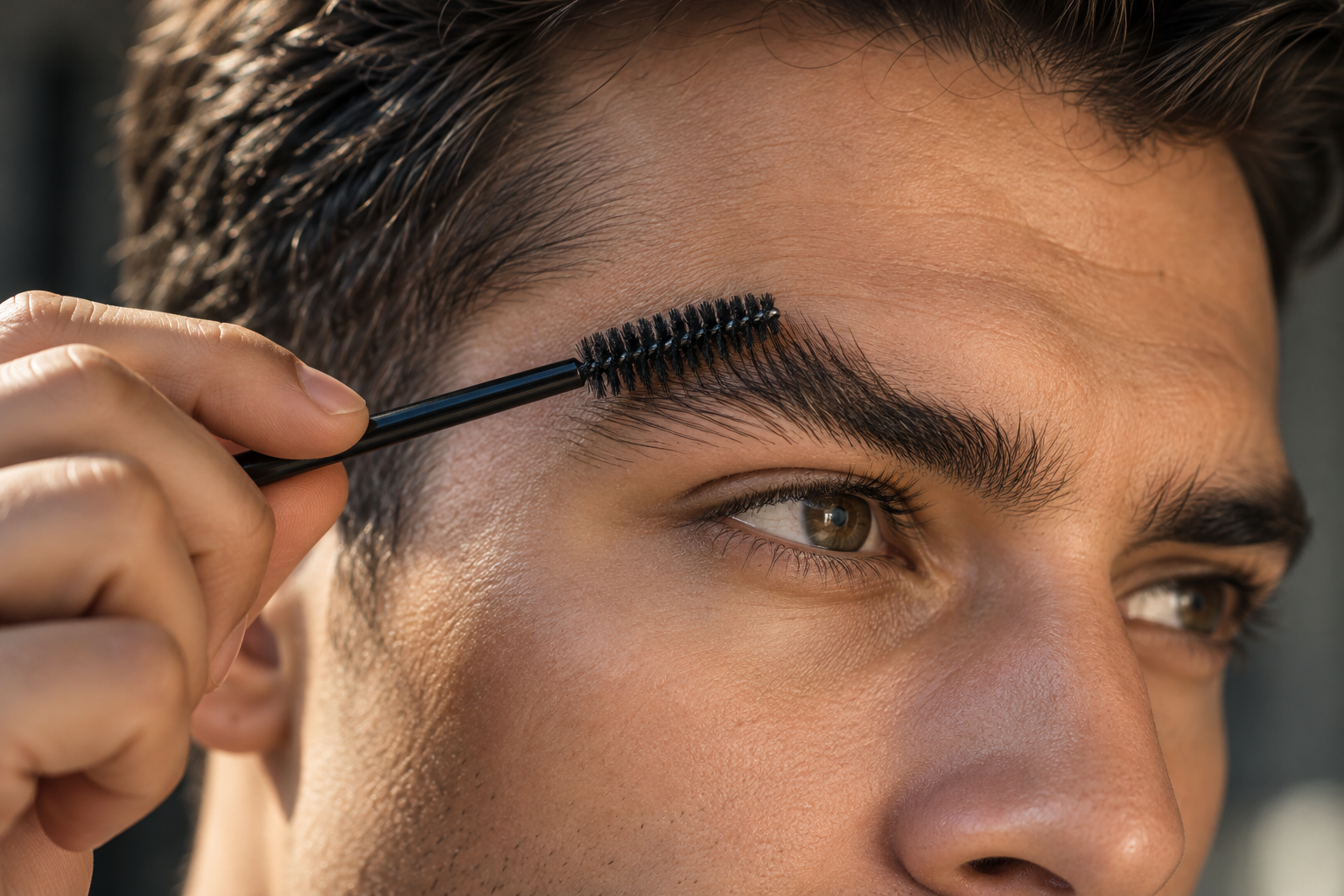
Run the spoolie against the direction of growth so every hair stands up and away from the skin. This is the only way to judge true length — hairs lying flat always look shorter than they are.
2. Identify hairs that clear the brow line by more than 2–3mm
Look along the top edge of the brow. Most hairs will fall back into roughly the same line. The ones that stick up noticeably above it — usually a handful near the arch and the outer third — are what you are trimming. If a hair is level with its neighbours, leave it.
3. Trim only the tip, not the base
Snip the excess length only, keeping the scissors parallel to the angle the hair was combed at. Cutting at the base, or cutting straight across regardless of each hair’s angle, is what produces the flat, “drawn-on” look. You are reducing length, not reshaping the brow.
4. Re-comb and reassess after every few snips
Brush the trimmed section back down into its natural position and look again before cutting more. Hair that looked too long standing up often settles into the right length once it lies flat. This single habit — stop, recomb, check — prevents almost every over-trim.
5. Brush back and do a final inspection
Once the obviously long hairs are handled, brush the whole brow back toward the temple in its natural resting direction. Check both brows side by side under even light. Symmetry between the two brows matters more than either brow being individually perfect.
Shaping Around Your Face, Not Against It
“Don’t create an arch” is correct as far as it goes, but it skips the part that actually matters: the shape you are protecting should follow your face, not a generic template.
| Face shape | What to protect |
|---|---|
| Round or square | A slightly angled, soft arch — avoid a flat, straight brow, which emphasises width |
| Long or oval | A flatter, gently curved brow with minimal peak — a sharp arch adds length the face does not need |
| Naturally straight brow | Leave it straight. Do not create an arch that was never there; it will look obviously groomed rather than natural |
| Naturally arched brow | Trim length only and keep the existing peak position — do not move it higher or sharper |
The rule in every case is the same: you are cleaning up the brow shape you were born with, not installing a different one. A barber or a trimmer who starts shaping with tweezers before they have combed and assessed the existing brow is usually about to make this exact mistake.
Handling Strays and the Unibrow
The hairs between the brows need a different tool and a different standard than the rest of the brow when you trim men’s eyebrows properly.
Tweezing technique: Pull in the direction of hair growth, close to the skin, in one quick motion. Pulling against the growth direction, or at an angle, increases the chance of breaking the hair below the surface — which is what causes an ingrown hair a few days later.
How much to remove: Clear the hair growing between the two brow-start points (the inner edges defined above). Do not tweeze into either brow itself to “open up” the space further. That is reshaping, not stray removal, and it is the second most common way men end up with eyebrows that look obviously worked on.

Aftercare: Avoiding Redness and Ingrown Hairs
Freshly tweezed or trimmed skin is briefly more vulnerable, and this is the step most guides skip entirely.
- Avoid touching the area with unwashed hands for the rest of the day.
- Skip retinol, exfoliating cleansers or alcohol-based products on the brow area for 24 hours if any redness is visible.
- If a small bump or ingrown hair appears a few days later, a warm compress for a few minutes loosens the follicle enough for the hair to work its way out on its own (see Mayo Clinic’s guidance on ingrown hairs for more). Do not pick at it.
- Persistent redness that lasts more than a day, or repeated ingrown hairs in the same spot, usually means tweezing too aggressively or too often in that area — space out sessions rather than going back in sooner.
Mistakes Men Make When They Trim Their Eyebrows
Over-trimming because “a little more” seemed safe
Hair does not grow back same-day. A brow trimmed too short stays too short for weeks. When in doubt, stop a session early and finish it in two or three days once you can see how the first pass settled.
Creating an arch that was not there
Covered above, and worth repeating: a brow that suddenly has a peak it never had before reads as groomed in an obvious, slightly feminine way that most men are not going for. Length control, not shape invention, is the goal for a first attempt.
Working under a magnifying mirror
Magnification exaggerates both hair thickness and the gaps between hairs, which leads to tweezing hairs that look sparse up close but are actually part of a normal, full brow at a normal viewing distance.
Rushing the final symmetry check
Two brows trimmed independently, each looking fine in isolation, can still end up visibly mismatched. Always finish with both brows visible at once, at arm’s length, under the same light.
How Often to Trim
Most men should trim men’s eyebrows every two to four weeks, closer to two weeks if your hair grows quickly or is naturally coarse. A trim that only removes 2–3mm of new growth each time is faster, safer and harder to get wrong than letting six weeks pass and trying to fix a visibly overgrown brow in one sitting.

Barber or DIY?
Plenty of men choose to have a barber trim their eyebrows rather than do it themselves. A barber who asks what shape you want, combs the brow first and trims conservatively is worth keeping. A barber who reaches straight for wax or a razor to “clean up the edges” is the more common experience, and it is where most of the over-shaped, over-thin brows men complain about actually come from. If you are not confident in a specific barber’s judgement on this one detail, the five-minute version above is lower-risk done yourself, at home, with good light.
FAQ
How short should I trim men’s eyebrows?
Trim only the hairs that clearly extend past your natural brow line by more than 2–3mm, cutting the tip rather than the base. There is no target overall length — the goal is an even line along hair that is already roughly the right length, not a uniform short trim across the whole brow.
Is it normal that one eyebrow needs more work when you trim men’s eyebrows?
Yes. Few men have perfectly symmetrical brows, and treating each one as its own project — rather than mirroring identical cuts on both sides — produces a more even result than forcing symmetry hair by hair.
Should I use an electric trimmer to trim my eyebrows instead of scissors?
A trimmer with a guard comb attachment works well for maintaining an already-shaped brow between full sessions, since the guard limits how short it can cut. For the first proper shaping, rounded-tip scissors give more control over individual hairs.
Does shaving or waxing the brow line give a cleaner result than tweezing?
It gives a sharper, more defined edge, which is exactly why it is higher-risk — a wax or razor mistake cannot be fixed by letting one hair grow back, the way an over-plucked hair can. Scissors and tweezers are more forgiving for anyone doing this without professional training.
Why do my eyebrows itch or feel irritated for a day after trimming?
Mild, short-lived irritation after tweezing is normal and usually settles within a few hours. Irritation that lasts into the next day, or recurs at the same spot each time, points to tweezing against the direction of growth or going back over the same area too soon — see the aftercare section above.
The Bottom Line
Learning to trim men’s eyebrows well produces results that are invisible. Nobody should be able to tell you did anything except notice that your face looks a little more awake. Comb up, trim only what clearly clears the line, recheck before cutting more, and leave the shape your brows already have alone. Pair this with the shaving and beard habits covered in our grooming mistakes guide for the rest of a five-minute daily routine that actually holds up.