Winter Hairstyles for Men: 18 Cuts That Survive Hats, Wind and Dry Air
Most winter hairstyles for men are chosen in a warm salon under good light, and then tested for the first time under a damp beanie at seven the following morning. That is the wrong order.
Winter does three specific things to hair, and only three. It flattens the crown under a hat. It charges the ends with static in dry indoor air. It roughens the cuticle in cold wind. A cut either resists those three things or it does not, and no amount of product rescues a cut that does not.
Almost every guide treats winter as a mood: darker, heavier, more texture. It is not a mood. It is three mechanical problems with three different answers. This guide covers those three risks first, then 18 winter hairstyles for men rated against all three, with the exact phrase to use with your barber for each one. The list runs in order of how much work the cut needs in cold weather, from the ones that survive a hat untouched to the ones that need a plan.
The Three Winter Risks
Before the looks, the mechanism. Each risk has a different cause and a different structural answer, and knowing which one hits you hardest is most of the decision.

| Risk | What causes it | What reduces it |
|---|---|---|
| Hat flattening | Pressure plus body heat at the crown. A hat holds hair against the scalp at body temperature for hours, and hair sets into whatever shape it cools in | Length under 5 cm on top, a shape cut into the hair rather than built with product, and a matte finish rather than a wax |
| Wind and static | Dry indoor air strips moisture from the hair shaft, then wool or acrylic moving over dry hair transfers a charge the hair cannot release. Fine and straight hair holds it worst | Weight and length, a leave-in conditioner, blunt rather than heavily thinned ends, and a satin or natural-fibre hat lining |
| Dry-air frizz | Indoor heating takes the air down to roughly 10 to 20 percent relative humidity, against the 40 to 60 percent hair sits comfortably in. The cuticle lifts and curl definition goes first | A cream or oil rather than an alcohol-based spray, and a shape that does not depend on a smooth cuticle |
Most men have one dominant risk rather than all three. The next section is how to find out which.
The Ten-Minute Beanie Test
Guides to winter hairstyles for men almost always open with face shape. Face shape matters, but in winter it matters far less than how your particular hair behaves under a hat, and that takes ten minutes to establish.
Put your usual hat on indoors and leave it for ten minutes. Take it off, touch nothing, and look in the mirror after sixty seconds.

The crown stays flat and does not lift. Hat flattening is your dominant risk. Go shorter on top than you think, under 5 cm, and pick a cut whose shape comes from the cut itself rather than from styling.
The hair lifts away from your head and follows the hat as you pull it off. Static is your dominant risk. You need moisture and weight rather than less length, and the hat lining matters more than the cut does.
The ends look pale and rough, and the scalp feels tight. Dry air is your dominant risk. The answer here sits almost entirely in the products and the washing schedule rather than in the cut.
Run the test with the hat you actually wear most. A thin acrylic beanie and a lined wool cap produce completely different results on the same head.
Winter Hairstyles by Hair Type
Hair type decides which of the three risks dominates more reliably than anything else does.

Straight hair
Flattens worst and holds static worst, because there is no bend in the shaft to hold either volume or moisture. Dry-air frizz is barely a problem. Keep it short enough that flattening does not show, or long enough that the weight holds the shape down deliberately. The middle ground, around 7 to 10 cm, is the worst place to be in winter.
Wavy hair
The most forgiving type in cold weather. The bend holds some volume after a hat, and the cuticle is less exposed than it is on a curl. Watch the ends, which go frizzy well before the roots do.
Curly hair
Dry-air frizz is the dominant risk and it is not close. Curl needs moisture to hold its pattern, and winter indoor air removes it faster than anything else in the year. Hat flattening matters less than most men expect, because curl recovers its shape as it cools.
Coily hair
The driest hair type to start with, and winter makes that worse rather than different. Protective styles and satin-lined hats do more here than any cut choice. Most guides to winter hairstyles for men skip coily hair entirely, which is why two of the looks below are built around it specifically.
Fine or thinning hair
The worst case for flattening and static together. Volume is the thing you are protecting, so remove weight rather than add product, and avoid anything with shine, which reads as scalp in flat winter light.
18 Winter Hairstyles for Men
These 18 winter hairstyles for men are ordered by how much work the cut needs once the temperature drops. The first eight survive a hat with no intervention at all. The last four need a plan. Every entry carries the exact phrase to use with your barber, because the right words in the chair matter more than the reference photo on your phone.
1. Buzz Cut With a Shadow Fade
Best for: Anyone who wears a hat for more than two hours a day
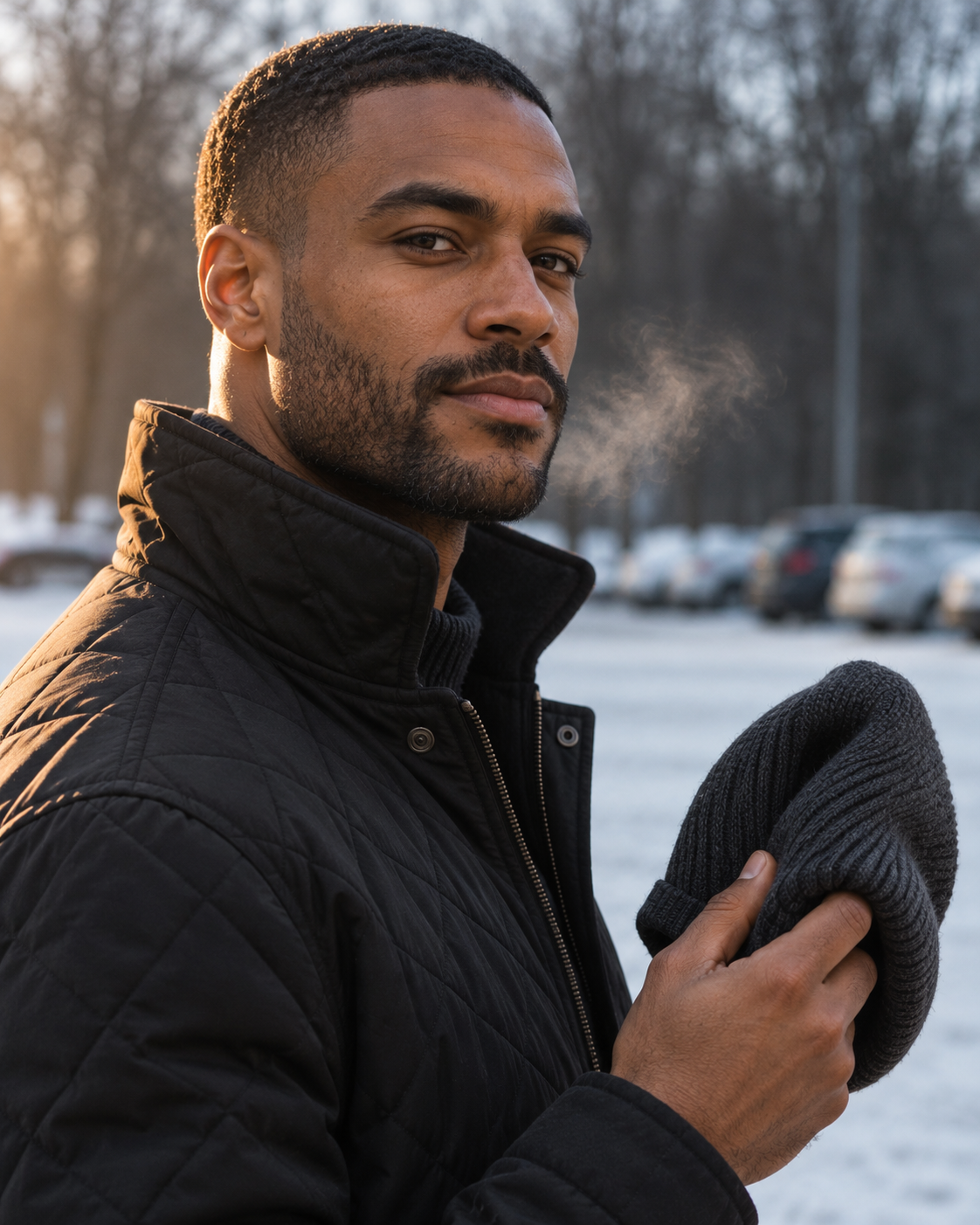
The lowest-risk of all the winter hairstyles for men here, by a wide margin. At 3 to 6 mm there is nothing for a hat to flatten, nothing for wind to move and nothing to style in the dark. The shadow fade, which stops short of skin, keeps it from reading as severe under flat winter light in the way a full skin fade does. What it does not do is insulate, so this becomes a hat-dependent cut rather than a hat-optional one.
Barber ask: “Number two on top, shadow fade at the sides, nothing taken down to skin.”
Winter risk: Hat flattening low · Wind and static low · Dry-air frizz low
Watch out for: Scalp dryness, which shows immediately at this length and nowhere else. Moisturise the scalp, not just the face.
2. Short Textured Crop, Matte Finish
Best for: Straight or slightly wavy hair, offices with a dress code

Three to four centimetres on top, point-cut so the shape sits in the hair rather than in the product. That distinction matters more for winter hairstyles for men than at any other point in the year: a cut-in shape recovers on its own after a hat, and a product-built shape does not. Use a matte clay rather than a wax, because wax stiffens in cold air and then grabs the inside of the beanie. Our guide to the messy textured crop covers the longer, looser version of the same cut.
Barber ask: “Short textured crop, point-cut on top, about three centimetres, tapered back and sides.”
Winter risk: Hat flattening low · Wind and static low · Dry-air frizz low
Watch out for: Cutting the fringe too short. Below 2 cm it stops reading as textured and starts reading as grown out.
3. French Crop With a Blunt Fringe
Best for: Thick straight hair, and receding temples
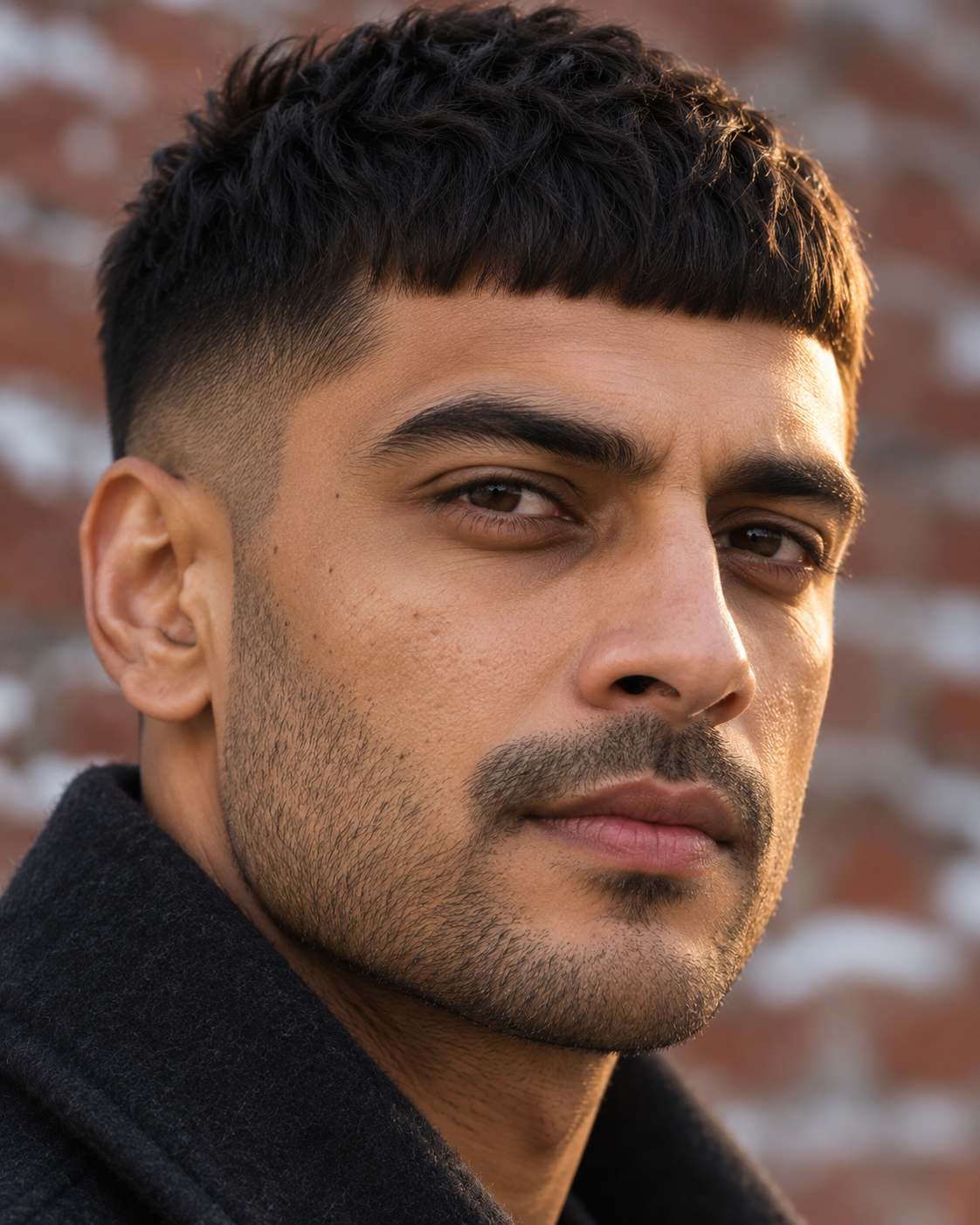
The blunt fringe is the entire point of this one. It covers a receding corner without looking as though it is covering anything, and because it is cut blunt rather than feathered it holds its line under a hat where a textured fringe separates into pieces. Among winter hairstyles for men with any kind of fringe, this is the most hat-tolerant.
Barber ask: “French crop, blunt fringe sitting on the forehead, high taper at the sides.”
Winter risk: Hat flattening low · Wind and static low · Dry-air frizz low
Watch out for: A fringe cut too short to sit flat. It lifts at the hat line and then stays lifted for the rest of the day.
4. Caesar Cut
Best for: Thinning at the crown, or a high hairline
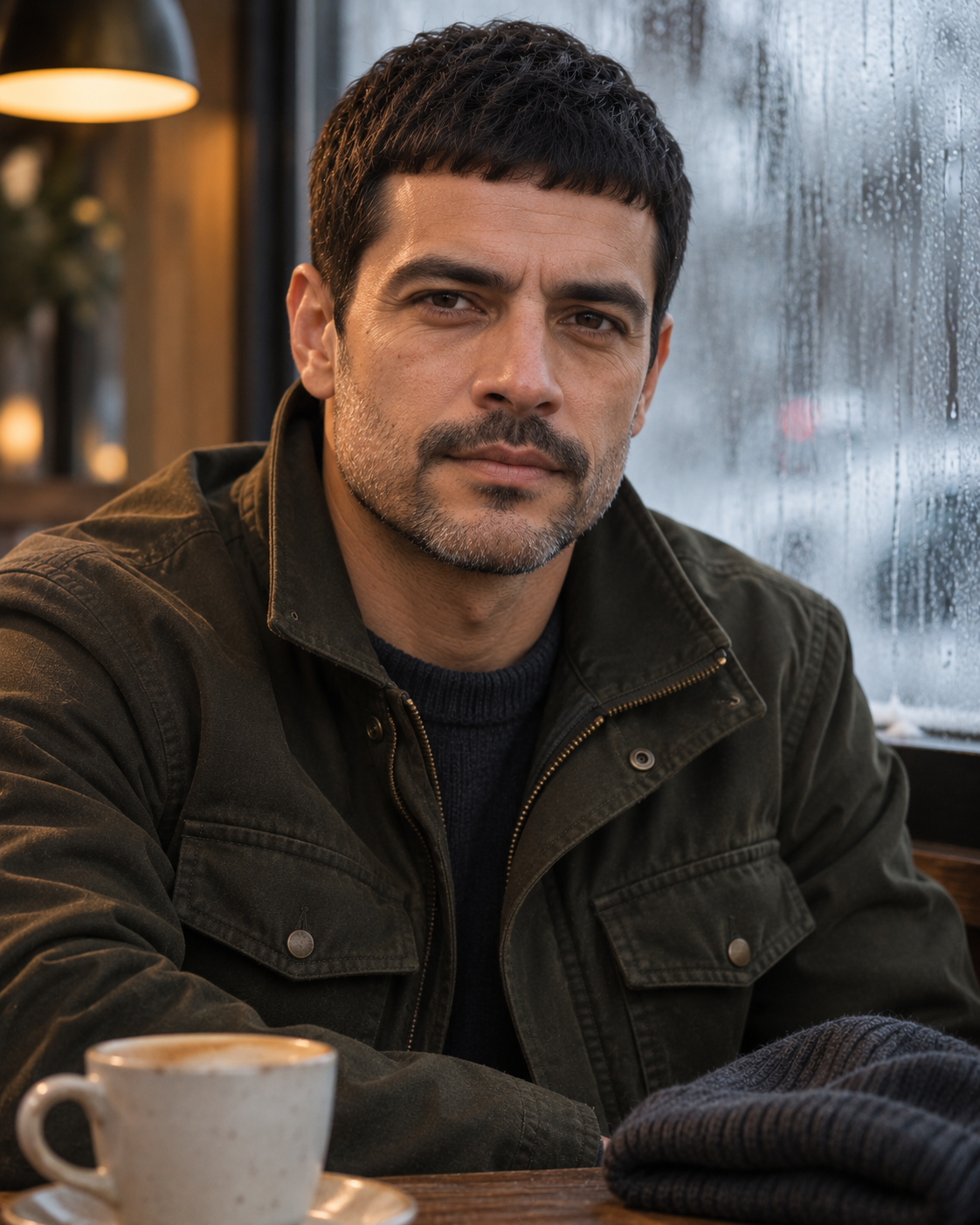
Short all over with the top combed forward, which puts whatever density you have exactly where the hairline needs it. The forward direction also works with a hat rather than against it, since the hat pushes in the same direction the hair is already going. This is one of the few winter hairstyles for men that genuinely looks better after a beanie than before one.
Barber ask: “Caesar cut, about three centimetres, styled forward, short straight fringe.”
Winter risk: Hat flattening low · Wind and static low · Dry-air frizz low
Watch out for: Combing it so far forward that it reads as a deliberate cover-up. Leave the fringe edge slightly uneven.
5. Crew Cut for Fine Hair
Best for: Fine or thinning hair

Fine hair has the worst winter of any type: it flattens fastest and it carries the most static. Among short winter hairstyles for men, the crew cut is the one that removes the weight making flattening visible in the first place. Keep 2 to 3 cm at the front graduating shorter towards the crown, so the front has something to lift and the back has nothing left to go flat.
Barber ask: “Crew cut, about three centimetres at the front graduating down to the crown, tapered sides.”
Winter risk: Hat flattening low · Wind and static medium · Dry-air frizz low
Watch out for: Any product with shine in it. On fine hair shine reads as scalp, and winter light is flat and unforgiving.
6. Short Afro With a Line-Up
Best for: Coily hair, 4A to 4C
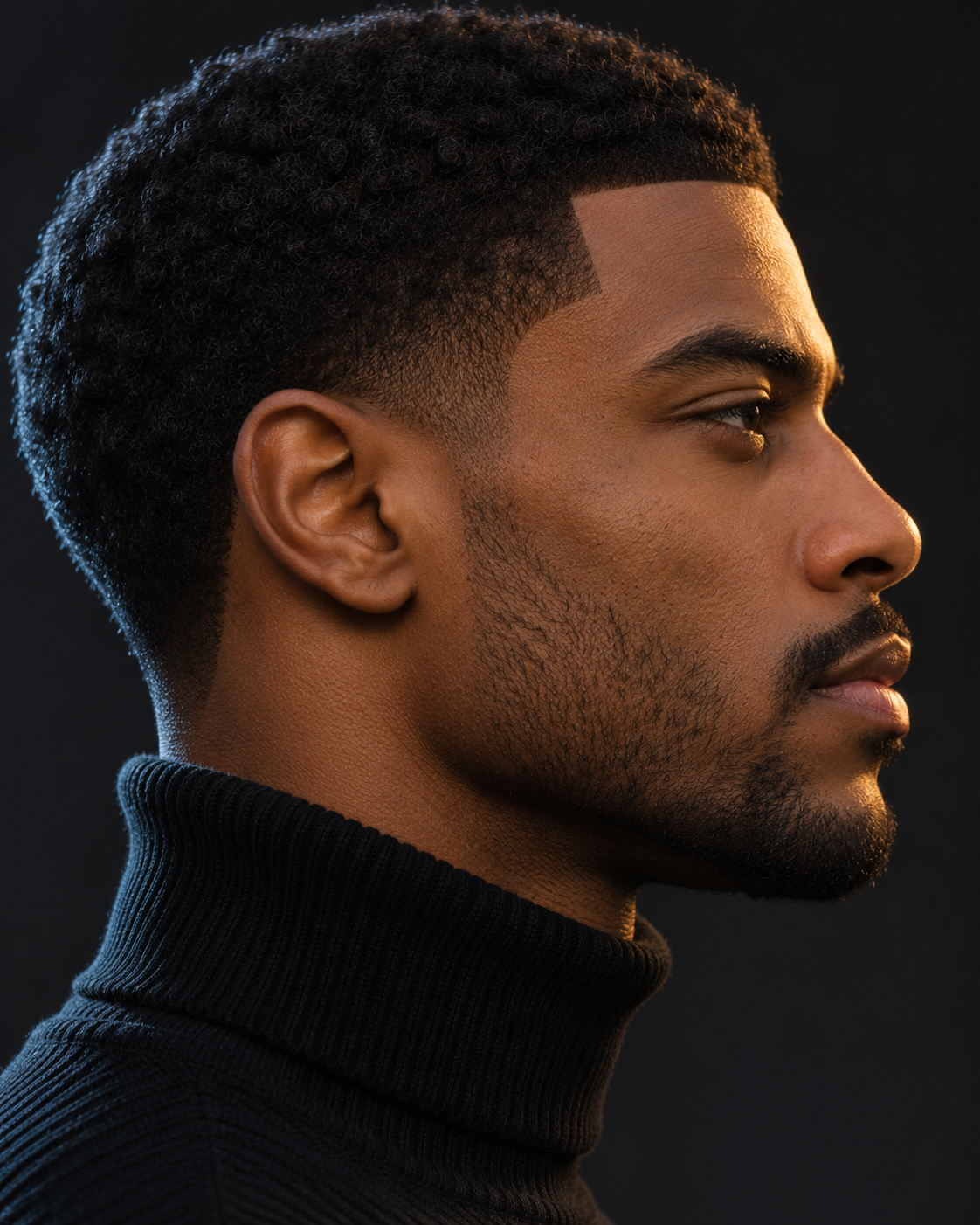
Two to three centimetres kept even, with a sharp line-up at the hairline and temples doing all the structural work. The line-up is what keeps this looking deliberate after a hat has been on and off four times, because the edge is cut against the skin rather than styled into the hair. Of all the winter hairstyles for men here, this is the one where the hat lining matters most: cotton and acrylic pull moisture straight out of coily hair, and a satin-lined beanie solves it for the price of a coffee.
Barber ask: “Even afro at about two and a half centimetres, sharp line-up at the hairline and temples.”
Winter risk: Hat flattening medium · Wind and static low · Dry-air frizz high
Watch out for: Going a fortnight past the line-up. It is the only maintenance this cut needs and the only thing that makes it look untidy.
7. Brushed Short Waves
Best for: Coily hair kept short, and men who want no morning styling at all

The wave pattern is built by brushing rather than by cutting, which makes it the most hat-resistant of the winter hairstyles for men on this list — pressure does not disturb a pattern that lies flat by design. Winter is the season it needs the most help, because the pattern depends on moisture and indoor heating removes it. Brush twice a day rather than once and it holds through February.
Barber ask: “Taper the sides, leave the top even for waves, no line in the fade.”
Winter risk: Hat flattening low · Wind and static low · Dry-air frizz medium
Watch out for: Loose wool hats, which drag against the pattern. A durag under a satin-lined cap keeps it intact on a long commute.
8. Two-Strand Twists or Short Locs
Best for: Coily hair, and anyone who wants to stop styling until March

A protective style is the most sensible cold-weather answer for coily hair, and it is the one almost every list of winter hairstyles for men leaves out. Twists and short locs keep the ends tucked away from wool collars and dry air for weeks at a time, and they survive a hat completely intact. The trade-off is the appointment: the style is fitted once and then maintained, rather than restyled every morning.
Barber ask: “Two-strand twists, parted evenly,” or for locs, “start short locs with comb coils.”
Winter risk: Hat flattening low · Wind and static low · Dry-air frizz low
Watch out for: Tension at the hairline. Twists set too tight cause traction damage, and a hat worn over them daily compounds it.
9. Long Fringe, Built Around the Beanie
Best for: Anyone whose hat stays on from October to March

The one cut here designed around the hat rather than in spite of it. The fringe is kept long enough to sit below the beanie’s edge and heavy enough to hold its own shape, so the hair that shows is the hair you actually styled. The sides can stay short, because nobody sees them. This is the most practical of the winter hairstyles for men who never genuinely take the hat off.
Barber ask: “Long fringe down to the eyebrows, disconnected from the sides, leave it heavy.”
Winter risk: Hat flattening low · Wind and static medium · Dry-air frizz medium
Watch out for: Wearing the beanie too far back on the head. It has to sit at the hairline for the fringe to read correctly.
10. Low Tie-Back for Long Hair
Best for: Hair past the shoulder, and cold commutes
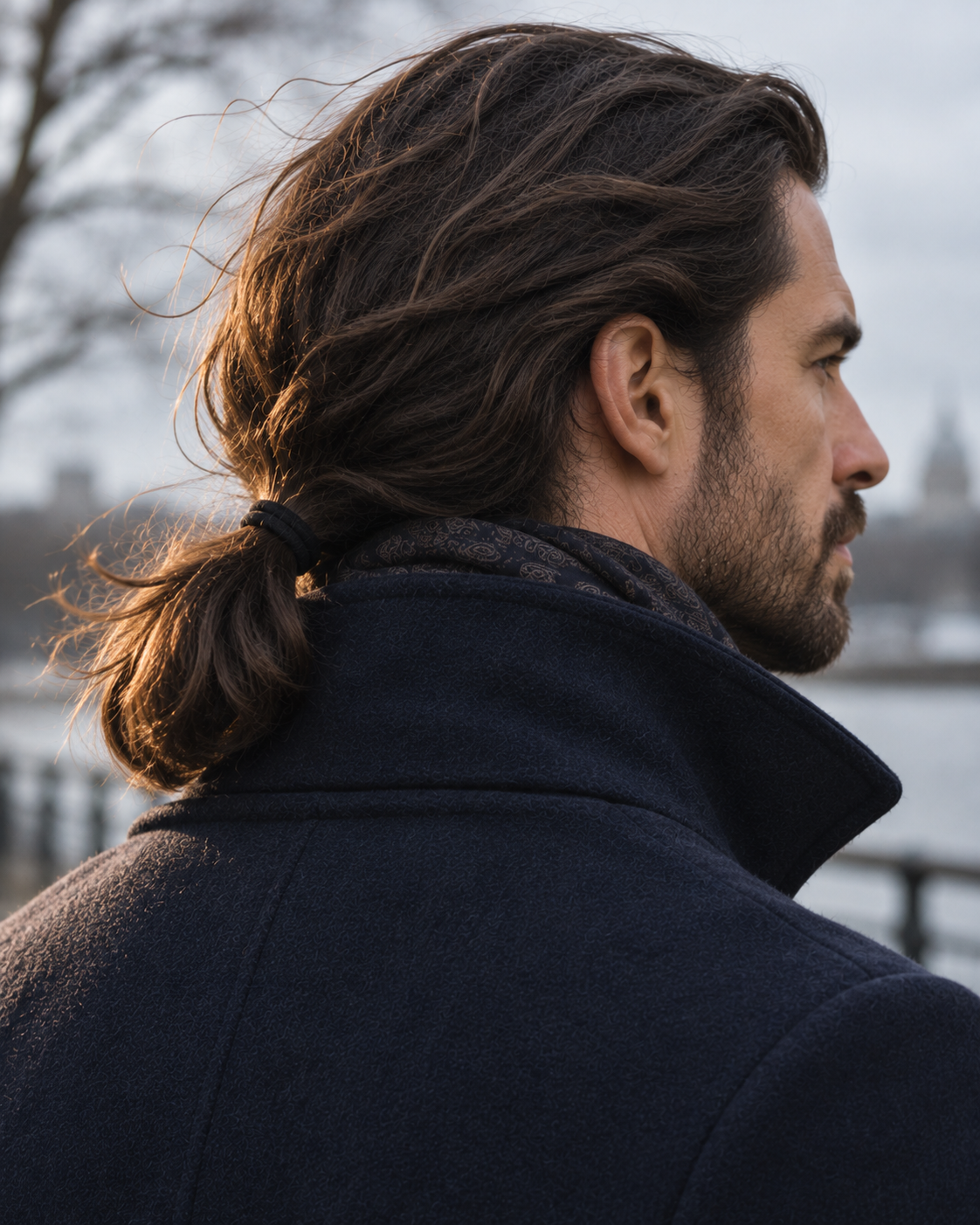
Wind and a wool collar are the two things that damage long hair in winter, and this is one of the few winter hairstyles for men that removes the hair from both at once. Tied low at the nape it also sits under a hat with no crown pressure at all, because the volume is behind the head rather than on top of it.
Barber ask: “Trim the ends only, keep all the length, no layers above the jaw.”
Winter risk: Hat flattening low · Wind and static low · Dry-air frizz medium
Watch out for: Elastics with a metal join. Cold makes the hair shaft more brittle, and the metal snaps strands where a fabric tie would not.
11. Ivy League
Best for: Straight hair, and anyone who needs one cut that works with a suit and with a parka
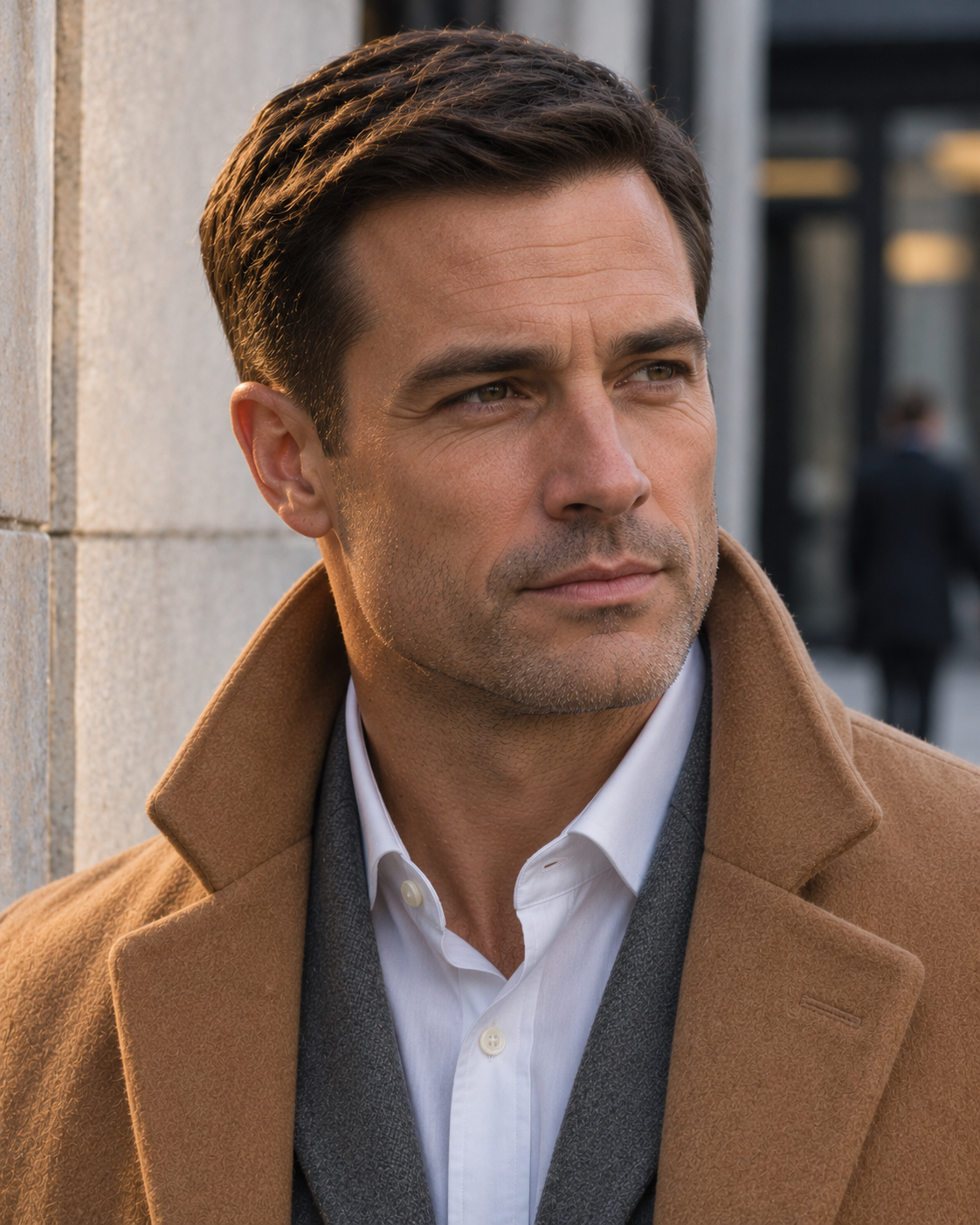
Short at the back and sides with enough length at the front to take a side part. The part is the weak point: it is the first thing a hat destroys and the first thing wind moves. Keep it a soft part combed in rather than a hard part shaved in, because a soft part can be re-set with your fingers and a shaved line cannot be hidden once the hair around it shifts. Among winter hairstyles for men that have to work indoors and outdoors in the same day, it is the most reliable, and it leads our round-up of professional men’s hairstyles for the same reason.
Barber ask: “Ivy League, scissor cut on top, long enough to part, tapered sides.”
Winter risk: Hat flattening medium · Wind and static medium · Dry-air frizz low
Watch out for: Flattening along the part line specifically. Lift that section with your fingers inside the first minute, before the hair cools into place.
12. Burst Fade With Short Curls
Best for: Curly hair, 2C to 3B
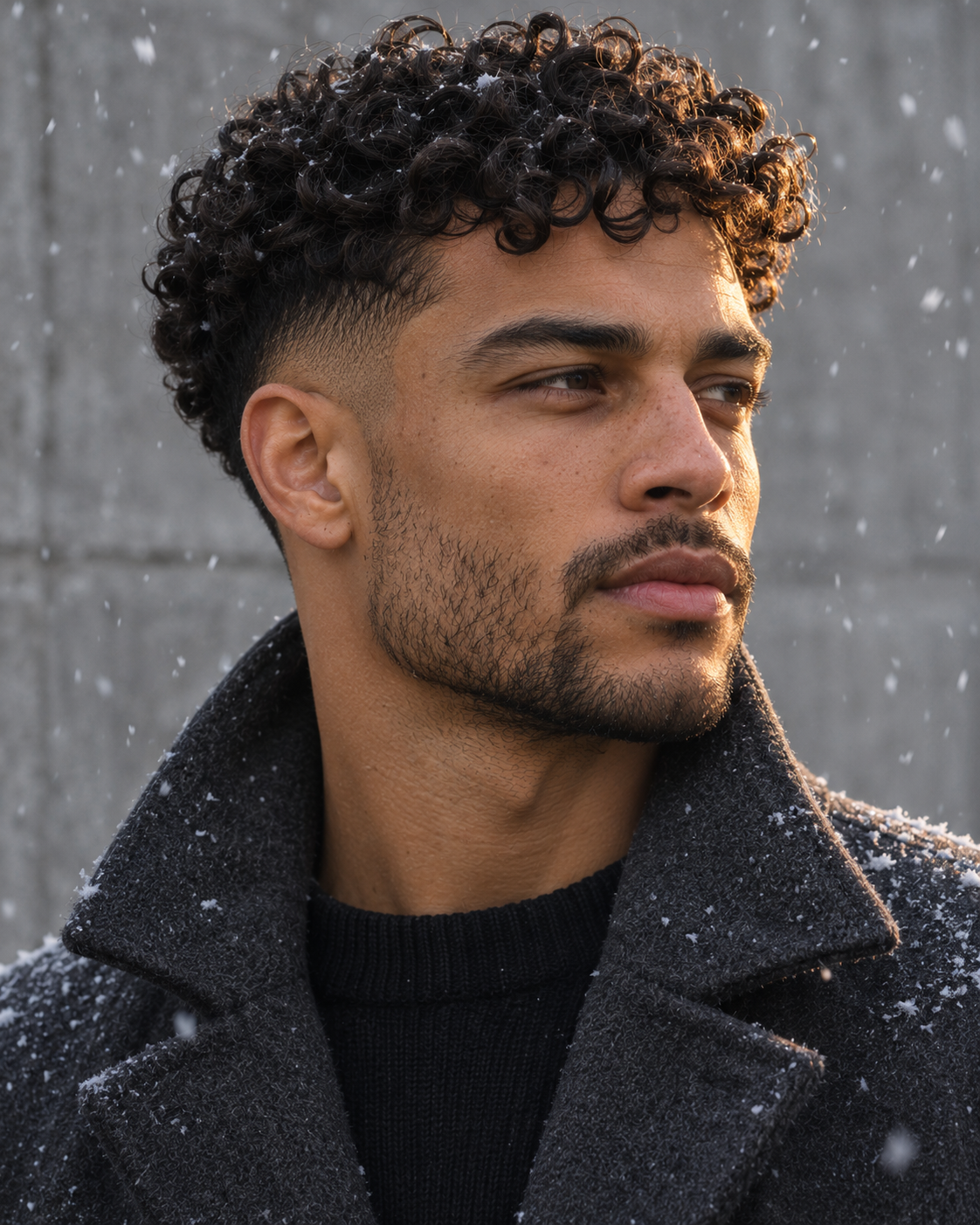
The burst fade curves around the ear and leaves the curl pattern on top untouched, which is the right division of labour for curly winter hairstyles for men: structure from the fade, volume from the curl. Four centimetres is enough to show the pattern and short enough that a hat does not crush it. Curl recovers from pressure as it cools in a way straight hair does not, so the hat is less of a problem here than it looks.
Barber ask: “Burst fade around the ear, leave the curls on top at about four centimetres, no thinning shears.”
Winter risk: Hat flattening medium · Wind and static low · Dry-air frizz high
Watch out for: Thinning shears, which is exactly why they are in the request. Thinned curly hair frizzes at the cut ends as soon as the air dries out.
13. Curly Fringe, Mid-Length
Best for: Curly hair, 2B to 3A, at 8 to 12 cm
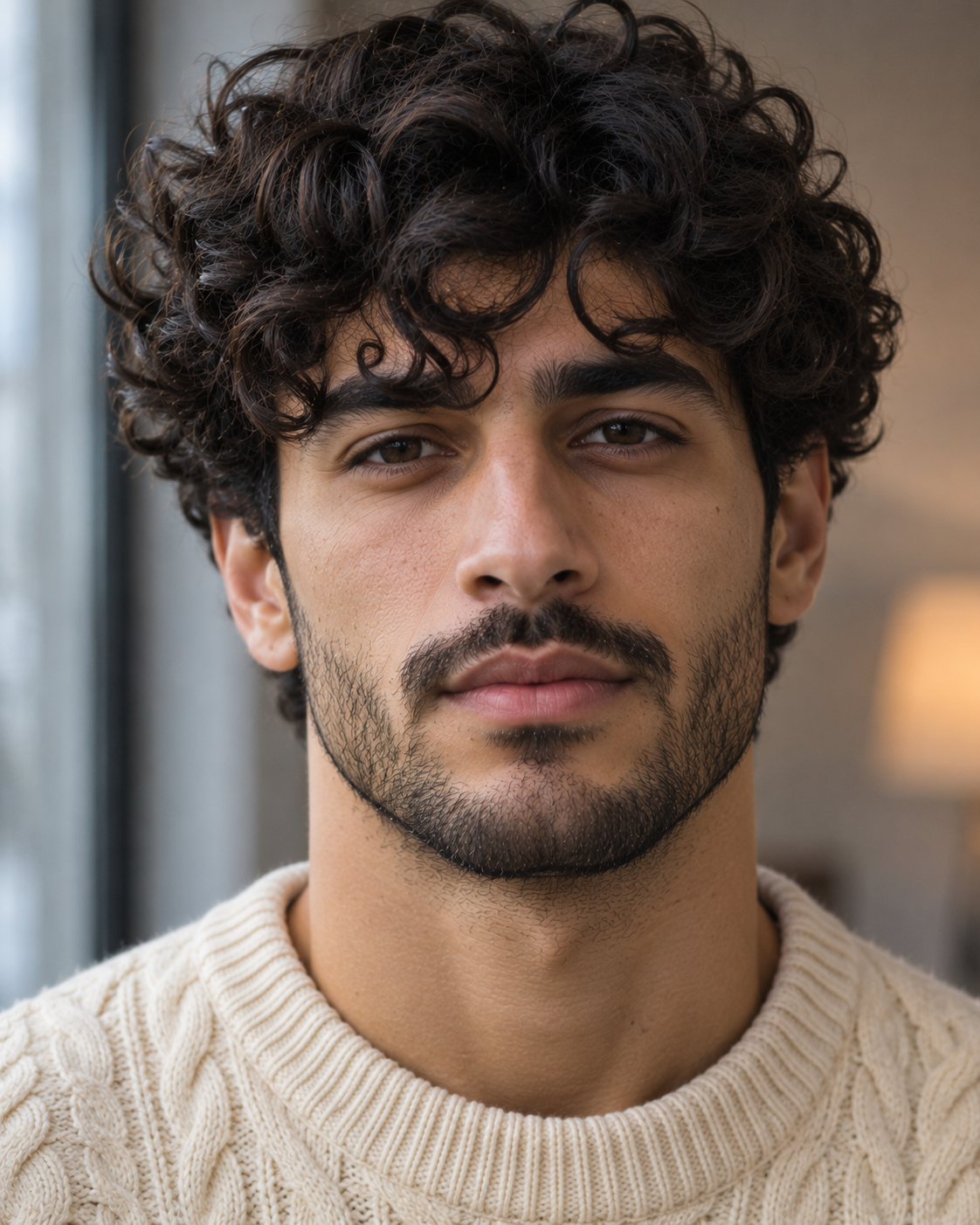
Enough length for the curl to form properly at the front, which is where it is actually seen. This is the point on the curly spectrum where winter hairstyles for men start to cost real effort, because the fringe sits exactly where the hat edge presses and the curl needs the moisture the air is actively removing. A curl cream worked into damp hair and then left alone does most of the work.
Barber ask: “Mid-length curly fringe, cut dry, no thinning, keep the length through the front.”
Winter risk: Hat flattening medium · Wind and static low · Dry-air frizz high
Watch out for: Washing daily. In winter that strips the oil the curl pattern depends on, and the frizz arrives by midday.
14. Matte Slick Back
Best for: Straight hair at 10 cm or more on top
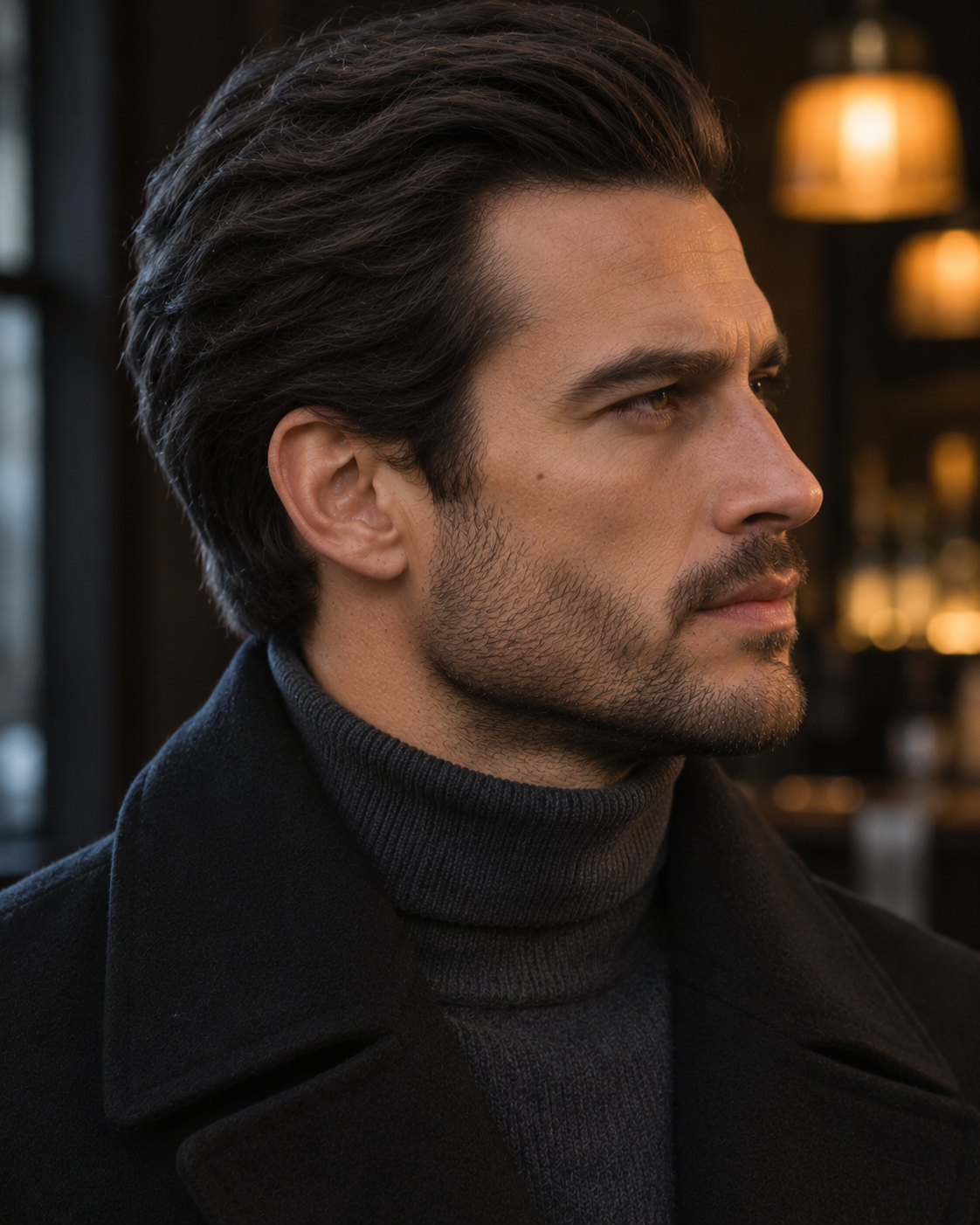
Slicking back is where winter hairstyles for men most often go wrong, and it has exactly one rule: matte, never wet. A wet-look product in sub-zero air stays genuinely wet, and wet hair in freezing wind is both unpleasant and bad for the cuticle. A matte paste gives the same direction and the same control with none of that, and it recovers from a hat with one pass of the hand.
Barber ask: “Leave ten centimetres on top to slick back, keep some weight in the sides, soft taper.”
Winter risk: Hat flattening medium · Wind and static low · Dry-air frizz medium
Watch out for: Gel. It stiffens in the cold, it flakes, and against a dark wool coat the flakes show.
15. Salt-and-Pepper, Brushed Back
Best for: Men in their forties and fifties, grey or greying
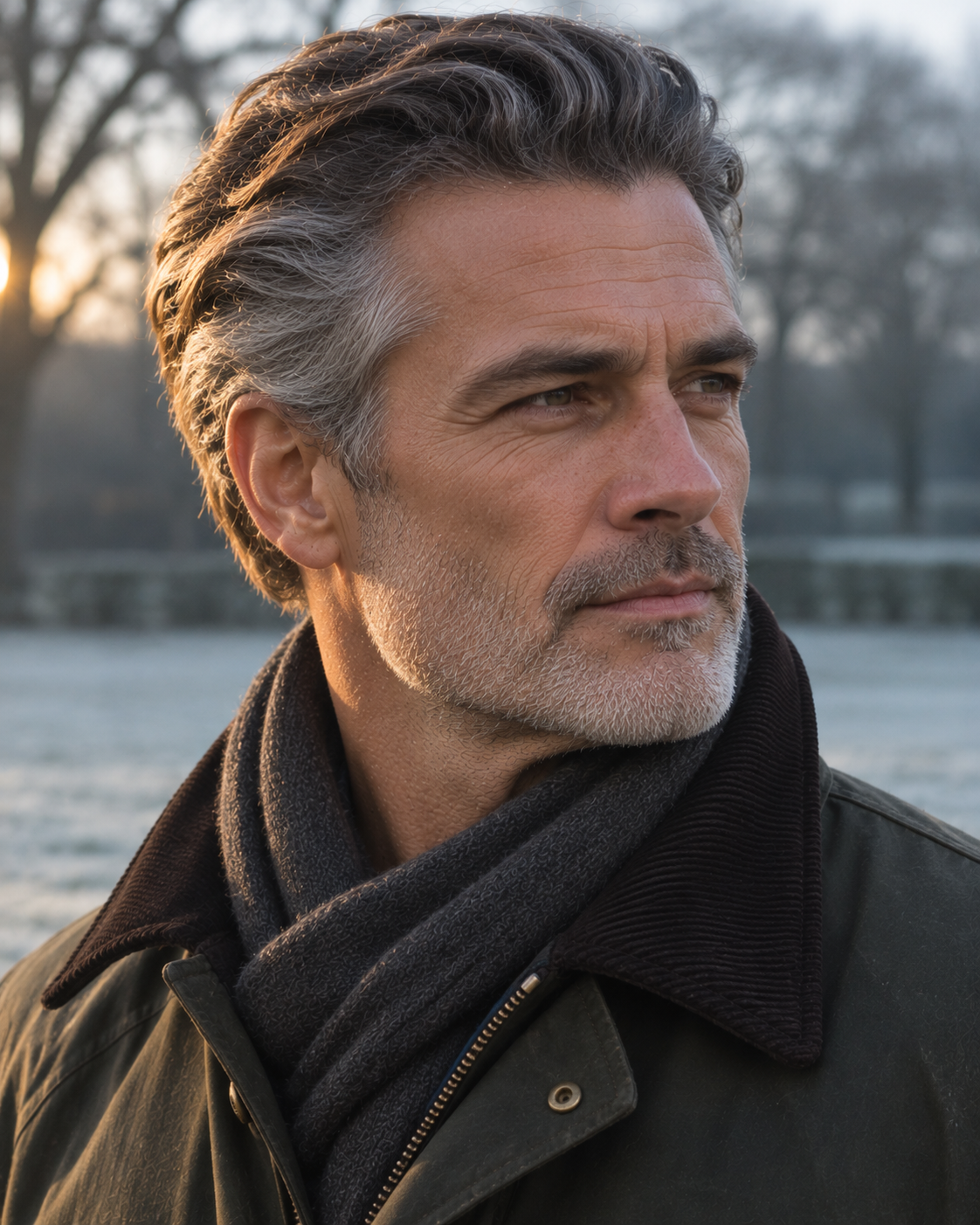
Grey hair is coarser and drier than pigmented hair and produces less of its own oil, which means it takes dry-air frizz harder and holds a hat crease for longer. Six to eight centimetres brushed straight back rather than parted is the answer: the volume disguises the crease, and a part shows scalp far more readily under flat winter light. Among winter hairstyles for men over forty, this is the one that improves as the hair goes greyer rather than in spite of it.
Barber ask: “Six to eight centimetres on top, brushed back rather than parted, soft taper at the sides, keep the weight.”
Winter risk: Hat flattening medium · Wind and static medium · Dry-air frizz high
Watch out for: Clarifying shampoos. Grey hair goes brittle quickly once it is stripped, and winter accelerates it.
16. Curtains, Middle-Parted
Best for: Straight to wavy hair at 12 to 15 cm

Structurally the worst of the winter hairstyles for men here to put under a hat, because the hat presses along exactly the line the whole style depends on. The redeeming feature is that the recovery is the easiest on this list: two fingers through the part and it is back. Accept that it needs doing every time the hat comes off and this is a perfectly workable winter cut.
Barber ask: “Mid-length curtains, twelve to fifteen centimetres, soft layers at the front, no heavy thinning.”
Winter risk: Hat flattening high · Wind and static medium · Dry-air frizz medium
Watch out for: A part that has set in the wrong place. Re-part it while the hair is still warm from the hat, not twenty minutes later.
17. Shoulder-Length Flow
Best for: Thick straight or wavy hair, and patience

Length is its own insulation and its own problem. Flow survives a hat well, because the weight pulls the shape back down, but it takes the full force of wind and dry air at the ends, which are the oldest and most damaged part of the hair. Our guide to the flow haircut with a beard covers the growing-out stages in full.
Barber ask: “Keep the length, light layers through the back, tidy the ends only.”
Winter risk: Hat flattening medium · Wind and static high · Dry-air frizz high
Watch out for: Collar friction. A wool coat collar roughens the ends over a single season, and a high knit collar does the same, an interaction covered in our guide to turtleneck outfits for men. A silk or satin scarf between the two prevents it entirely.
18. Mid-Fade Quiff With Volume
Best for: Straight or wavy hair, and evenings where the hat comes off at the door

The highest-maintenance of the winter hairstyles for men here, and the one a hat punishes most, because the volume is built with a dryer and held with product and both are undone by ten minutes of pressure. It is still worth it if your hat genuinely comes off indoors and stays off. If it does not, take something from the first half of this list instead.
Barber ask: “Mid fade, leave five to six centimetres at the front for a quiff, blended back.”
Winter risk: Hat flattening high · Wind and static medium · Dry-air frizz low
Watch out for: Hairspray in cold air. It goes brittle, then it flakes, and the flakes show against a dark coat from across a room.
The Hat-Hair Rescue: Three Steps
Every guide to winter hairstyles for men mentions hat hair and almost none of them say what to actually do about it. Here is the sequence, and the order matters more than the products.
Step one: work on it while the hair is still warm. Hair sets as it cools. You have roughly sixty to ninety seconds after the hat comes off in which the shape can be changed with nothing but your hands. After that you need water.
Step two: lift from the root, not from the length. Push your fingers in at the scalp around the crown and shake, rather than pulling the ends upward. Flattening is a root problem, and working on the length achieves nothing.

Step three: water before product, never after. If the ninety seconds have gone, damp the roots with a light spritz rather than a rinse, then re-dry with your fingers or thirty seconds of a dryer on low. Adding product to flattened dry hair weighs it down further and makes the problem permanent for the rest of the day.
For static specifically, none of the above helps. Run slightly damp hands over the surface, or work a leave-in conditioner through the ends. A dryer sheet passed over the hair also works, and it is the one piece of grandmother’s advice here that is mechanically correct.
The Hat Itself
Almost every discussion of winter hairstyles for men treats the hat as a fixed problem to work around. It is not fixed. The lining and the fit change how much damage reaches the hair, and swapping the hat is cheaper and faster than changing the cut.
| Hat | Static risk | Moisture loss | Best for |
|---|---|---|---|
| Unlined acrylic beanie | High | High | Very little. It is the cheapest option and comfortably the most damaging |
| Unlined wool beanie | Medium | High | Short cuts, where neither effect is visible |
| Satin- or silk-lined beanie | Very low | Very low | Coily and curly hair, long hair, and anyone whose beanie test showed static |
| Fleece-lined wool cap | Low | Medium | Cold commutes and short to mid-length cuts |
| Structured wool flat cap | Low | Low | Mid-length cuts, because the crown sits off the hair rather than on it |
| A coat hood over bare hair | Low | Low | The lowest-damage option there is, and it costs nothing |
Fit matters nearly as much as material. A hat pulled down tight compresses the crown against the scalp and holds it there; the same hat sitting loosely on the head does noticeably less. If you can only change one thing after reading this, change the lining.
Styling Products for Winter, by Hold Level
Product behaves differently in the cold, and most winter hairstyles for men fail on the product rather than on the cut.
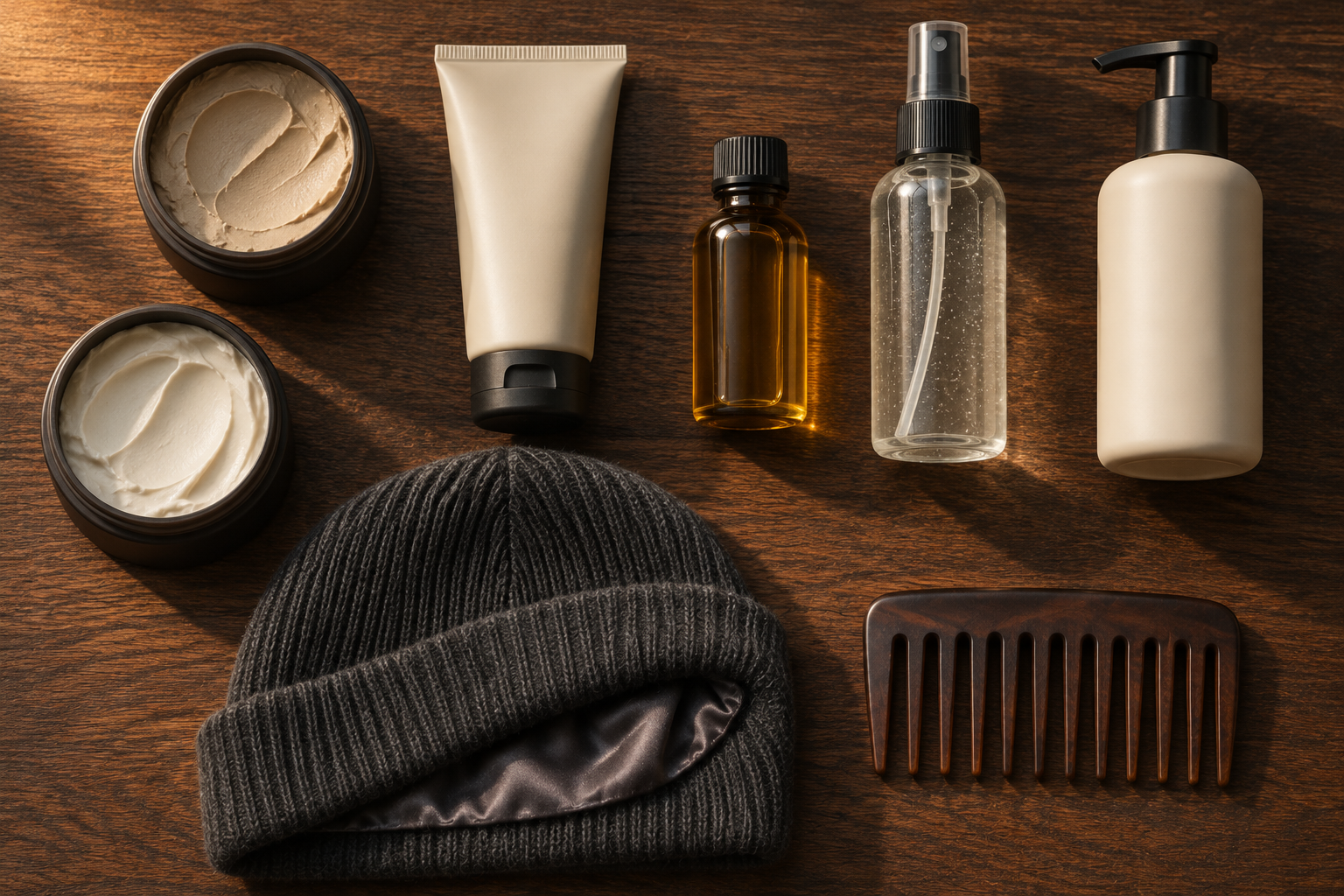
| Product | Hold and finish | Best for in winter | Avoid if |
|---|---|---|---|
| Matte clay | Medium to strong, no shine | Short crops, textured cuts, anything under 5 cm | Your hair is fine — clay is heavy and flattens it |
| Matte paste | Medium, flexible, no shine | Slick backs, mid-length cuts, restyling after a hat | You want all-day hold with no touch-ups |
| Cream | Light, soft, adds moisture | Curly and wavy hair, dry-air frizz | You need lift at the root |
| Sea salt spray | Light, matte, adds grip | Fine hair that needs texture before a dryer | Your hair is already dry, since salt dries it further |
| Leave-in conditioner | No hold, moisture only | Static, long hair, coily hair, the ends of anything | Your scalp is oily rather than dry |
| Oil | No hold, seals the cuticle | Coily hair, locs, grey hair, very dry ends | Your hair is fine or already flat |
Three to drop for the season: wax, which stiffens in cold air and transfers to the inside of a hat; gel, which goes brittle and flakes; and anything sold as wet-look, for the reason in look 14.
Winter Scalp and Hair Care
The best of the winter hairstyles for men still fails if the scalp underneath it is in poor condition, and winter is the season that reliably causes that.
Indoor heating takes relative humidity down to roughly 10 to 20 percent. Hair and scalp sit comfortably somewhere around 40 to 60 percent. That gap is why the scalp tightens and flakes from December onwards, and why static arrives at the same time.
Wash less often than you do in summer — two or three times a week suits most hair types, and coily hair needs less still — and condition every time you wash rather than every other time. Cleveland Clinic’s guidance on protecting hair through the winter covers the moisture side in detail, including why static is as much a product-buildup problem as a dry-air one.
Three habits that matter more than any product:
- Never go outside with wet hair below freezing. Water in the shaft expands as it freezes, and the hair becomes brittle enough to snap.
- Run a humidifier in the bedroom. Eight hours a night at 40 percent undoes most of what the heating does during the day.
- Moisturise the scalp, not only the hair. A few drops of a light oil at the hairline twice a week is enough. Our bald men’s skincare routine covers scalp care in full, and most of it applies whether you have hair or not.
Mistakes to Avoid
Putting the hat straight onto damp hair. The hair sets flat and stays that way all day. It is the single most common cause of hat hair that refuses to recover.
Choosing a cut in September for a winter you have not had yet. Book the cut you want in October, wear it under a hat for two weeks, then adjust at the next appointment.
Adding product to fix flattening. It weighs the hair down further. Water first and product second, or neither.
Using the same product all year. The wax and the gel that worked in July are the two worst things you can reach for in January.
Washing more because the scalp feels dry. Dryness is the reason it feels like that. Washing more makes it worse inside a week.
Stretching the time between trims because it is cold. Ends split faster in winter, not slower. Six to eight weeks holds for most of these cuts.
A hard-shaved part in hat season. It cannot be re-set with your fingers and it cannot be hidden once the hair around it moves.
Ignoring the hat lining. An acrylic beanie over dry hair causes most winter static, and a satin or silk lining removes the problem completely for very little money. There are more avoidable errors in our round-up of grooming mistakes men make.
What to Buy and What It Costs
None of the winter hairstyles for men here need an expensive kit, and two of the most useful purchases are not hair products at all.
The cut itself, 15 to 30 dollars. That is a standard barber, rising to 40 to 80 dollars at a specialist and higher in a major city. The cuts here that genuinely want a specialist are the burst fade, the line-up and anything involving locs, because the edge work is the entire style. A buzz cut, a crew cut and a Caesar can be done anywhere.
Products, 10 to 20 dollars. One matte clay or matte paste matched to your length, plus one leave-in conditioner. For most men that is the whole winter kit, and both last the season.
Products, 25 to 40 dollars. Salon-grade versions of the same two, plus a lightweight oil for the ends if your hair is coily, grey or long.
The two accessories worth more than any product. A satin-lined beanie at roughly 20 to 30 dollars, which solves static and moisture loss together. A small bedroom humidifier at 30 to 60 dollars, which is the highest-return purchase on this page and the one almost nobody makes.
Maintenance. Budget a trim every six to eight weeks for the short cuts, every four weeks for a line-up or a fade, and every ten to twelve weeks for anything shoulder length.
Frequently Asked Questions
What are the best winter hairstyles for men who wear a hat all day?
Short winter hairstyles for men whose shape comes from the cut rather than from product: a buzz cut with a shadow fade, a short textured crop, a French crop or a Caesar. Below about 5 cm on top there is nothing for a hat to flatten. If you want length, the long fringe built around the beanie is the one cut here designed for a hat that stays on.
How do you fix hat hair quickly?
Work on it within sixty to ninety seconds of taking the hat off, while the hair is still warm, by pushing your fingers into the roots around the crown and shaking. After that window the hair has cooled into shape, and you need to damp the roots and re-dry. Never add product to flattened dry hair.
Why does hair get so static in winter?
Dry indoor air removes moisture from the hair shaft, and a wool or acrylic hat moving over dry hair transfers a charge the hair cannot release. Fine and straight hair carries it worst. A leave-in conditioner and a satin-lined hat fix most of it.
Should you wash your hair less in winter?
For most men, yes. Two or three times a week suits most hair types in cold weather, and coily hair needs less still. The scalp produces less oil in winter, and washing strips what it does produce, which is what makes the dryness worse rather than better.
What is the best winter haircut for thinning hair?
A crew cut or a Caesar. Both remove the weight that makes flattening visible, and the Caesar’s forward direction puts the density at the hairline. Avoid shine of any kind, since it reads as scalp under flat winter light, and avoid any style that depends on volume a hat is going to remove.
Can you wear long hair through winter without wrecking it?
Yes, with two habits. Tie it back low at the nape on cold or windy days, and put a silk or satin scarf between your hair and a wool coat collar. Collar friction does more damage to long hair over a season than the weather does.
Do winter hairstyles for men need different products?
Yes. Wax stiffens in cold air and transfers to the inside of a hat, gel goes brittle and flakes, and wet-look products stay genuinely wet in freezing air. Switch to a matte clay or a matte paste, and add a leave-in conditioner for the static.
The Bottom Line
The best winter hairstyles for men are the ones chosen after the beanie test rather than before it. Put your hat on for ten minutes, take it off, and establish whether your problem is flattening, static or dryness. Then pick from the top of this list if it is flattening, change the hat lining and add a conditioner if it is static, and change the products and the washing schedule if it is dryness.
The cut matters, but only a handful of the eighteen here genuinely fight the season. The rest of it comes down to a satin lining, a humidifier and ninety seconds of attention when the hat comes off.
For the rest of the cold-weather kit, our guides to the messy textured crop and professional men’s hairstyles are the natural next reads, and the full hairstyles archive has everything else.


