
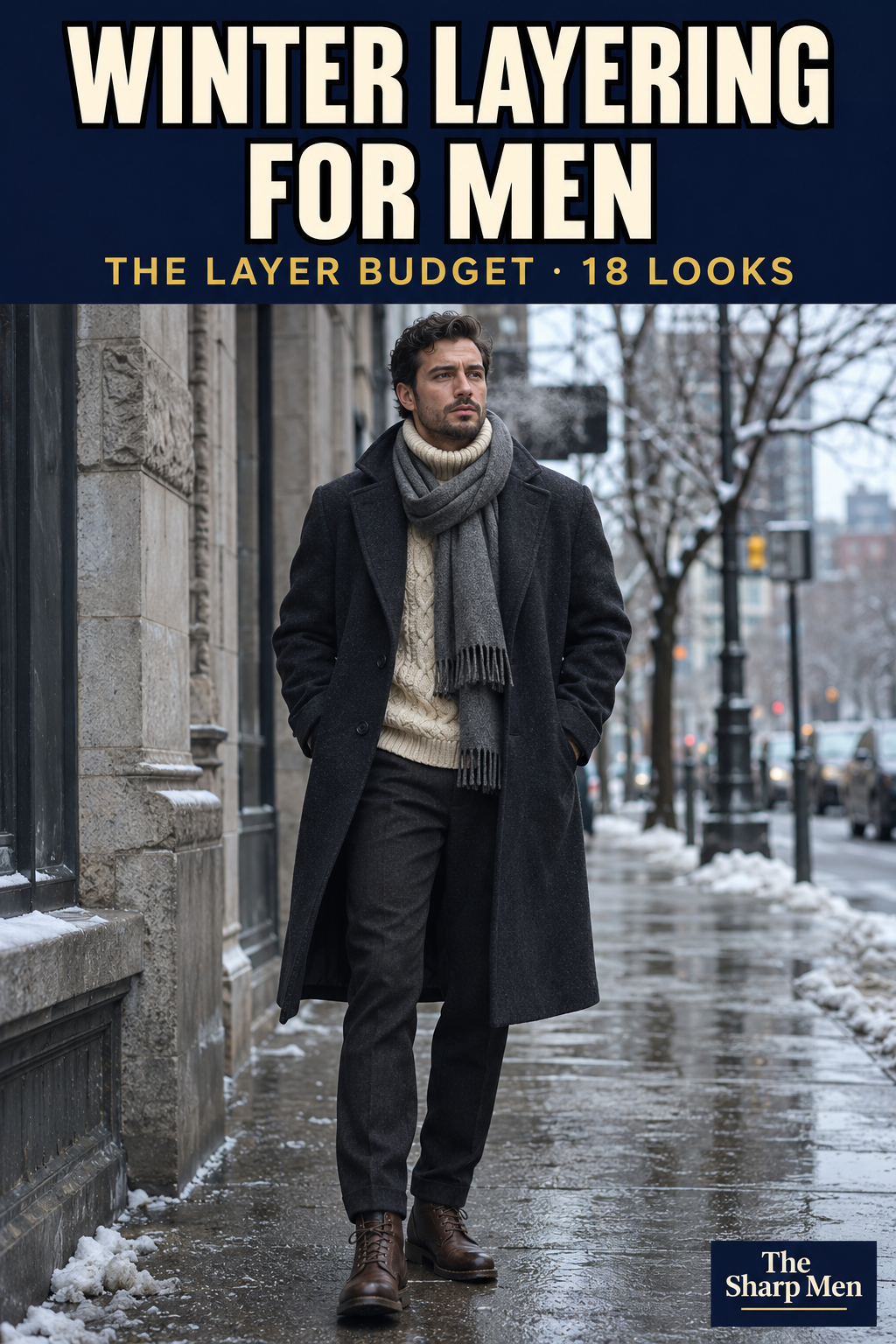
Winter Layering for Men: 18 Looks That Beat the Cold
Every winter style guide gives the same instruction. Wear layers. None of them tells you how many.
That is the gap this guide closes. Winter layering for men fails for one boring reason: men guess. They put on a jumper because it looked cold out of the window, then spend the day either shivering at a bus stop or sweating through a shirt on a heated train. The outfit was never the problem. The amount of insulation was.
So this guide gives every garment a number, gives every temperature band a target, and makes the two meet. It is called the Layer Budget, and once you have it, the outfit picks itself. Below it you will find 18 complete looks running from a mild 15°C (59°F) autumn morning down to a genuine −10°C (14°F), each one tagged with its budget so you can see the maths working.
The Layer Budget: How Winter Layering for Men Actually Works
A layer budget is a single number that describes how much insulation an outfit carries. Each garment is worth a certain number of points. Add up what you are wearing, compare the total against the temperature, and you know before you leave the house whether you have got it right.
The numbers below come from real fabric weights. A fine-gauge merino knit at 200 gsm does not hold the same air as a lambswool cable at 450 gsm, and no amount of styling advice changes that.
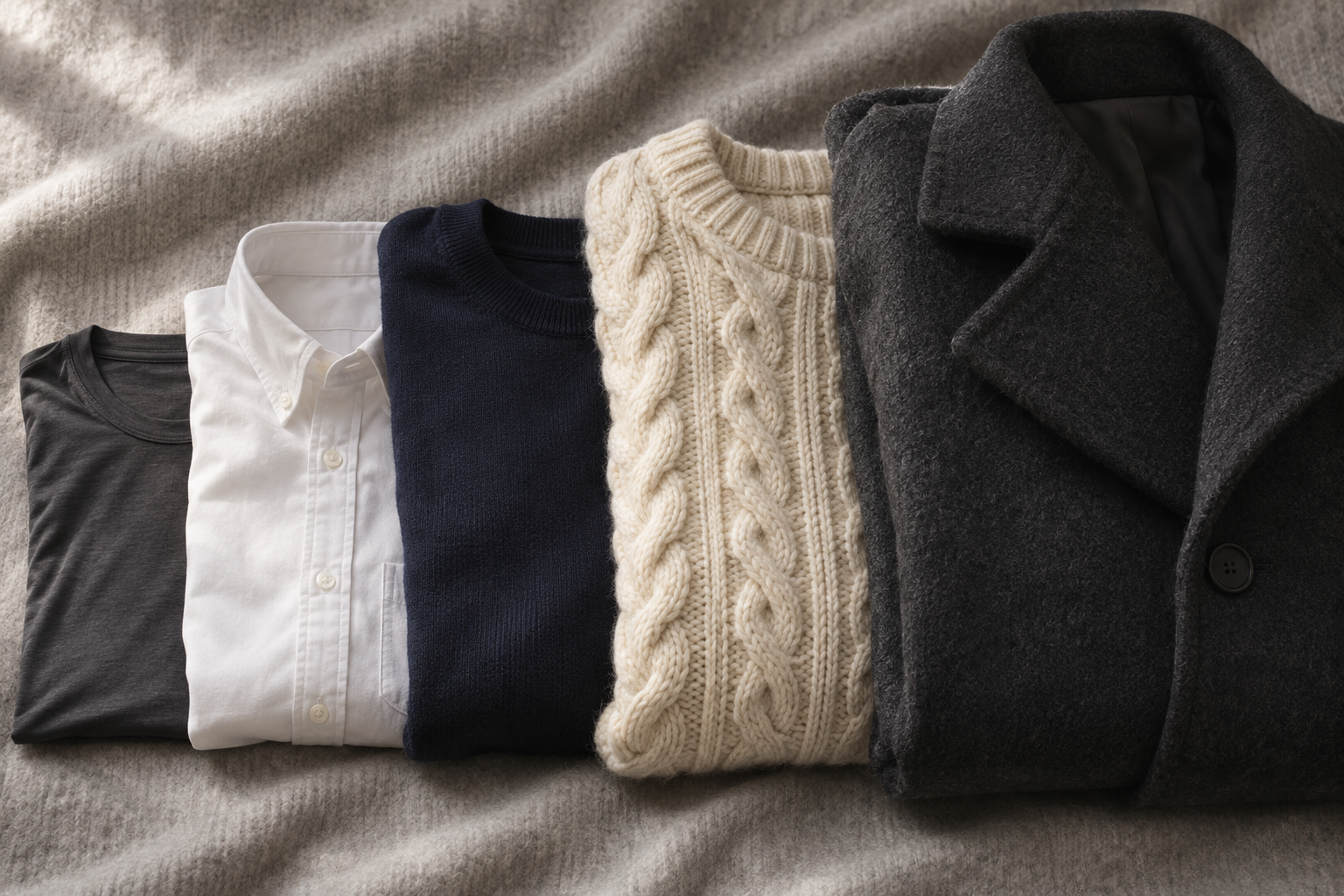
Warmth values by garment
| Garment | Typical weight or spec | Points |
|---|---|---|
| Cotton t-shirt | 150–180 gsm | 0.5 |
| Oxford or poplin shirt | 120–140 gsm | 1 |
| Thermal or merino base layer | 180–220 gsm | 1.5 |
| Flannel shirt | 200–260 gsm | 1.5 |
| Fine-gauge knit (merino, 12–14 gauge) | 180–250 gsm | 1.5 |
| Overshirt or shacket, unlined | 300–400 gsm | 2 |
| Quilted gilet | 40–60 g synthetic fill | 2 |
| Fleece, mid-weight | 200–300 gsm | 2 |
| Chunky knit (lambswool, 5–7 gauge) | 400–550 gsm | 2.5 |
| Waxed cotton jacket, unlined | 8–10 oz cotton | 2 |
| Unlined wool coat | 400–500 gsm cloth | 2.5 |
| Lined wool overcoat (melton) | 600–750 gsm cloth | 3.5 |
| Down gilet | 600+ fill power | 2.5 |
| Down jacket | 600–800 fill power | 4 |
| Insulated parka | 200 g synthetic or 650 fill | 4.5 |
Temperature bands and target budgets
| Conditions | Target budget | What that feels like |
|---|---|---|
| 12–15°C / 54–59°F | 2.5 points | Still air, bright afternoon |
| 7–11°C / 45–52°F | 3.5 points | Standard autumn, light wind |
| 2–6°C / 36–43°F | 5 points | Proper cold, frost on cars |
| −4 to 1°C / 25–34°F | 6.5 points | Hard winter, hands hurt |
| Below −5°C / 23°F | 8 points | Exposed skin stings in minutes |
Two adjustments matter. Add one point if the wind is above 25 km/h (15 mph), because wind strips the warm air out of knitwear faster than cold alone does. Subtract one point if you are walking continuously rather than standing, since a brisk pace generates roughly the heat of one mid-layer.
The budget is a floor, not a ceiling, and that is the point. Winter layering for men goes wrong in both directions, and overshooting the budget indoors is the more common of the two.
Two Fit Tests That Decide Whether Your Layers Work
Most winter layering for men collapses at the shell. Men buy an overcoat in September wearing a t-shirt, then discover in January that it does not close over a chunky knit. These two tests take ten seconds each and catch it.

The arms-crossed test
Put on the full outfit, every layer, and fasten the outer layer. Now cross your arms and reach round to grip your own shoulders, as though you were hugging yourself.
Two things can go wrong. If the fabric pulls hard across your upper back or the shoulder seams drag forward, the shell is one size too small for what is underneath. If the cuffs ride up past your wrist bone, the sleeves are too short once the mid-layer takes up room. Either result means the coat works over a shirt and fails over a jumper, which makes it an autumn coat, not a winter one.
The flat-hand chest gap
With every layer on and the coat fastened, slide a flat hand between your chest and the coat front. A flat hand should pass. A closed fist should not.
Less than a flat hand and you have compressed the insulation, which is the detail nobody explains: a down or wool layer only works because it traps still air, and squashing it under a tight shell removes most of the warmth you paid for. More than a fist and the coat is carrying so much dead volume that wind circulates inside it.
Base, Mid and Shell: What Each Layer Is Actually For
Three layers, three separate jobs. Confusing them is why men end up cold in expensive clothes.
The base layer moves moisture, it does not warm you
The job of a base layer is to pull sweat off your skin and pass it outward. Merino wool at 180–220 gsm does this while staying warm when damp. Cotton does the opposite: it absorbs moisture, holds it against your skin and then cools you steadily for the rest of the day. A cotton t-shirt is a fine base in mild weather and a liability below freezing.
The mid layer is where the warmth lives
This is the layer that actually traps air, and it is where your budget should be spent. A chunky knit, a fleece or a quilted gilet all do the same physical work. The choice is about formality, not heat. For a smarter version of the mid layer, a knit with a high collar earns its place twice over, and the collar height rules in our turtleneck guide explain which one suits your neck.
The shell blocks wind and water
A shell does not need to be warm. It needs to stop moving air from reaching your mid layer. This is why a thin waxed cotton jacket can outperform a thick unlined wool coat in a gale, and why winter layering for men in a wet climate should start with the shell rather than finish with it.
18 Winter Layering Looks for Men
Every look carries its layer budget and the temperature band it covers. Work down the list until you reach your own weather.
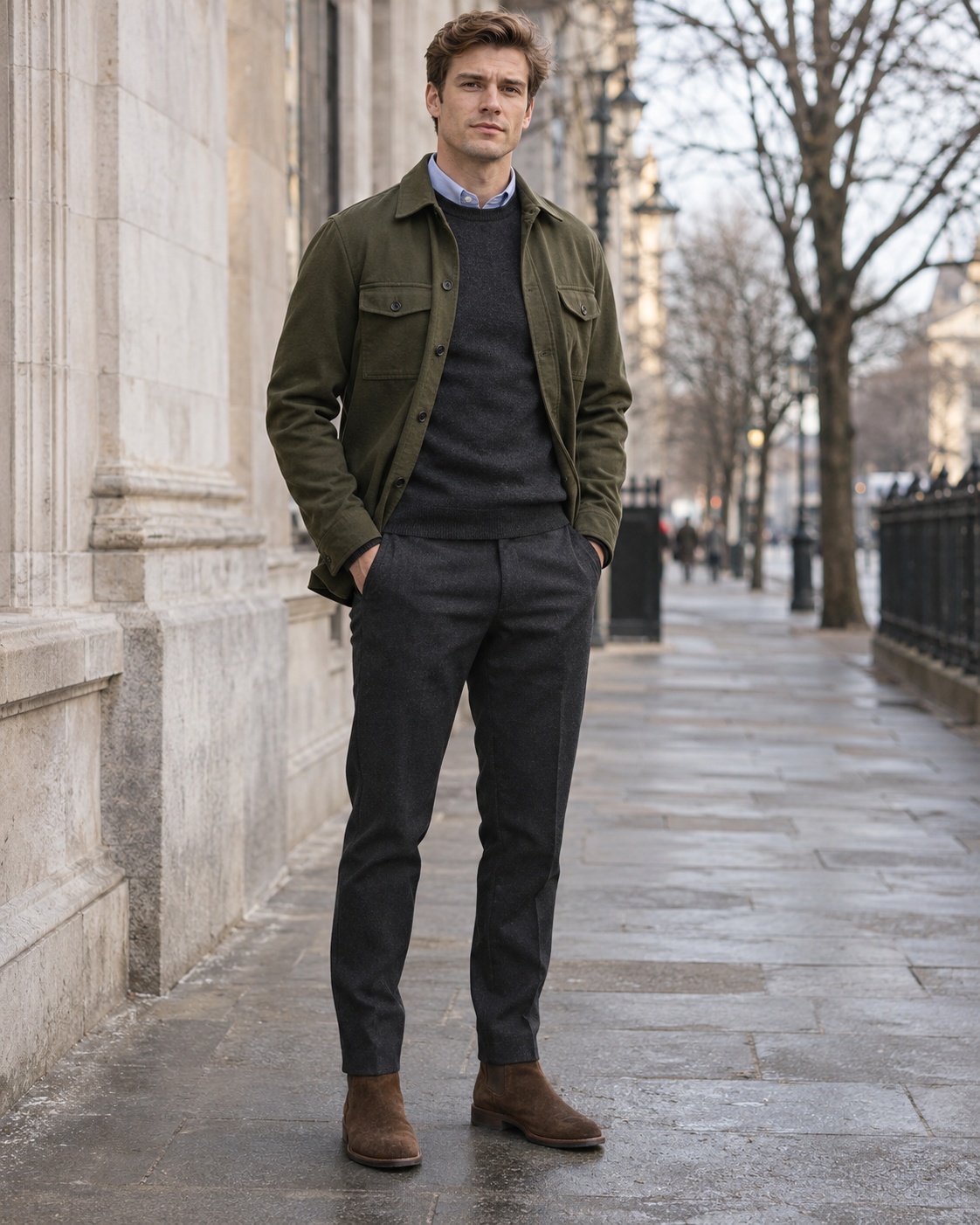
1. Oxford shirt, fine merino crew and an unlined overshirt
Layer budget: 2.5 points · 12–15°C (54–59°F)
The mildest end of winter layering for men, and the one most men overdress for. A pale blue Oxford, a fine-gauge merino crew in charcoal over the top, and an unlined overshirt in olive cotton drill as the shell. Total insulation is modest on purpose, because at 14°C (57°F) a wool coat will have you carrying it by eleven in the morning.
Leave the overshirt open. The visible band of shirt collar above the knit does the work that an expensive accessory would otherwise have to do, and it costs nothing.
Fit check: the overshirt should sit roughly 5 cm (2 in) longer than the knit, never shorter.
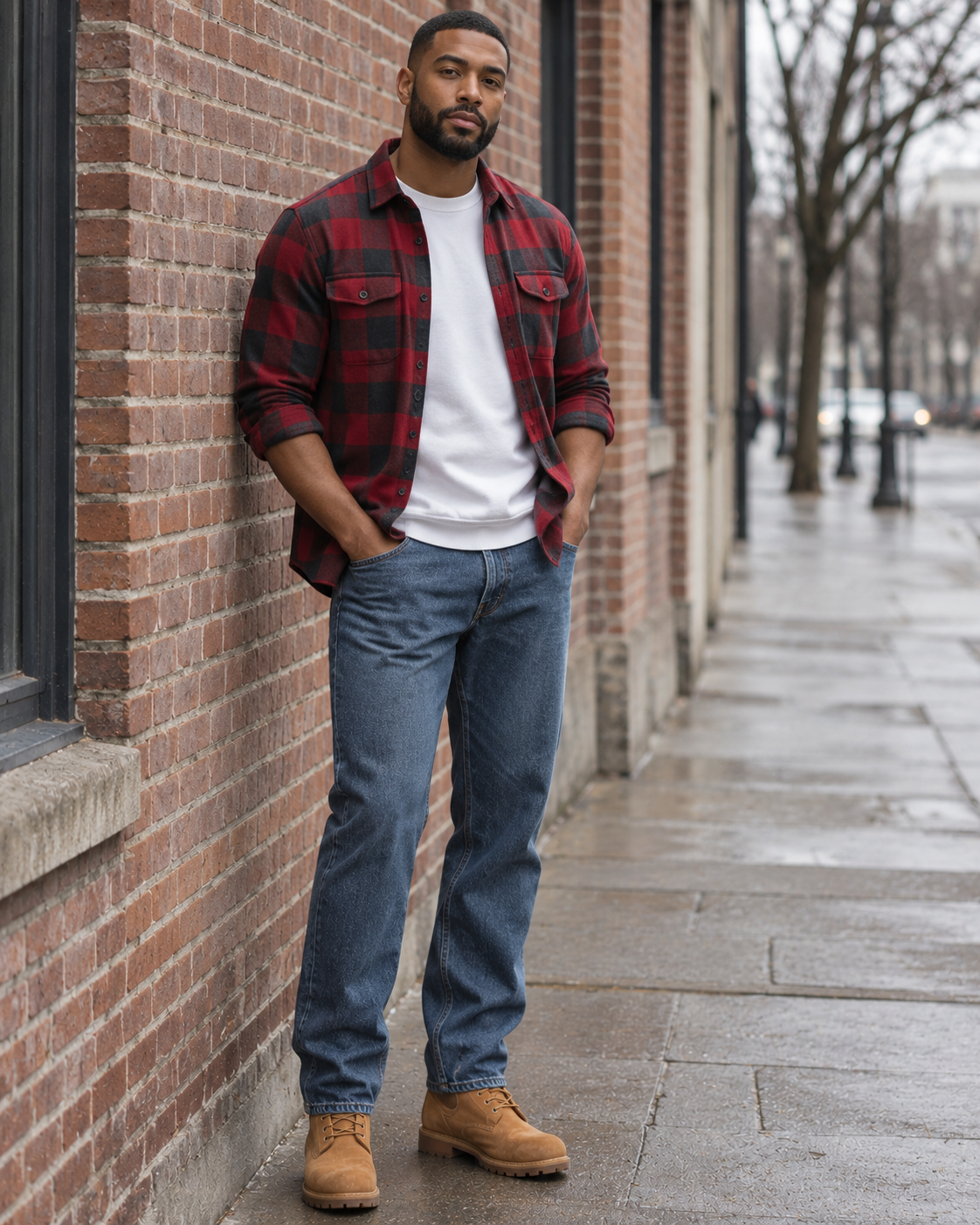
2. Tee, open flannel shirt and nothing else
Layer budget: 2.5 points · 12–15°C (54–59°F)
Two garments reaching the budget, which makes this the cheapest winter layering for men outfit here. A plain white heavyweight tee at 180 gsm under a brushed flannel at 240 gsm, worn fully open with the sleeves rolled to just below the elbow.
The reason this works and the version in most winter guides does not is contrast in weight. A thin tee under a thin shirt reads as unfinished. A heavy tee gives the open shirt something to frame. If you want the full range of this one garment, our flannel shirt outfit guide covers 19 ways to wear it.
Fit check: the flannel’s shoulder seam should land on the edge of your shoulder bone, not below it.
3. Roll neck under an unlined wool blazer
Layer budget: 2.5 points · 12–15°C (54–59°F)
The smartest low-budget look here, and proof that winter layering for men does not have to mean bulk. A fine-gauge roll neck in oatmeal, an unlined wool blazer in mid-grey over it, dark denim or flannel trousers below.
Two layers, both thin, and it carries to a restaurant without a coat. The whole effect rests on the knit being genuinely fine: anything above 14 gauge will bunch at the blazer’s shoulder and ruin the line.
Fit check: you should see 1–2 cm (half an inch) of knit at the cuff, same as you would show shirt cuff.

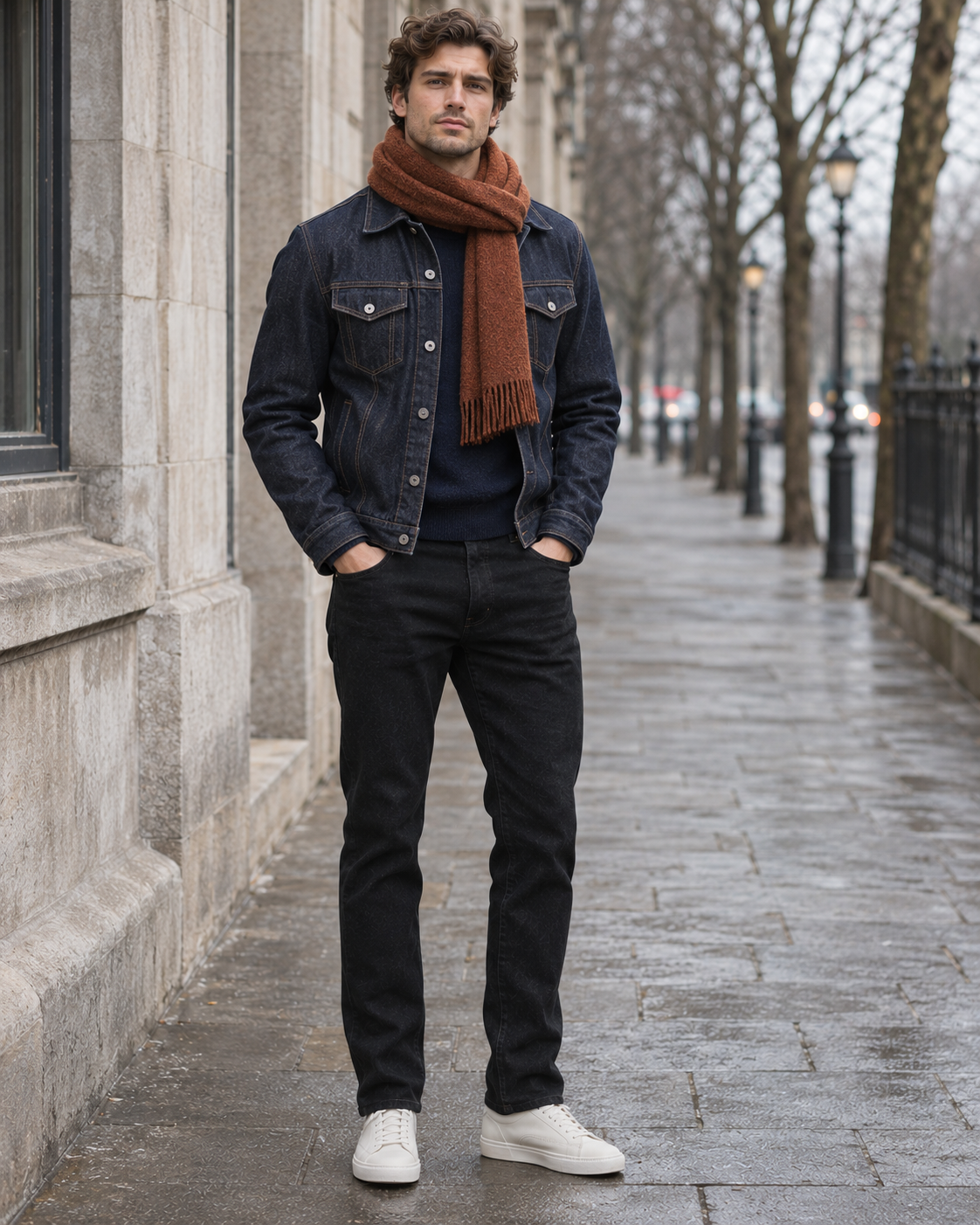
4. Merino crew, denim jacket and a wool scarf
Layer budget: 3.5 points · 7–11°C (45–52°F)
A denim jacket is worth two points and no more, which is exactly why it needs a scarf to clear this band. Merino crew in navy, raw indigo denim jacket sized to close over it, and a lambswool scarf in a rust or mustard tone.
The scarf is not decoration here. A wool scarf seals the neck opening, and the neck is where a short jacket leaks the most heat. Our denim jacket guide runs through 15 further ways to place this piece in a layered outfit.
Fit check: the jacket must fasten over the knit without the chest buttons straining.
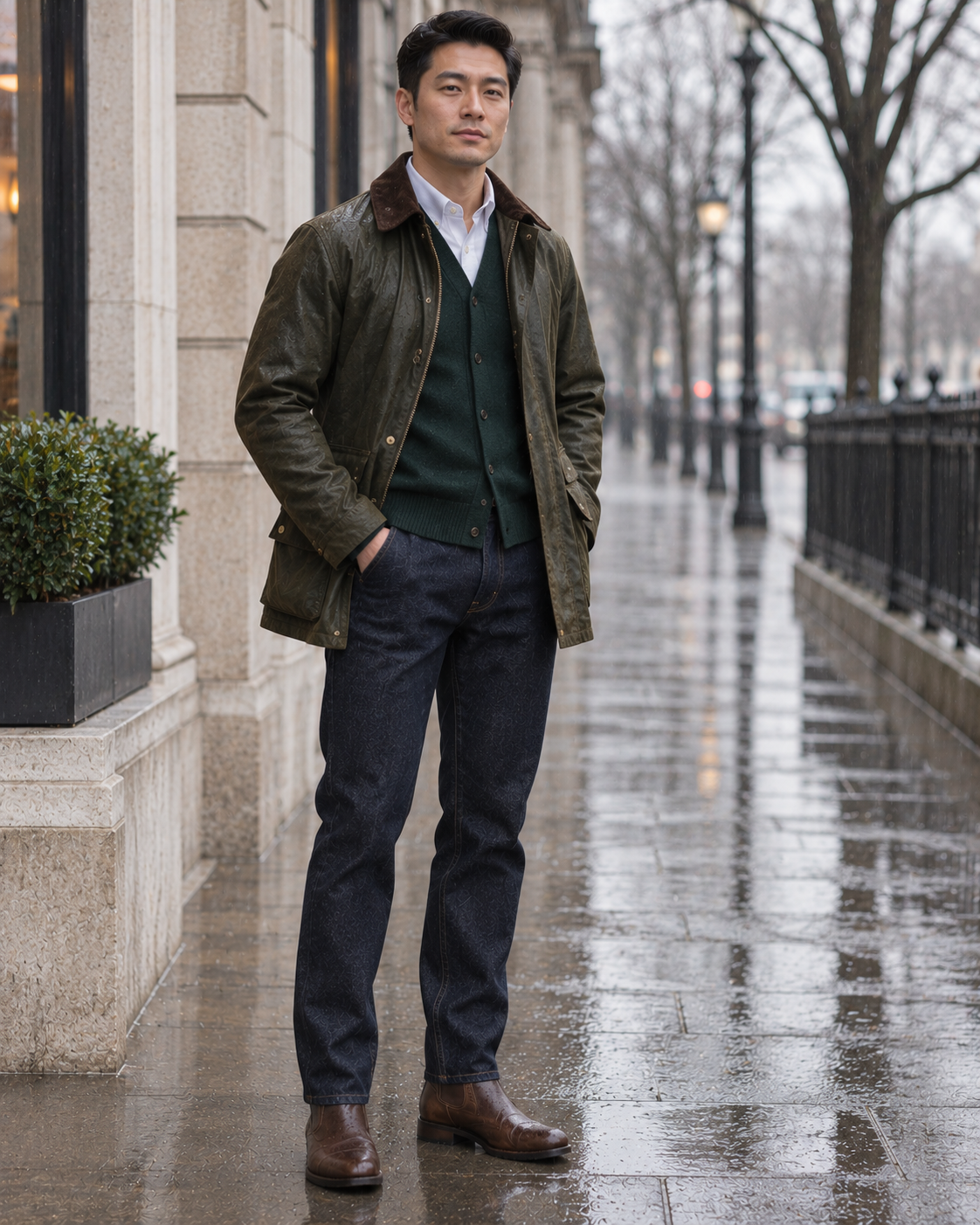
5. Oxford, lambswool cardigan and a waxed cotton jacket
Layer budget: 3.5 points · 7–11°C (45–52°F)
The wet-weather entry. A cardigan is the most underrated mid layer in winter layering for men, because you can open it indoors without taking anything off. White Oxford, mid-weight lambswool cardigan in forest green, 8 oz waxed cotton jacket over the top.
Waxed cotton earns its place at this temperature by blocking wind and rain while adding almost no bulk. It is a shell doing shell work, nothing more.
Fit check: button the cardigan from the bottom and leave the top button open, so the collar does not fight the shirt.
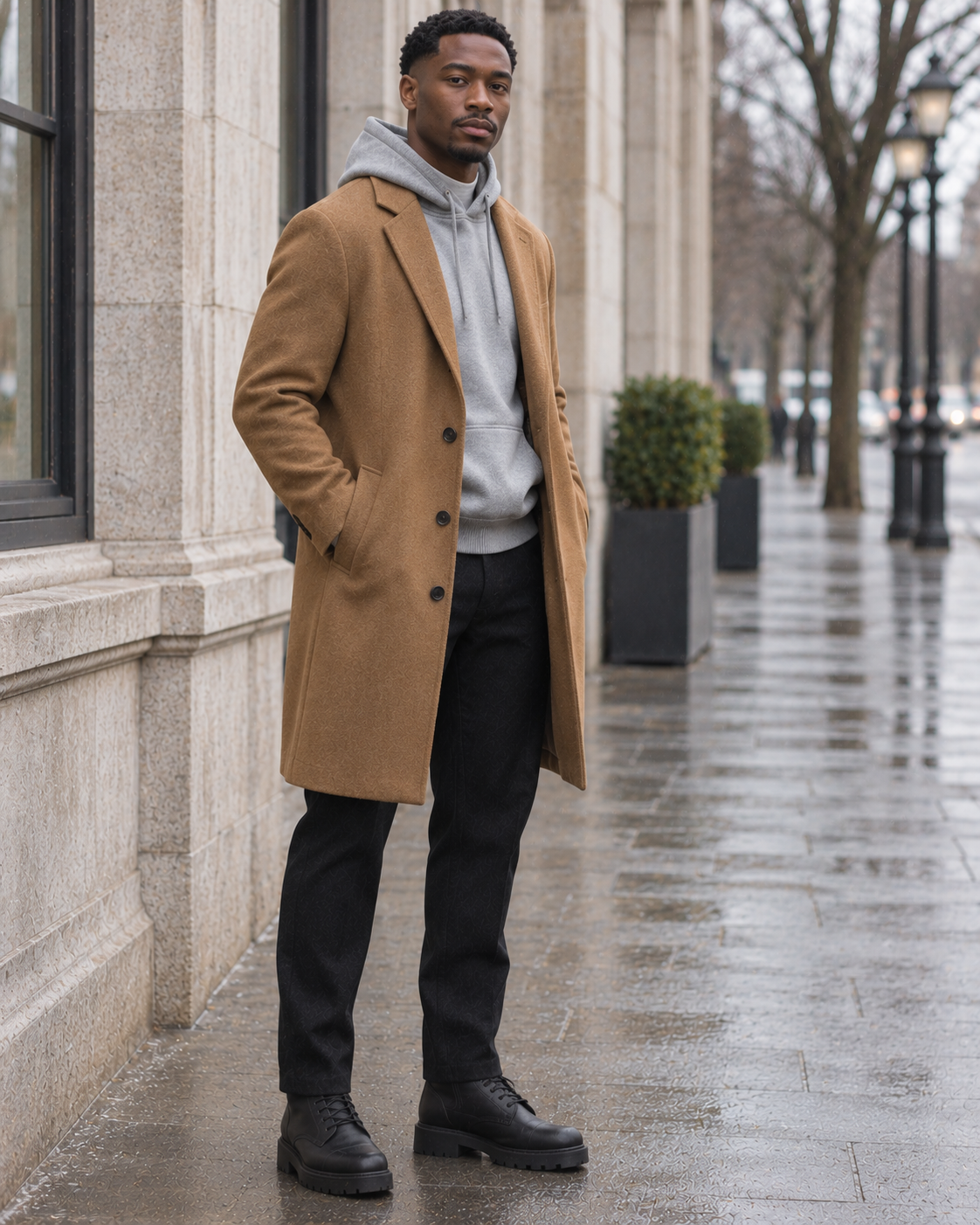
6. Hoodie under an unlined wool coat
Layer budget: 3.5 points · 7–11°C (45–52°F)
The pairing most style guides warn against, and they are wrong. A heavyweight hoodie at 400 gsm in grey marl, under a single-breasted unlined wool coat in camel or charcoal, works because the two pieces are at opposite ends of the formality scale rather than near each other.
The failure mode is a thin, cheap hoodie with a floppy hood, which collapses into a lump at the back of the coat collar. Buy the hood structured and the rest follows.
Fit check: the hood should sit flat enough that the coat collar still lies against your neck.
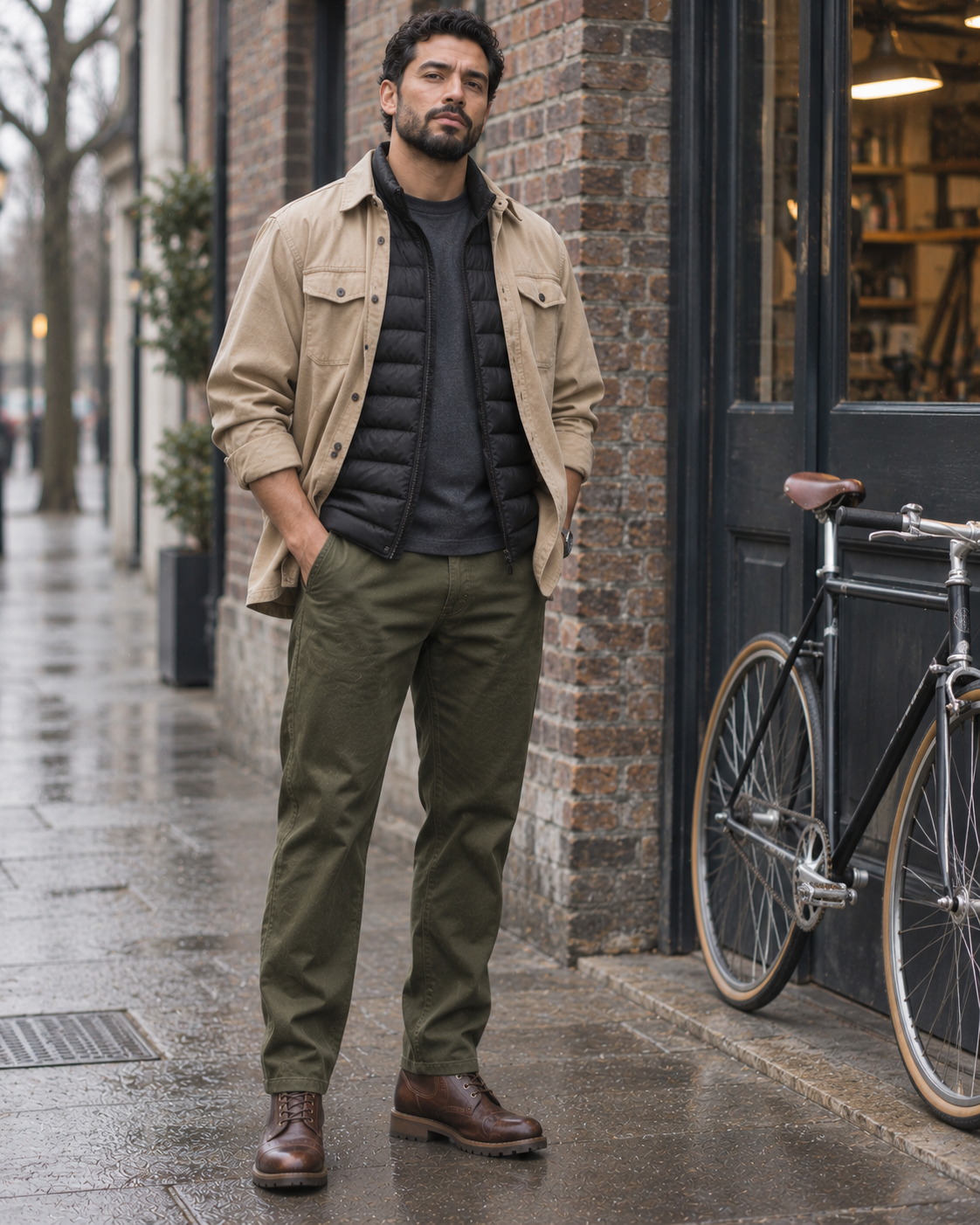
7. Tee, quilted gilet and an overshirt
Layer budget: 3.5 points · 7–11°C (45–52°F)
A gilet placed in the middle rather than on the outside, which is the move almost nobody makes. Heavyweight tee, quilted gilet with 40 g synthetic fill, oversized cotton overshirt over the whole thing.
This keeps the warmth on your core, where you want it, while leaving your arms in a single layer so you can actually work, drive or carry things. Winter layering for men is often described as a stack, when it is really a map of where you need heat.
Fit check: the gilet must be slim enough that the overshirt closes over it if required.
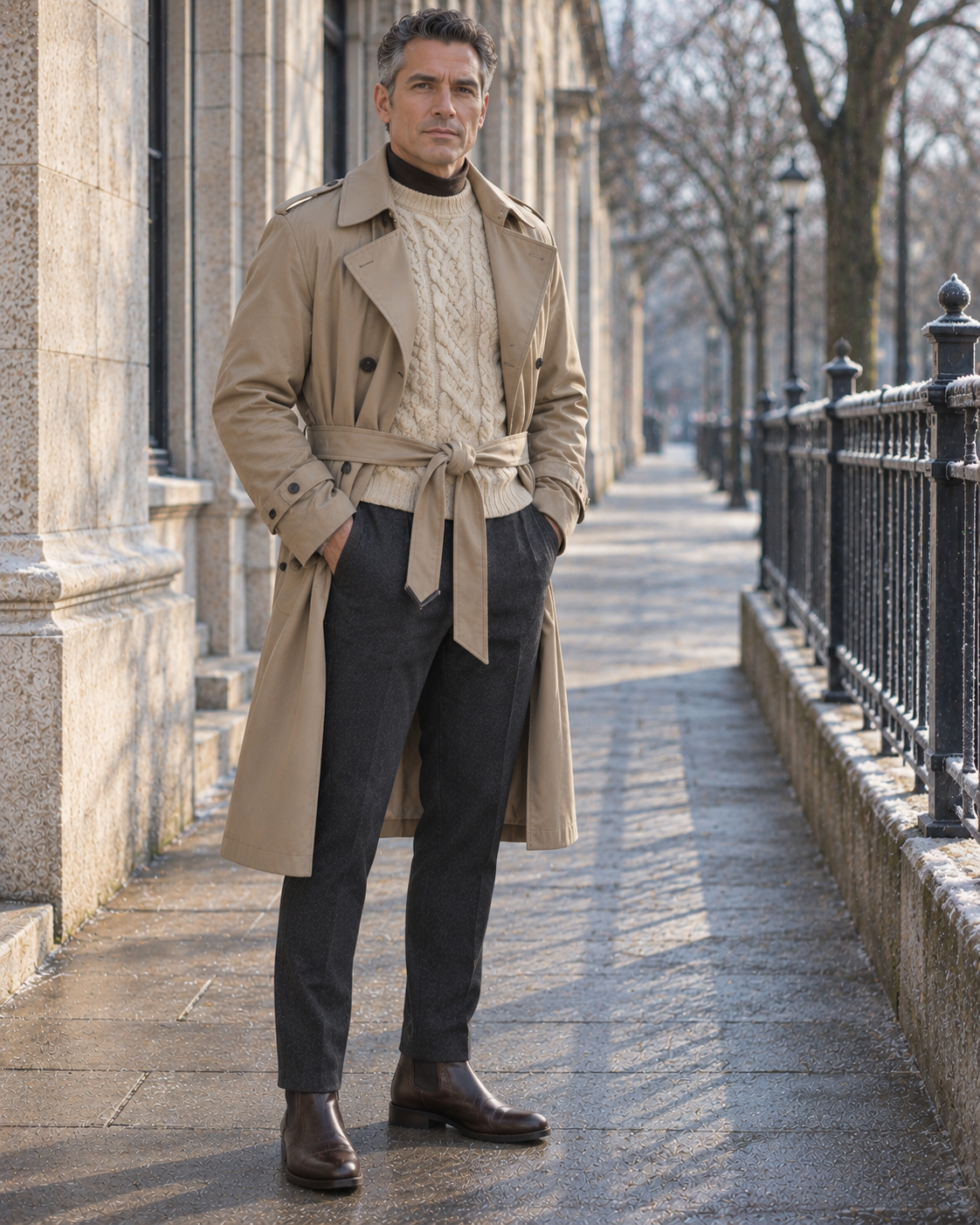
8. Merino base, chunky knit and an unlined trench
Layer budget: 5 points · 2–6°C (36–43°F)
Here the budget doubles and the mid layer takes the strain. A 200 gsm merino base, a 450 gsm chunky lambswool knit in cream, and a stone trench coat over the top, left unbuttoned at the throat.
A trench is not a warm coat and was never designed as one. It reaches this band only because the knit beneath it is doing nearly half the work, which is the whole argument for budgeting in points rather than garments.
Fit check: belt the trench rather than buckling it, so the chunky knit is not compressed at the waist.
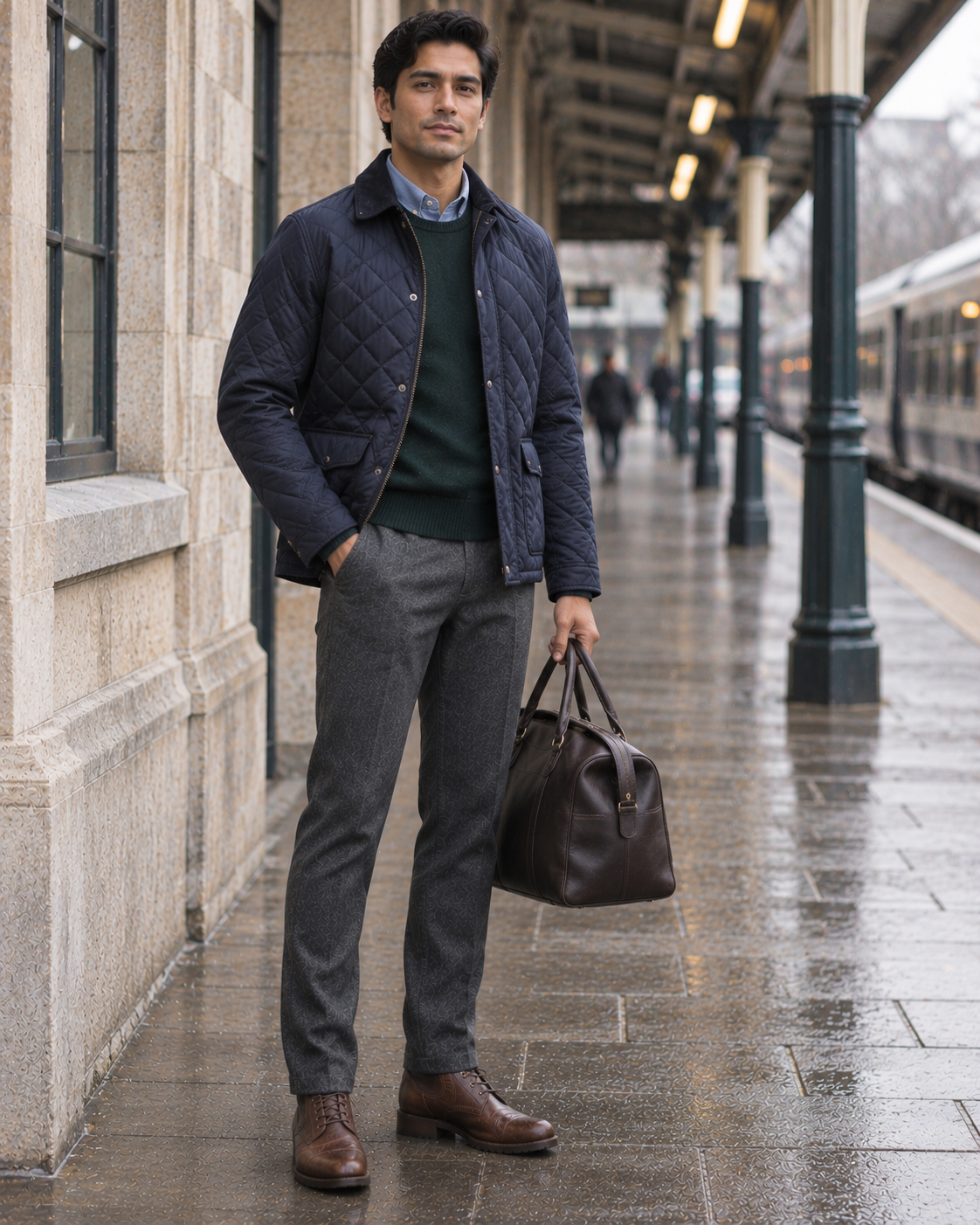
9. Shirt, fine knit and a quilted liner jacket
Layer budget: 5 points · 2–6°C (36–43°F)
The commuting answer. Chambray shirt, fine-gauge knit in dark green, diamond-quilted liner jacket in navy. Three thin layers rather than two thick ones, so the whole outfit compresses on a crowded train and comes back out without creasing.
Quilted liners are the most heat-per-millimetre you can buy at this price, which makes them the most efficient garment in winter layering for men by a clear margin.
Fit check: the liner’s hem should finish at the base of your hip, never mid-thigh.
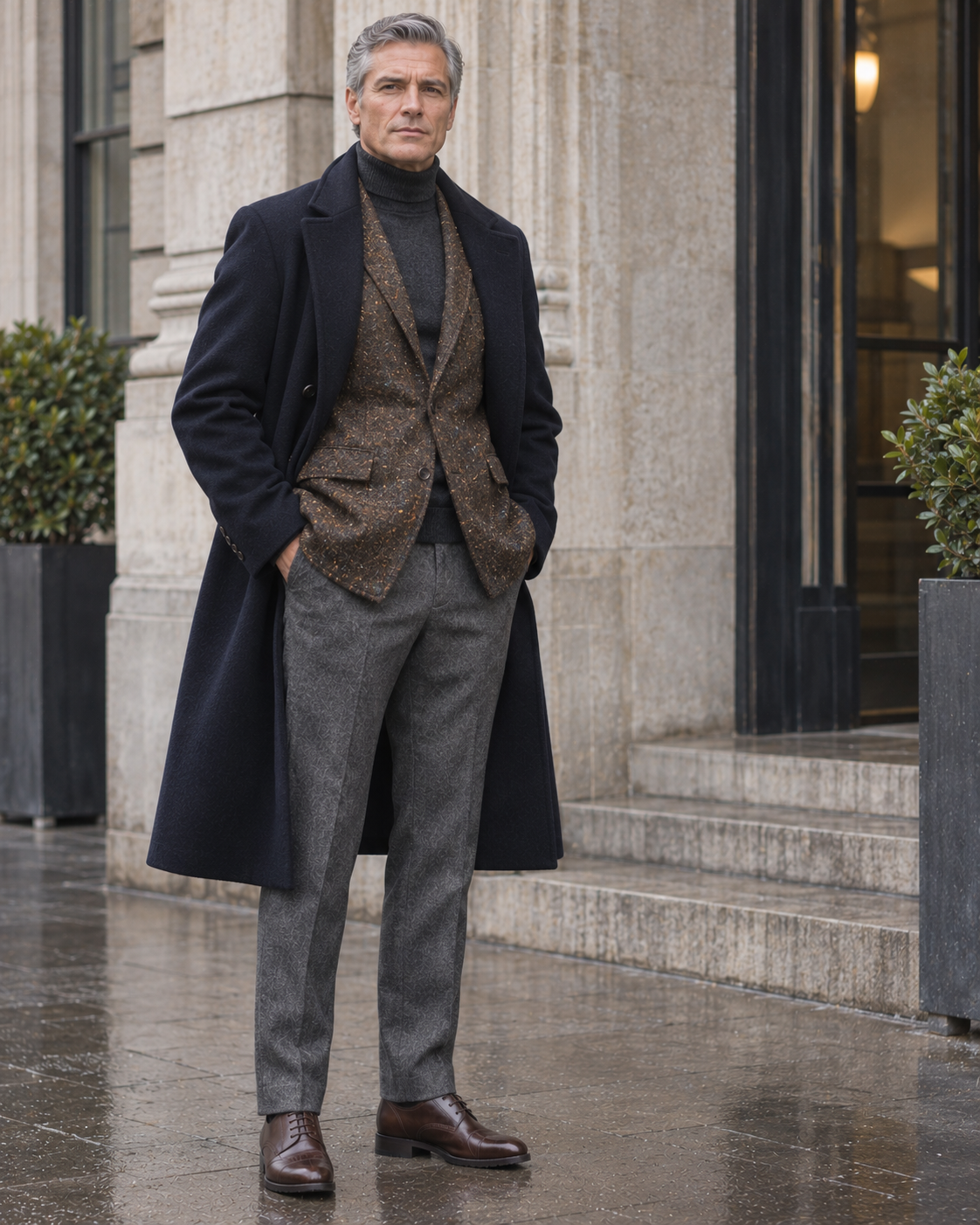
10. Roll neck, tweed sport coat and a topcoat
Layer budget: 5 points · 2–6°C (36–43°F)
The look that most winter guides skip entirely, because it belongs to men over forty and to offices with a dress code. A charcoal roll neck, a brown Donegal tweed sport coat at 450 gsm, and a navy topcoat over the pair.
Three tailored layers demand one thing: each one must be cut to go over the last. Buy the topcoat last and buy it while wearing the sport coat, or the arms-crossed test will fail you in January.
Fit check: the topcoat’s shoulder must extend 1–1.5 cm (half an inch) beyond the sport coat’s.
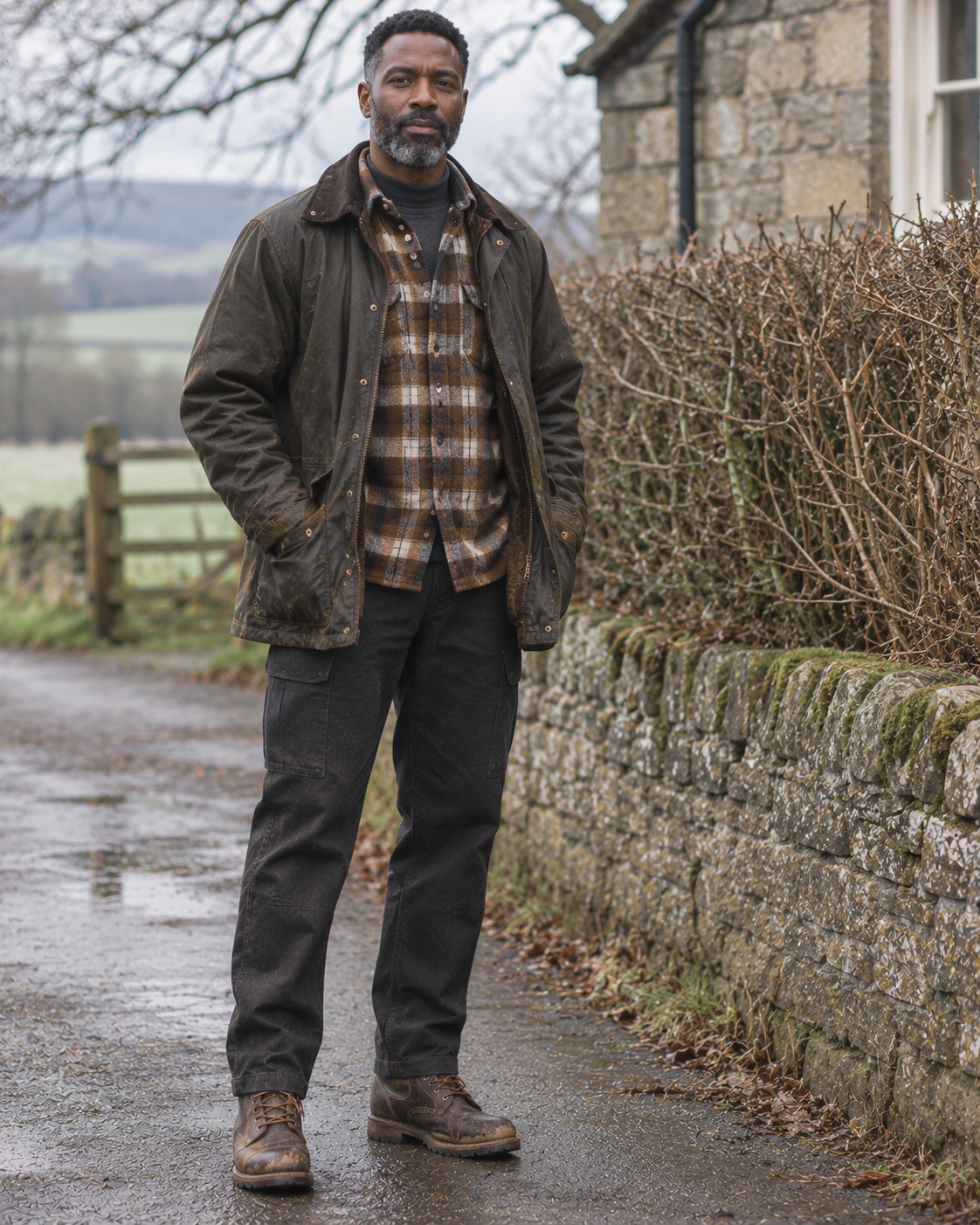
11. Thermal base, flannel shirt and a waxed jacket
Layer budget: 5 points · 2–6°C (36–43°F)
The budget build. Every piece here can be bought second-hand or at the cheap end of the high street, and the total still clears five points: a 200 gsm thermal top, a heavy brushed flannel over it, and a waxed cotton jacket as the shell.
Cost is the gap in nearly every winter layering for men guide online, which tends to photograph shearling and suede and then fall silent on price. Warmth is physics, not budget.
Fit check: tuck the thermal, leave the flannel out, so the waist does not bunch under the jacket.
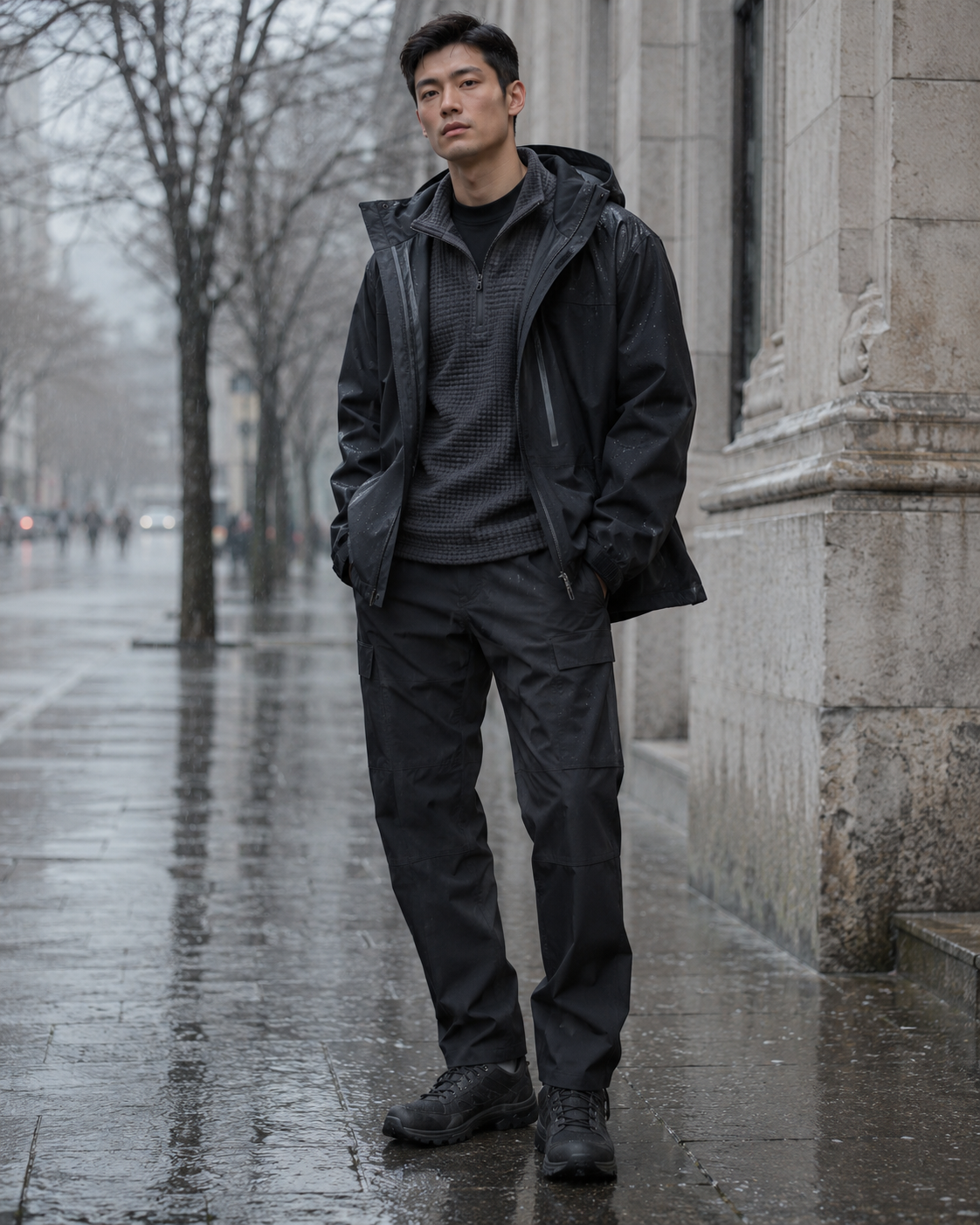
12. Merino base, fleece and a hard shell
Layer budget: 5 points · 2–6°C (36–43°F)
The technical version, for men who walk or cycle to work in weather that cannot be trusted. Merino base at 200 gsm, mid-weight grid fleece at 250 gsm, and a waterproof hard shell with taped seams.
This combination handles rain that a wool coat cannot, and it dries in an hour. Keep the colours flat and dark, because technical fabric in bright colour reads as sportswear the moment you step indoors.
Fit check: the shell’s hem drawcord should pull in enough to stop wind rising up the back.
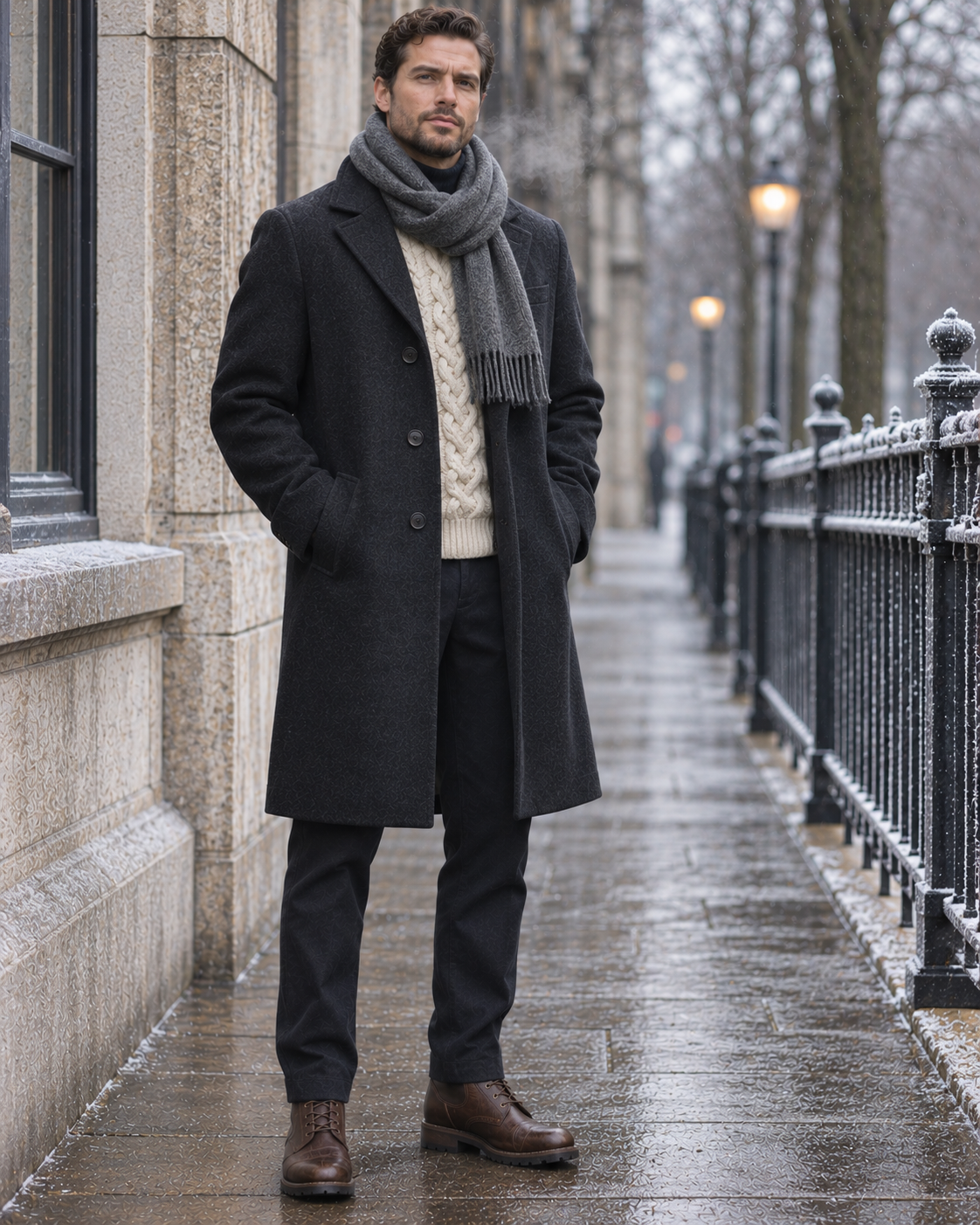
13. Merino base, chunky knit, melton overcoat and scarf
Layer budget: 6.5 points · −4 to 1°C (25–34°F)
The classic cold-city outfit, and if you only take one example of winter layering for men from this guide, take this one. A 200 gsm merino base, a 450 gsm chunky knit, a 700 gsm melton wool overcoat, and a heavy wool scarf doubled at the throat.
Melton is the reason this reaches 6.5 points in only four pieces. Densely woven wool at 700 gsm blocks wind almost completely, so none of the warmth underneath gets stripped away.
Fit check: the overcoat should close with a flat hand of room at the chest and no more.
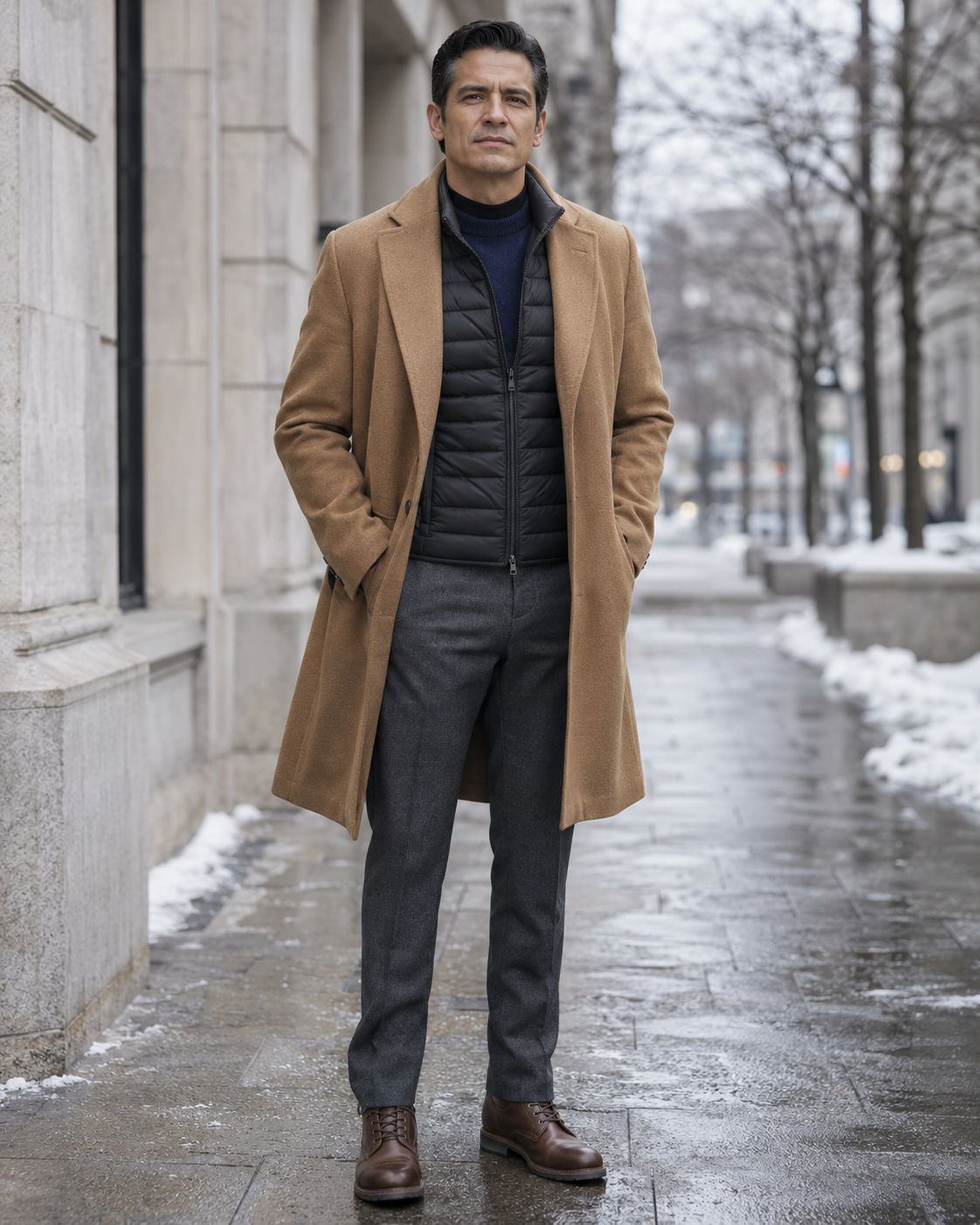
14. Base, fine knit, down gilet and a wool coat
Layer budget: 6.5 points · −4 to 1°C (25–34°F)
The trick most men have never been shown: a down gilet worn under a tailored wool coat rather than over a jumper. A thin base, a fine-gauge knit, a 600 fill power down gilet, and an unlined wool coat over everything.
The gilet is slim enough to disappear under the coat, and the two together outperform a single heavy overcoat while looking entirely conventional from outside. For office winters where a parka is not an option, this is the answer.
Fit check: a 600 fill power gilet should pack to the size of a loaf of bread. If it does not, it is too bulky for this.
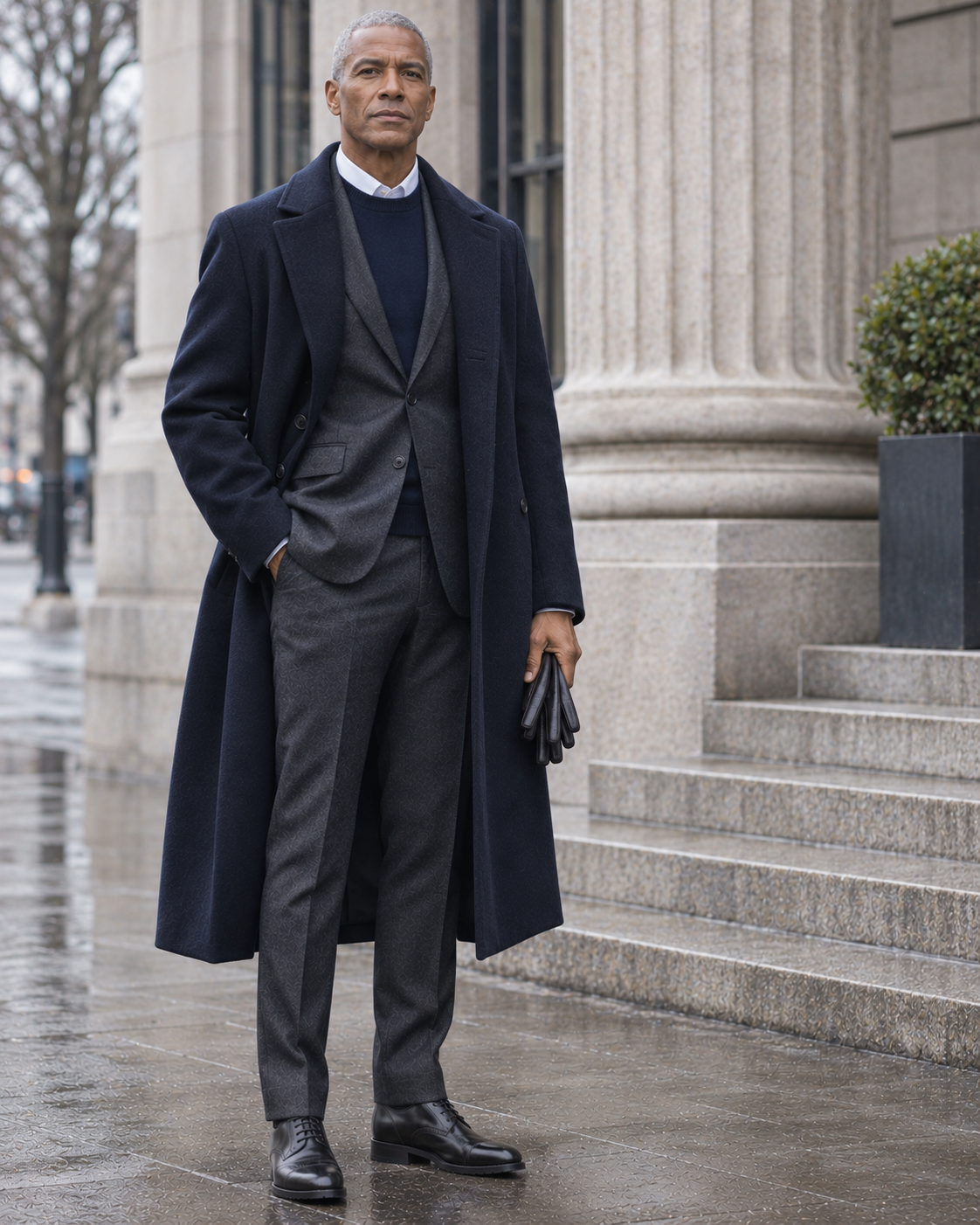
15. Suit, fine knit and a topcoat
Layer budget: 6.5 points · −4 to 1°C (25–34°F)
Formal winter, solved, and the hardest case in winter layering for men because nothing may look added on. A wool suit at 320 gsm, a fine merino crew worn over the shirt and under the jacket, and a full-length navy topcoat.
Putting the knit under the suit jacket rather than over it keeps the lapel line clean and adds a point and a half without a visible change. The topcoat must reach at least to the knee, or the suit trousers are exposed to wind for the entire walk.
Fit check: the knit must be fine enough that your shirt collar still sits flat beneath it.
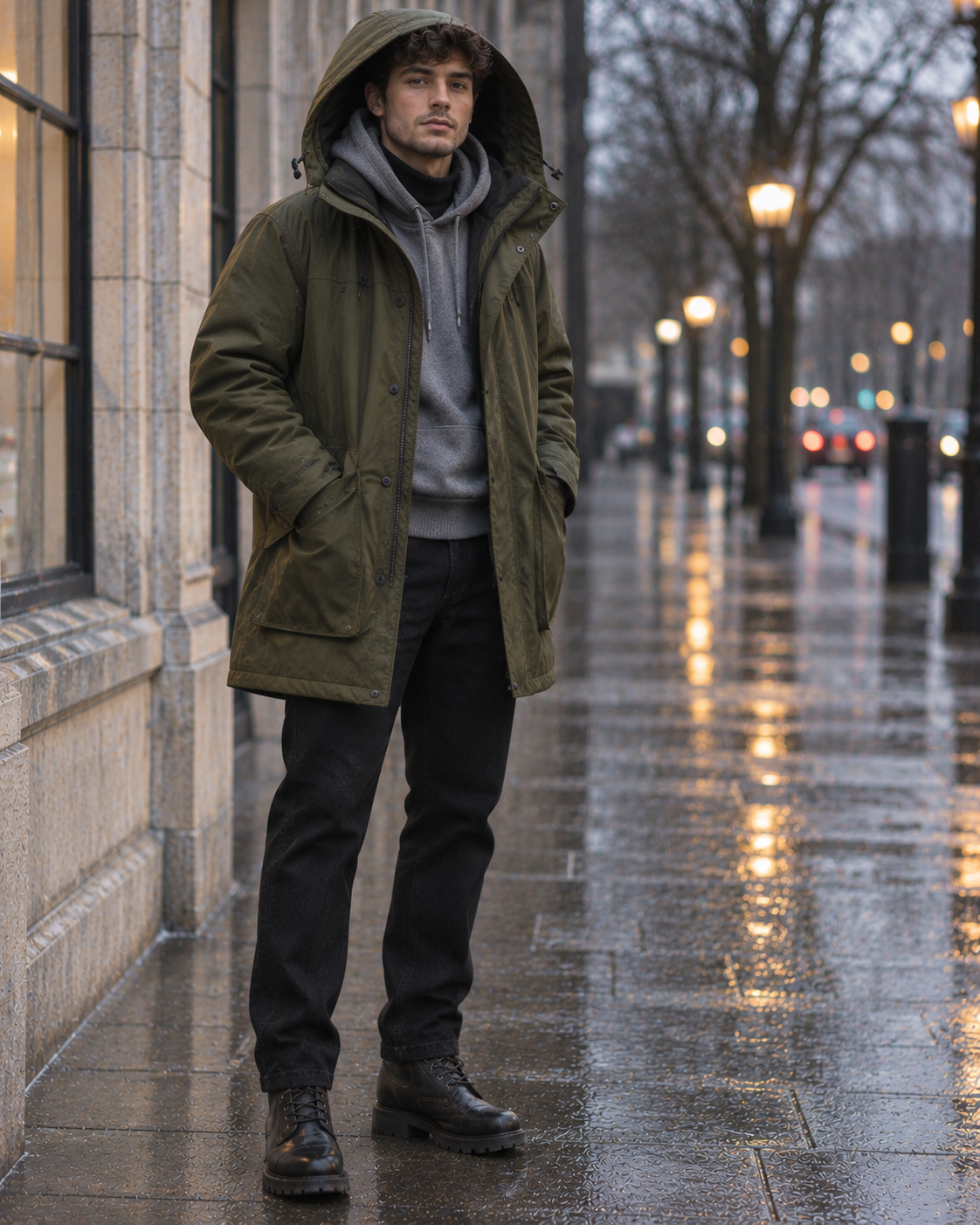
16. Base, hoodie and a parka
Layer budget: 6.5 points · −4 to 1°C (25–34°F)
The casual cold-weather default, built properly. A merino base rather than a cotton tee, a heavyweight hoodie, and a parka with 200 g synthetic insulation and a genuine storm hood.
Synthetic insulation is the right call over down here if your winter is wet, because synthetic keeps most of its warmth when damp and down loses nearly all of it. That single distinction matters more than any brand decision.
Fit check: the parka hood should turn with your head rather than staying put when you look sideways.
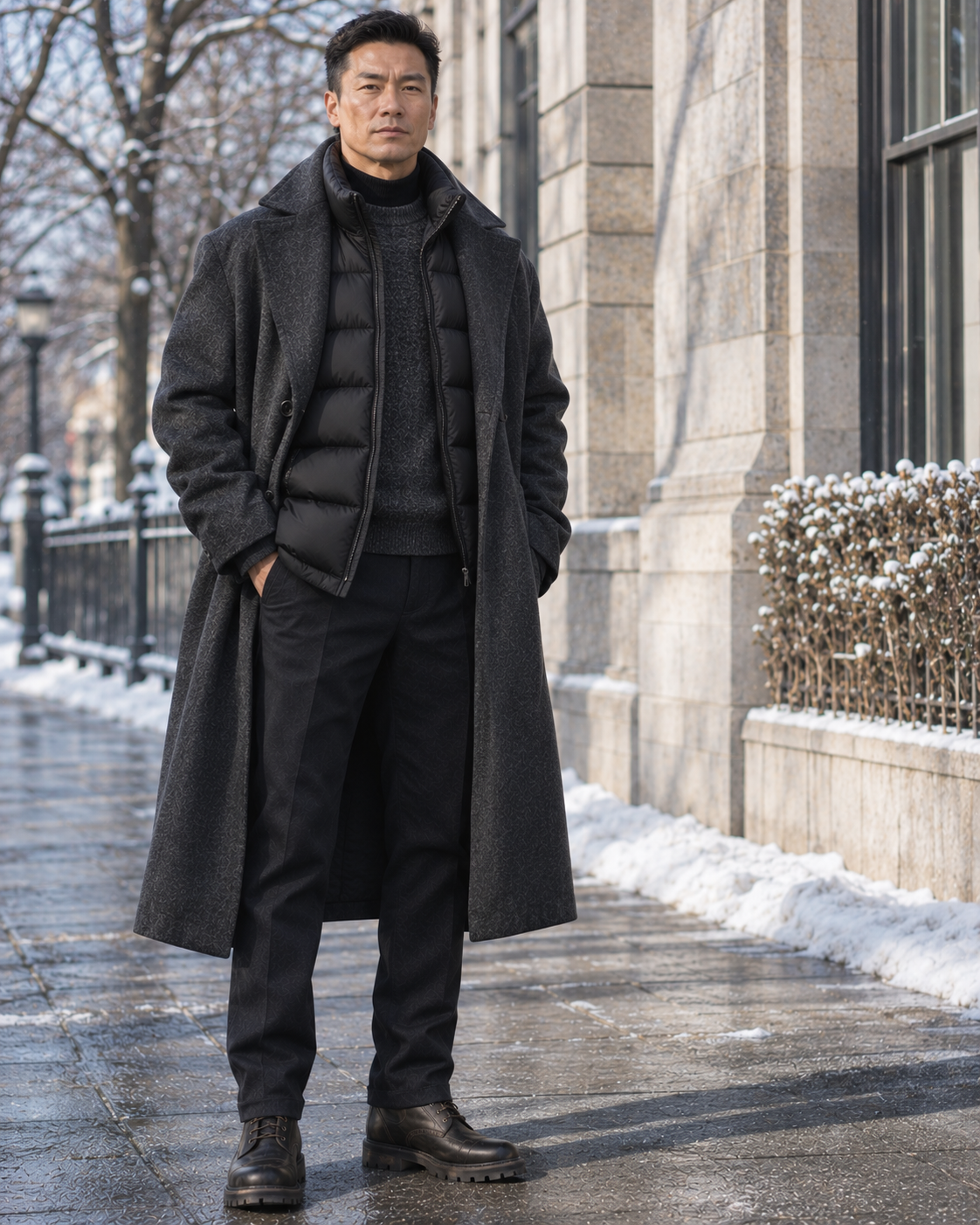
17. Merino base, mid-weight knit, down jacket and overcoat
Layer budget: 8 points · below −5°C (23°F)
Two outer layers, which sounds excessive until the first genuinely cold morning. A 220 gsm merino base, a mid-weight knit, an 800 fill power down jacket, and a loose wool overcoat over the top of it.
The overcoat is there as a windbreak, not as insulation, which is why it must be cut generously enough to not compress the down beneath. This is the upper limit of what winter layering for men can do while still looking like clothing rather than equipment.
Fit check: run the arms-crossed test on this one specifically. It is the outfit most likely to fail it.
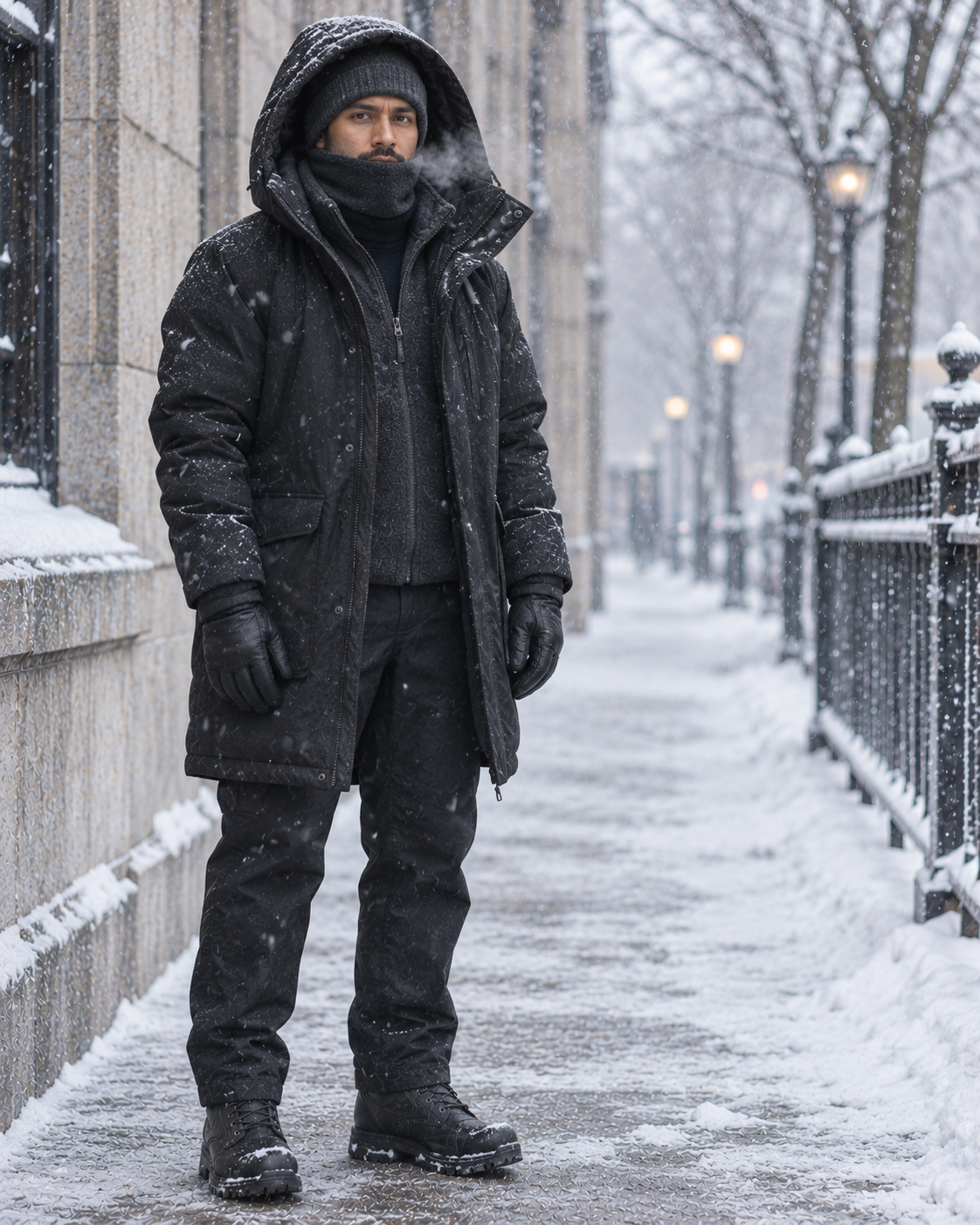
18. Base, fleece and an insulated parka, fully accessorised
Layer budget: 8 points · below −5°C (23°F)
The one built for standing still in real cold. A 220 gsm merino base, a 300 gsm fleece, and a 650 fill power insulated parka reaching mid-thigh, with a wool beanie, lined gloves and a neck gaiter.
Accessories are not a finishing touch at this temperature, they are roughly a point and a half of the budget. The head, hands and neck are where an otherwise correct outfit loses its heat, and the US National Weather Service makes the same point in its guidance for extremely cold weather, which recommends layers of loose-fitting, lightweight, warm clothing alongside covered extremities.
Fit check: gloves should allow you to make a full fist without the fingertips pulling tight, or circulation suffers and your hands get colder.
Winter Layering for Men by Body Type
The budget stays the same for everyone. Where you spend it changes, and this is the part of winter layering for men that generic advice never reaches.
Short builds, under 173 cm (5 ft 8 in)
Spend on thin, warm layers and keep every hem high. A 600 fill power down gilet gives you 2.5 points at almost no visual bulk, where a chunky knit gives the same points and widens your torso. Keep the shell at or above the hip, since a mid-thigh parka cuts a short frame roughly in half.
Tall builds, above 188 cm (6 ft 2 in)
You have length to spend, so use the long shell: a knee-length overcoat reads as proportionate on you and as a costume on shorter men. Watch sleeve length through every layer, because the arms-crossed test fails more often on tall builds than any other.
Broad or athletic builds
Your problem is the shell closing over the mid layer, not warmth. Buy outerwear with a raglan sleeve or a generous armhole and run the flat-hand chest gap test before paying. Avoid stacking two bulky mid layers; use one fine base and one dense knit instead.
Slim builds
You can carry the bulk that others cannot, so chunky knits and quilted shells are yours to use. Add a point beyond the target band, because less body mass means less heat generated and a slim frame genuinely does feel cold sooner at the same temperature.
Larger builds
Prioritise breathability over raw insulation, since overheating between a heated building and a cold street is the real discomfort. Reach for a buttoned cardigan or a zipped fleece as your mid layer rather than a pullover, so you can shed heat without undressing.
Layering for Extreme Cold, Wet and Dry Climates
The target budget assumes still, dry air. Three conditions break that assumption, and each one changes winter layering for men in a different direction.
Wet cold, around 2–7°C (36–45°F). The most uncomfortable weather there is, and the one where fabric choice beats thickness. Go synthetic or waxed for the shell and avoid down entirely, because wet down collapses to nothing. Add half a point over the band.
Dry cold, below −10°C (14°F). Down comes into its own here and outperforms everything per gram. Seal the gaps instead of adding thickness: a neck gaiter and a hat are worth more at this temperature than a fourth layer on your torso.
Humid cold with heated interiors. Common in cities, and the reason men arrive at work damp. Build the outfit so that two full points can be removed in ten seconds, which in practice means one openable mid layer rather than one pullover.
Footwear and Accessories That Finish a Winter Layer
Accessories are the part of winter layering for men that budgets usually ignore. At the cold end of the scale a hat, a scarf and proper gloves are worth more than an entire extra mid layer, and they cost a fraction as much.
| Piece | Spec that matters | Best with | Avoid |
|---|---|---|---|
| Leather boots, rubber sole | Goodyear welt, 2.5 mm leather | Looks 1–11 | Leather soles on ice |
| Insulated boots | 200 g insulation, waterproof | Looks 16–18 | Wearing indoors all day |
| Chelsea boots | Rubber Dainite-style sole | Looks 3, 10, 15 | Deep snow |
| Wool scarf | Lambswool or cashmere, 30 cm wide | Looks 4, 13, 15 | Acrylic, which does not breathe |
| Beanie | Merino or lambswool, ribbed | Looks 16–18 | Cotton, which holds damp |
| Gloves | Leather shell, cashmere lining | Looks 10, 13, 15 | Anything too tight to fist |
| Thick socks | Merino, 70% minimum | All cold-band looks | Cotton socks below freezing |
Grooming Inside Winter Layers
Cold air and indoor heating strip moisture from skin faster than any other season, and a hat worn for eight hours flattens a haircut that worked perfectly in October.
Two fixes carry most of the weight. Choose a cut that recovers from a beanie rather than fighting it, which is the whole premise of our winter hairstyles guide, and move to a heavier moisturiser for the season. Men who shave their heads feel this first and hardest, and our bald men’s skincare routine covers the winter adjustments in detail. If your layering relies on a high collar, keep the beard line clean where it meets the knit, since the two textures merge into one mass otherwise, a trap covered in our grooming mistakes guide.
9 Winter Layering Mistakes
Every one of these is a budget failure wearing a disguise. Winter layering for men rarely goes wrong on taste, it goes wrong on physics.
1. Buying the coat in autumn wearing a t-shirt. The single most expensive error in winter layering for men. Shop for outerwear in the layers you will actually wear under it.
2. Using cotton as a base layer below freezing. It absorbs sweat, holds it and cools you for hours afterwards.
3. Compressing down under a tight shell. A squashed down jacket is a thin nylon jacket.
4. Treating the scarf as decoration. An open neck leaks more heat than any other gap in the outfit.
5. Three layers of the same weight. Thin, medium, then heavy. Three mediums produces bulk without warmth.
6. No way to shed heat. If nothing in the outfit unzips or unbuttons, you will arrive damp.
7. Ignoring wind. Above 25 km/h (15 mph) a knit without a shell over it is barely working.
8. Matching every layer in the same tone. The layers merge into one shape and the outfit reads as a single bulky garment.
9. Letting the shell hem sit shorter than the mid layer. It looks unfinished and it funnels cold air straight up your back.
Care and Maintenance
The garments that make winter layering for men work are also the ones most easily ruined, and nearly all of the damage happens at home rather than out in the cold.
Wool knits. Fold, never hang, because the shoulders stretch under their own weight. Wash at 30°C on a wool cycle no more than every four to five wears, and air the knit overnight between wears instead.
Pilling. Normal on lambswool and merino in the first season, and not a sign of poor quality. Remove it with a fabric comb rather than a razor, working in one direction.
Down. Wash once a season with a down-specific detergent and dry with two clean tennis balls to break up the clumps. Store uncompressed, because a down jacket left stuffed in a bag all summer loses loft permanently.
Waxed cotton. Never machine wash. Sponge with cold water and re-wax once a year, usually at the end of winter.
Melton and tailored coats. Brush after each wear with a stiff clothes brush and have them cleaned once a year at most, since dry cleaning degrades the cloth.
What to Buy: Fabrics and Price Tiers
Fabric decides how far the money goes. These are the materials that carry winter layering for men, and what each one is honestly good at.
| Fabric | Warmth per gram | Wet performance | Lifespan | Best used as |
|---|---|---|---|---|
| Merino wool | High | Good, warm when damp | 3–5 years | Base and fine mid |
| Lambswool | High | Moderate | 5–10 years | Chunky mid |
| Down, 600–800 fp | Very high | Poor | 10+ years | Cold, dry shell or gilet |
| Synthetic fill | Moderate | Good | 5–8 years | Wet-climate shell |
| Waxed cotton | Low | Excellent | 15+ years | Wind and rain shell |
| Melton wool | High | Good | 10–20 years | Overcoat |
| Fleece | Moderate | Good | 5–8 years | Technical mid |
Entry tier, roughly 200–350 USD for a full cold-band outfit. A merino base, a lambswool knit and an insulated jacket from a high-street brand. Prioritise the base layer here: a good merino base at 60 USD improves a cheap outfit more than an expensive coat does.
Middle tier, roughly 600–1,000 USD. This is where a melton overcoat becomes realistic, and where the arms-crossed test starts passing by default because the cut allows for layers.
Upper tier, 1,500 USD and above. Cashmere blends, full-canvas tailoring and high fill power down. The warmth gain over the middle tier is small. The difference you are paying for is weight, drape and how long it lasts.
Winter Layering for Men FAQ
How many layers should a man wear in winter?
Between two and four, decided by the layer budget rather than by a fixed rule. At 12–15°C (54–59°F) two layers reaching 2.5 points is correct. Below −5°C (23°F) you need four layers reaching about 8 points. Counting garments without weighing them is why so many men get this wrong.
Can you wear a hoodie under a coat?
Yes, provided the hood is structured rather than floppy and the coat has room at the shoulder. A heavyweight hoodie at 400 gsm is worth two points, which makes it a legitimate mid layer rather than a compromise.
Is down or synthetic insulation better for winter layering for men?
Down wins in dry cold and loses badly in wet. Synthetic keeps most of its warmth when damp and costs less, so a wet winter favours synthetic almost every time. Down is lighter, packs smaller and lasts longer if you keep it dry.
Why am I still cold despite wearing several layers?
Almost always one of three causes: a cotton base layer holding sweat, a shell compressing your insulation, or an open neck. Check those three before adding a fourth layer.
What is the warmest layer for the least bulk?
A down gilet at 600 fill power or above. It delivers 2.5 points at a fraction of the thickness of a chunky knit, which is why it works beneath a tailored coat where a jumper will not.
Does winter layering for men work the same in a heated office?
No, and this is the most overlooked constraint. Build every outfit so that at least two points can be removed quickly, which means favouring cardigans, zipped fleeces and gilets over pullovers whenever your day includes a heated building.
The Short Version
Give every garment a number. Match the total to the temperature. Run the arms-crossed test before you buy any shell, and the flat-hand chest gap before you fasten it.
Everything else in winter layering for men is preference. Once the budget is right, the outfit is warm whether you chose the camel coat or the navy one, and that is the point of working in numbers rather than in adjectives.
For more cold-weather pairings, our guides to turtleneck outfits, flannel shirt outfits and denim jacket outfits each take one piece from this list and run it to its limit, or browse everything in Outfits.


