

21 Messy Textured Crop Ideas for Men — And Exactly What to Ask Your Barber
A messy textured crop is the cut most men are describing when they walk into a barbershop and say “short on the sides, a bit messy on top” — and it is also the cut they most often walk out without. The problem is that the sentence describes the sides. The sides are the part that barely matters.
What makes a crop a crop is the fringe: the top is cut forward, not back, and the front edge is broken up so it never lies flat. Change the fade and you still have a crop. Comb the fringe back and you do not. Once you know that, the 21 looks below stop being 21 unrelated photos and start being the same cut at different settings.
The Three Dials That Make Any Messy Textured Crop
Every crop in this guide is the same haircut with three things turned up or down. Learn these and you can describe any of them to a barber without a photo.
| Dial | Range | What it changes |
|---|---|---|
| Fringe length | Brow-skimming → barely past the hairline | How much forehead shows, and how much the cut hides |
| Fringe edge | Blunt (cut straight) → point cut (chopped into) | Whether the crop reads sharp and deliberate or soft and lived in |
| Side height | Low taper → high skin fade | How much contrast the top has to work against |
A blunt fringe on a high skin fade is a sharp, graphic crop. The same length point cut over a low taper is a soft, grown-out one. Nothing else changed.
Every entry below lists its three dial settings, so you can find the look you want and read its settings straight off the page.
Before You Pick One: Hair Type, Hairline and Face Shape
Your hair type decides how much texture you get for free
Wavy and curly hair arrives with texture already in it, so the cut only has to give it somewhere to sit. Fine, straight hair has none, which means every bit of movement has to be cut in — and this is where most men go wrong, reaching for more product when the problem is the cut underneath it.
Coily and afro-textured hair holds a messy textured crop better than any other type, because the hair stands on its own rather than falling. It needs a different conversation at the chair, covered in entry 11.
A messy textured crop is the best cut available for a receding hairline
This is the part almost nobody says out loud. When the hairline retreats, it goes at the temples first, leaving two corners. A cut combed back or to the side points directly at them. A crop does the opposite — the fringe is cut forward, so hair sits over the recession instead of exposing it.
Texture does the second half of the job. Broken, separated pieces read as more hair than a flat, solid shape does, because the eye reads the gaps as shadow rather than scalp. Entries 5 and 12 cover the hairline and crown versions specifically.
Face shape: the forehead question
A crop with a short fringe exposes the forehead; a longer fringe covers it.
- Long or oblong faces want a longer fringe sitting lower, which shortens the face visually
- Round or square faces want the opposite — a shorter fringe and more height, which adds length
- Oval faces take either, which is the only real advantage of having one
If you are not sure, go slightly longer. A fringe can be taken shorter in two minutes at the next visit. It cannot be put back.
21 Messy Textured Crop Ideas
1. The Classic French Crop
Best for: Anyone who wants the baseline version before experimenting
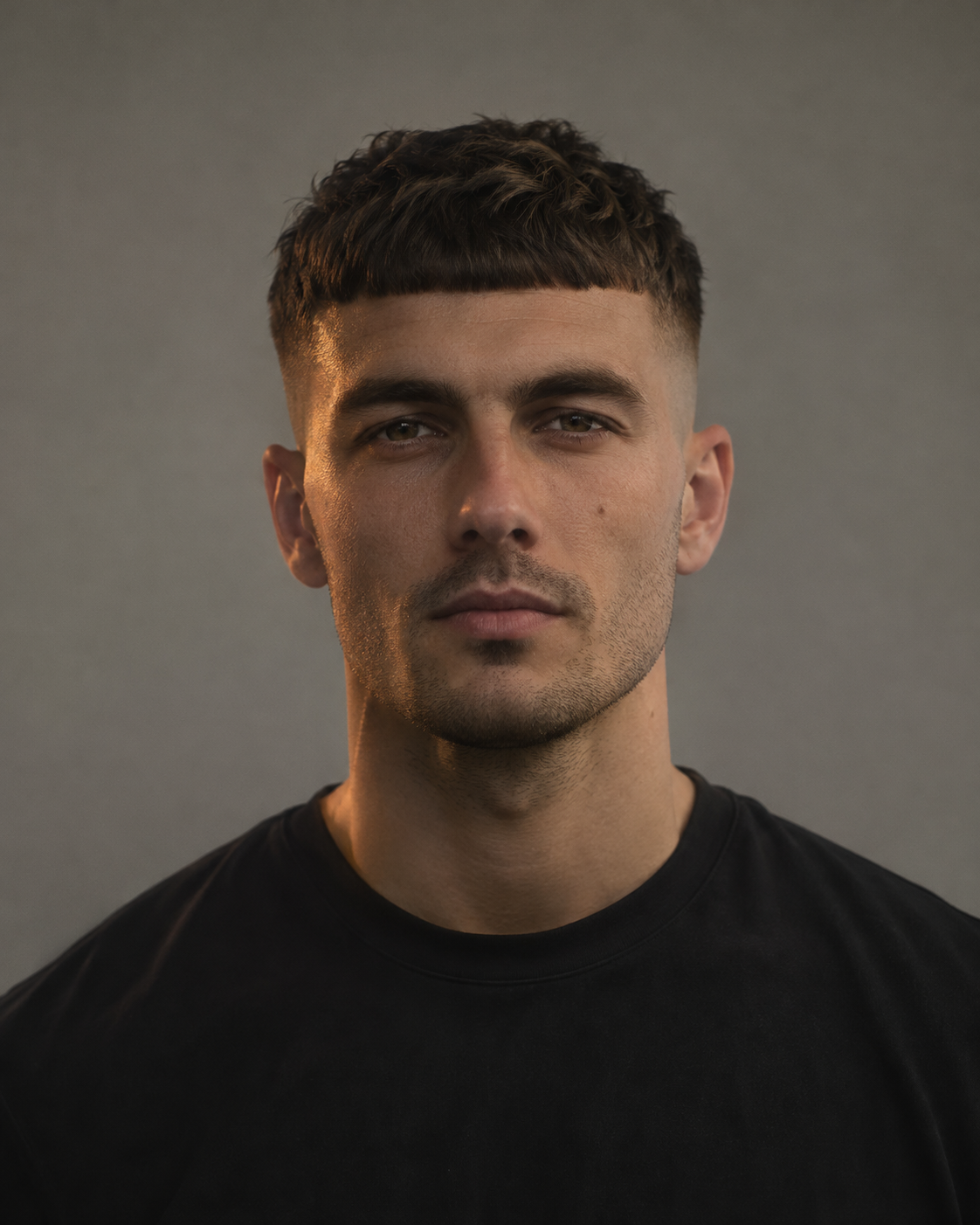
This is the cut everything else in the list is a variation of. The top is cropped short with a blunt fringe cut straight across the forehead, and the sides drop away in a high fade so the shape reads as one clean block. It looks sharp without looking fussy, and it is the single easiest crop to ask for by name because every barber knows it.
Dials: short fringe / blunt edge / high fade
Ask for: “A French crop — blunt fringe, high fade, leave a little length on top.”
Styling: A pea of matte clay, raked forward with your fingers. Thirty seconds.
Back to the barber: Every 2 to 3 weeks; the high fade is what dates it when it grows.
2. Curly Messy Textured Crop With a Low Fade
Best for: Natural curl that you have been fighting

Curls do the messy work on their own here, so the cut only decides where they sit. Weight is left on top so the curls fall forward in a ragged line, and the sides drop into a low fade that makes the top look fuller by contrast. The lower the fade sits, the softer the whole thing reads.
Dials: medium fringe / natural edge / low fade
Ask for: “Keep the weight on top, clean up the sides and neckline only.”
Styling: Curl cream or light mousse into damp hair, then leave it alone while it dries. Touching it while it dries is what causes frizz.
Back to the barber: Every 4 to 5 weeks.
3. Point-Cut Fringe on a Low Taper
Best for: Men who want the crop to look grown into rather than freshly cut

Nothing in this one has a hard line. The fringe is point cut so the front edge breaks into uneven ends, and the sides taper gently around the ear rather than stopping at a fade line. On dark hair the texture shows as shadow between the pieces, which means you get visible shape without needing any shine at all.
Dials: medium fringe / point-cut edge / low taper
Ask for: “Point cut the fringe instead of cutting it straight, and taper the sides — no fade line.”
Styling: Matte paste through dry hair, pushed forward, then left rough.
Back to the barber: Every 5 to 6 weeks — the softest crops are also the most forgiving.
4. Short Spiky Crop With a Mid Fade
Best for: Thick hair that stands up whether you ask it to or not

Thick hair with natural lift is wasted on a flat cut. Here the top is left just long enough at the front to stand, the sides fade at the midpoint of the head, and the spikes are pushed forward rather than straight up — forward reads modern, straight up reads 2003.
Dials: short fringe / point-cut edge / mid fade
Ask for: “Short enough at the front to stand up, mid fade on the sides.”
Styling: Wax or firm paste, warmed between the palms first so it goes on thin.
Back to the barber: Every 3 weeks.
5. The Messy Textured Crop for a Receding Hairline
Best for: Temple recession you have been combing around
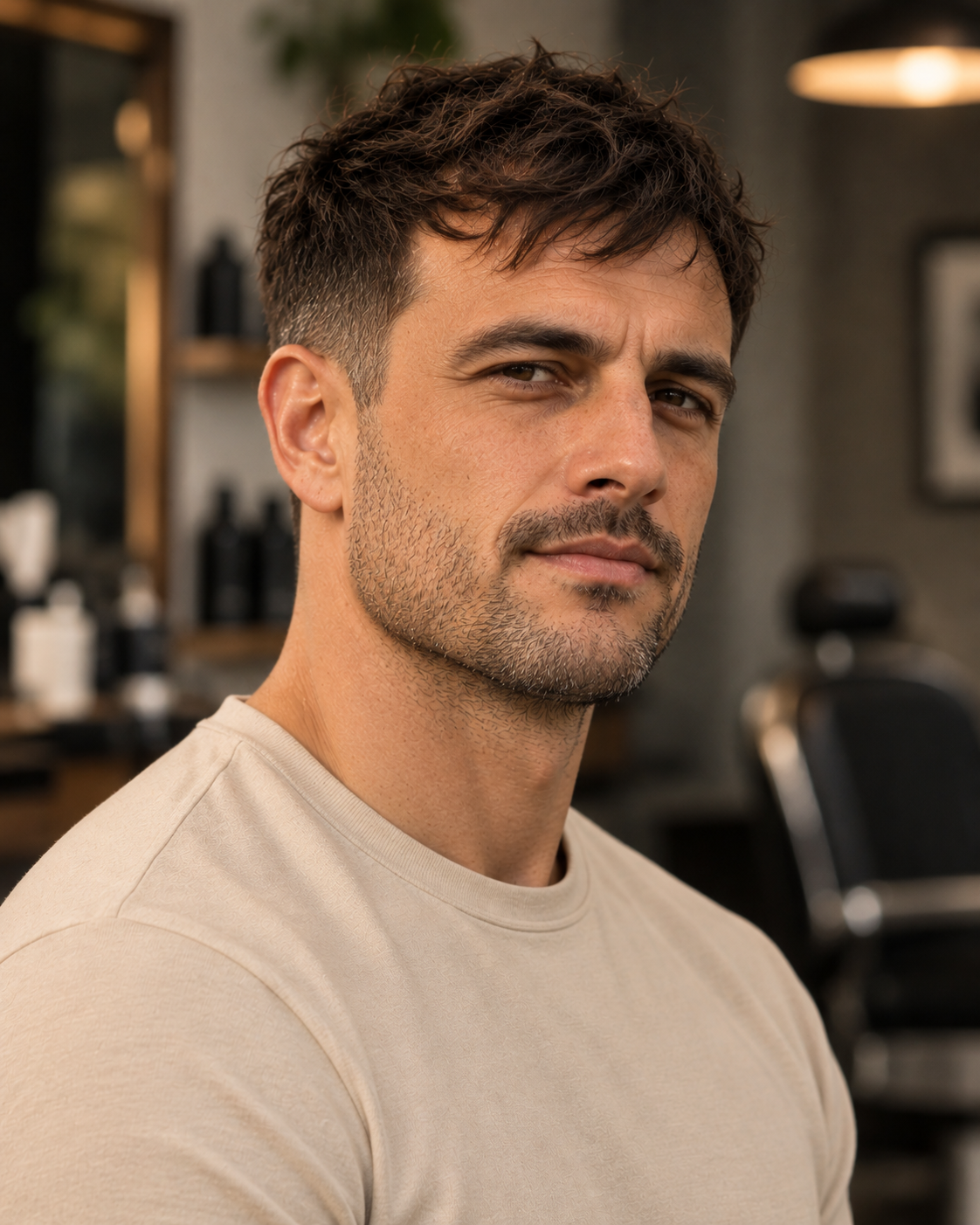
The single most useful cut on this list. The fringe is cut forward and kept slightly longer at the corners, so it covers the temporal recession rather than framing it. The sides stay short but stop short of a skin fade, because too much contrast draws the eye straight up to the hairline. Texture through the fringe keeps it from sitting as a flat curtain, which is what makes a comb-forward look obvious.
Dials: longer fringe / point-cut edge / low to mid fade
Ask for: “Keep the fringe forward and leave the corners a bit longer. Low fade, nothing too tight.”
Styling: Matte product only — shine makes a thinner hairline read as thinner. Push forward, never back.
Back to the barber: Every 3 to 4 weeks.
6. Chunky Piecey Crop With a Full Beard
Best for: Thick, coarse hair and a beard you are not giving up

Thick sections are twisted together on top so the hair reads as rope rather than as a combed mass, while the sides fade out clean and a full beard fills the lower face. The high fade is doing load-bearing work here: with a beard this full, anything less and the head starts to look heavy from the jaw down.
Dials: medium fringe / chunky point-cut edge / high fade
Ask for: “Leave the chunky texture on top, do not thin it out. High fade, and keep the beard following the jaw.”
Styling: Light clay worked through in sections, twisting the front pieces between your fingers.
Back to the barber: Every 2 to 3 weeks — mostly for the beard line.
7. Wavy Swept Crop With a Taper
Best for: Loose waves that fall forward on their own
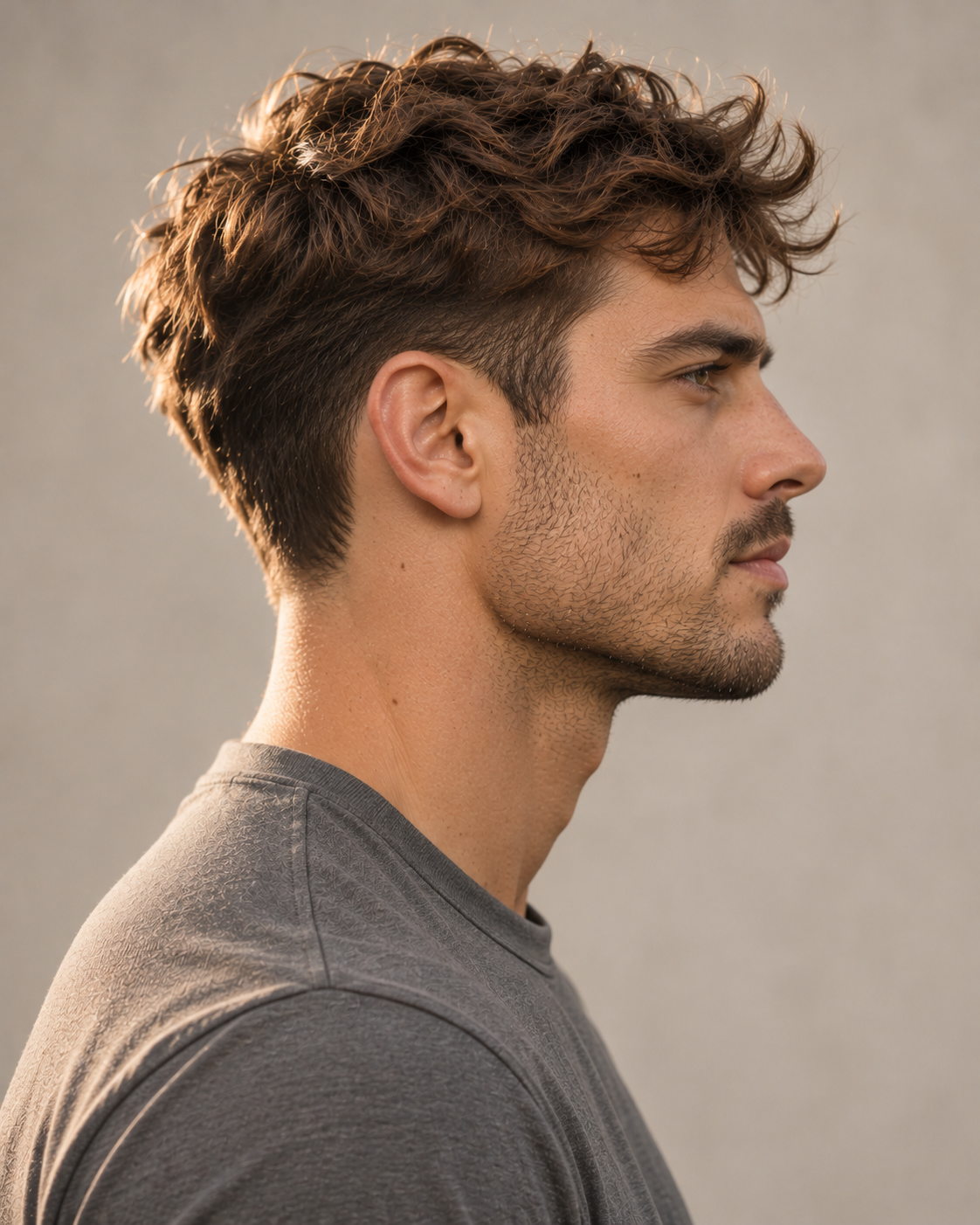
A slight natural wave is easier to work with than dead-straight hair, and this cut leans into it rather than flattening it out. The top is pushed up and forward with loose ends flicking out at the front, and the sides taper tight around the ear and neck so every bit of volume stays on top where it is useful.
Dials: medium fringe / natural edge / tight taper
Ask for: “Taper tight at the ears and neck, keep the length and the wave on top.”
Styling: Rough dry with your fingers and a dryer, lifting at the roots, then clay from back to front. Skip the comb entirely.
Back to the barber: Every 4 weeks.
8. The Choppy Bowl Crop
Best for: Straight, heavy hair that holds a line

A bowl shape with the flatness taken out of it. The fringe sits straight across the forehead, but the texture inside it is broken up so it never reads as a solid block, and the sides are faded short underneath. It is a strong, graphic shape that needs straight hair to work — on wavy hair the line will not hold past the first humid afternoon.
Dials: short-to-medium fringe / blunt outline, chopped inside / short fade
Ask for: “Bowl shape at the front, but chop into the fringe so it is not flat.”
Styling: A little paste, fingers, out the door. The cut does the work.
Back to the barber: Every 3 weeks; the shape depends on the line staying exact.
9. Messy Textured Crop for Fine, Straight Hair
Best for: Hair that goes flat by midday no matter what you put in it

Fine hair cannot be given texture by product — product is weight, and weight is the enemy. Texture has to be cut in. Here the top is layered short with heavy point cutting through the ends so the pieces separate on their own, and the sides are kept tight to make the top look denser than it is. The fringe stays short, because length on fine hair is length that lies down.
Dials: short fringe / heavy point-cut edge / high fade
Ask for: “Point cut through the top to break it up. Keep it short — I do not want it lying flat.”
Styling: Sea salt spray on damp roots, rough dried. Then stop. Clay and wax will undo it.
Back to the barber: Every 3 weeks — fine hair loses its shape fastest.
10. Long Tousled Fringe on a Tight Taper
Best for: Pairing a loose top with a collar and jacket

Proof the mess holds up dressed. The fringe runs long and falls forward and across to one side, while the sides are cut short and tapered so the contrast stays sharp under a jacket collar. The appeal is entirely in the mismatch: tailored below, slept-on above.
Dials: long fringe / point-cut edge / tight taper
Ask for: “Keep the fringe long and sweeping, tapered short at the sides.”
Styling: Texture spray through damp hair, dried forward and to one side with your fingers.
Back to the barber: Every 4 weeks — and book it the moment the fringe reaches your lashes, because past that it stops looking deliberate.
11. Coily Textured Crop With a Twisted Top
Best for: 4A to 4C hair you want short but defined
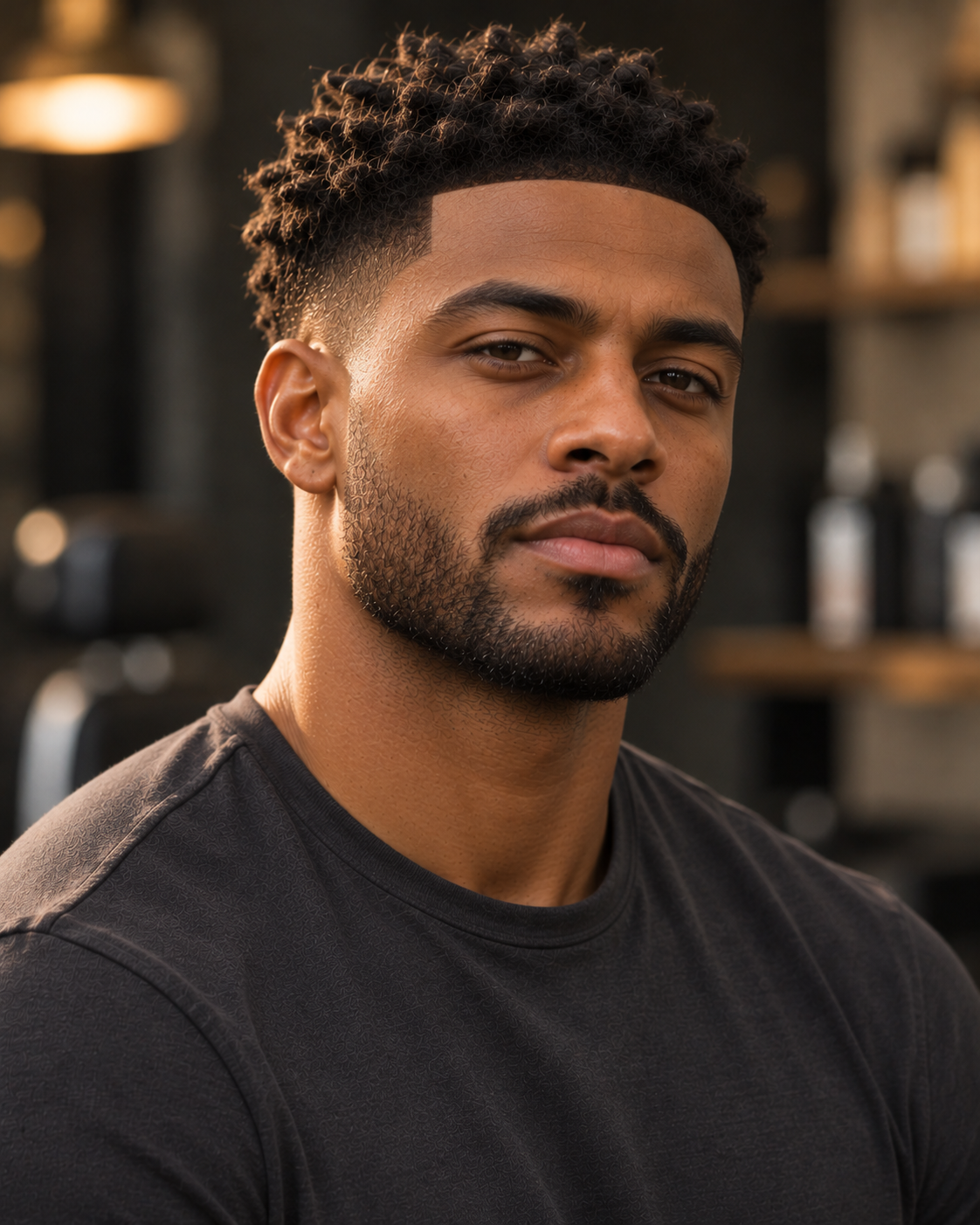
Coily hair holds a crop better than any other texture, because it stands rather than falls — the shape stays where the barber left it. The top is kept short and worked into defined twists with a twist sponge, and a clean taper at the sides and neckline frames it. The key instruction is about the line, not the length: a sharp, straight edge-up at the front is what separates this from simply short hair.
Dials: short fringe / defined coil texture / taper with a sharp line-up
Ask for: “Keep the length on top, taper the sides, and give me a clean line-up at the front.”
Styling: Leave-in moisturiser on damp hair, then a twist sponge in small circles. Sleep in a durag to keep the definition overnight.
Back to the barber: Every 2 to 3 weeks for the line-up.
12. Thinning Crown Messy Textured Crop
Best for: A crown that is showing more scalp than it used to
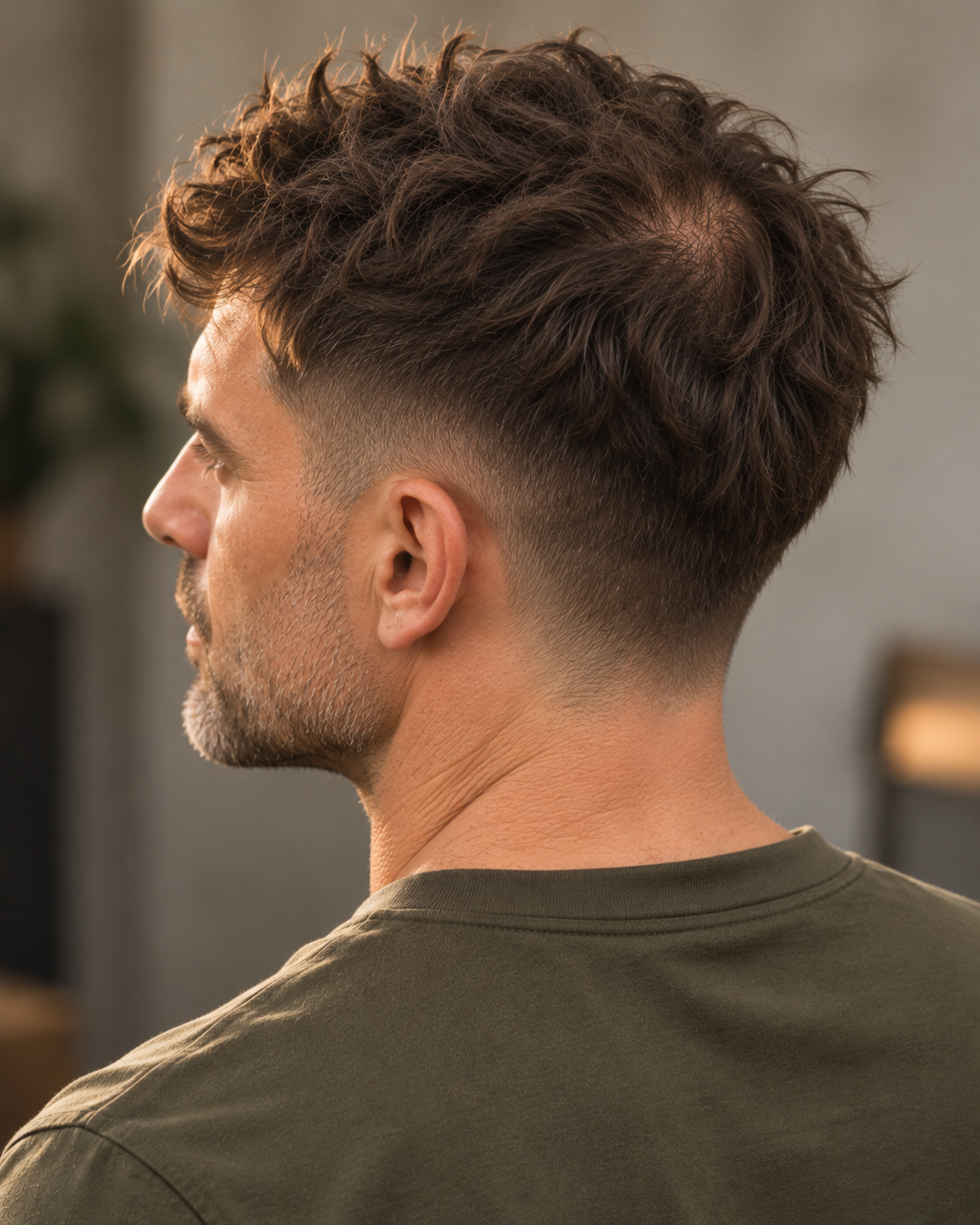
The crown needs the opposite treatment to the sides. Length is kept through the top and back so the hair has something to lie across, and the sides are faded to create contrast without ever going short on the crown itself — cutting the crown down is what makes scalp visible under overhead light. Texture through the length breaks up the surface so the eye reads shadow instead of skin.
Dials: medium fringe / point-cut edge / mid fade, length kept at the crown
Ask for: “Keep the length through the crown and back. Fade the sides but do not take the top down.”
Styling: Matte clay only, worked in at the roots for lift. Avoid anything with shine, and avoid combing a parting in.
Back to the barber: Every 4 weeks.
13. Wild Jagged Crop on a High Skin Fade
Best for: Making the mess look like a decision

Maximum contrast. The top is tossed and jagged with the fringe chopped at an angle across the forehead, and the sides drop away to skin fast and high. The tight fade is the entire reason this works — the top can be as wild as you like as long as the edges around it are immaculate, because that is what tells people it was cut this way on purpose.
Dials: medium fringe / heavily chopped edge / high skin fade
Ask for: “High skin fade, and chop the top up — I want it uneven on purpose.”
Styling: Dry clay, worked in with your fingertips in different directions.
Back to the barber: Every 2 weeks. A skin fade grows out faster than any other side.
14. The Salt-and-Pepper Crop
Best for: Grey coming in, and leaning into it
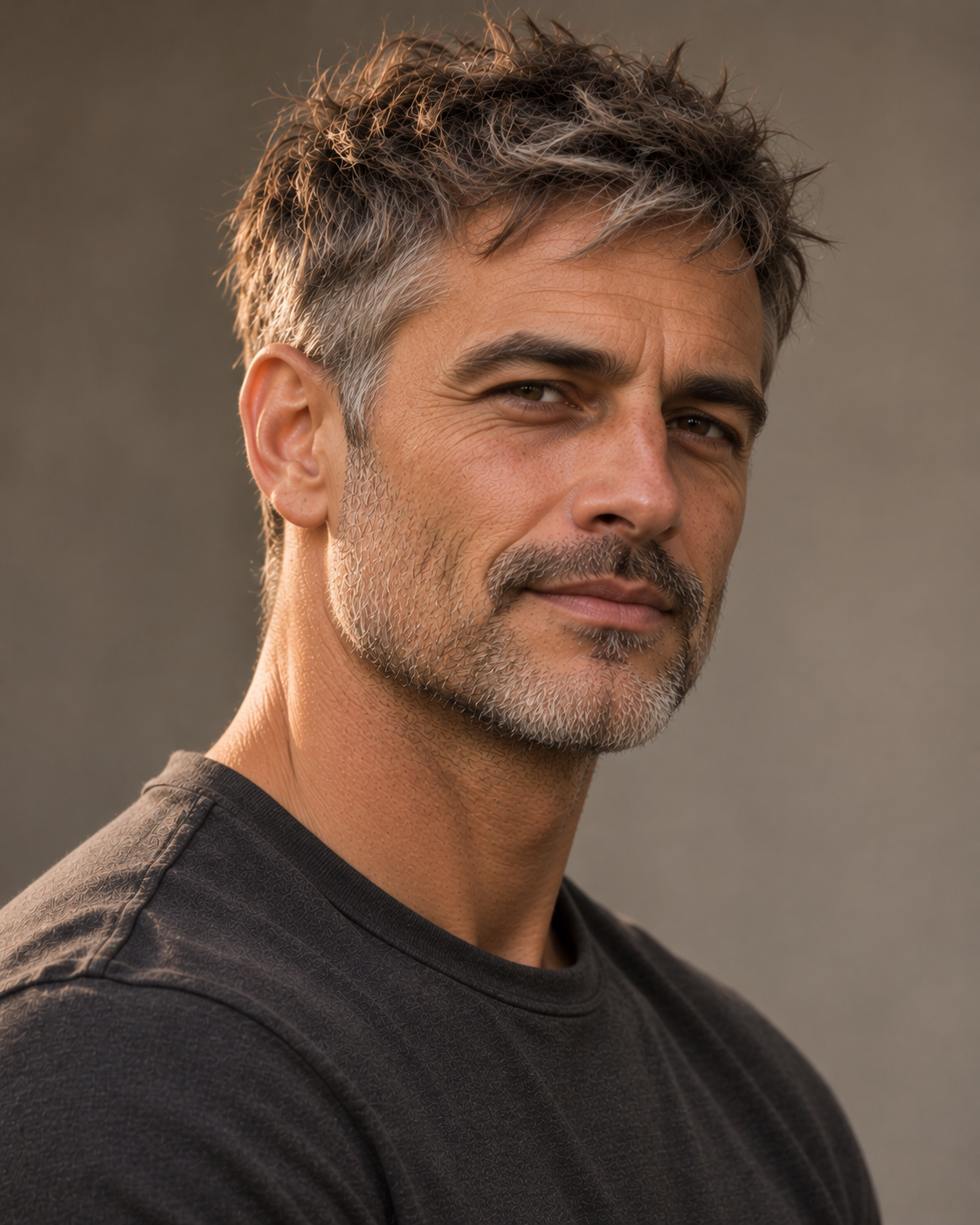
Grey hair is coarser and often finer at once, which means it takes texture well but loses shape quickly. A short crop with a soft point-cut fringe suits it better than anything longer, and keeping the sides tapered rather than skin-faded stops the look tipping severe. The mixed tone does something useful here that dyed hair cannot: the colour variation makes every separated piece visible on its own.
Dials: short fringe / point-cut edge / taper
Ask for: “Short crop, soft fringe, taper the sides — nothing too severe.”
Styling: A small amount of matte cream, which handles coarse grey better than clay does.
Back to the barber: Every 3 to 4 weeks.
15. Grown-Out Natural Curls, No Fade
Best for: Curl that you want to dry on its own and forget about

A crop without a fade anywhere. Loose curls sit on top and fall around the ears, the sides are left soft instead of cut tight, and the whole thing is shaped rather than faded. It still counts as a crop because the top is cut forward — and it is the best option if you want something that looks the same on day two as it did on day one.
Dials: medium fringe / natural edge / no fade, softly shaped sides
Ask for: “Shape it, do not fade it. Keep the sides soft and take the weight out of the back.”
Styling: Air dry. That is the entire routine.
Back to the barber: Every 6 to 8 weeks.
16. Blond Spiky Crop With Extra Length
Best for: Light hair, where texture shows up most

This runs longer than most crops here, with strands pushed up in several directions and the back left slightly longer than the sides. Light hair is the ideal canvas for it, because blond shows every separated piece where dark hair swallows the detail. At this length the product decides the result more than the cut does.
Dials: long fringe / point-cut edge / taper, longer at the back
Ask for: “Longer on top with the back left a touch long. Taper above the ears.”
Styling: Texture spray for softer, airier spikes on damp hair; clay for sharper, separated pieces on dry hair. Not both.
Back to the barber: Every 5 weeks.
17. Dimensional Crop With Soft Highlights
Best for: Brown hair that reads as one flat colour

Colour doing the work that texture usually does. The top is long enough for feathered pieces to sweep forward, and warm, lighter tones run through the brown so each piece separates visually even before any product goes in. The sides fade low, and a short beard keeps the whole thing anchored.
Dials: medium fringe / feathered edge / low fade
Ask for: “Layered top, longest at the front, and soft warm highlights through the brown — nothing stripey.”
Styling: Matte texture product, rough dried into shape.
Back to the barber: Every 4 weeks for the cut, 8 to 10 for the colour.
18. Feathered Crop With a Tapered Nape
Best for: Straight hair, and a bit of length at the back

The top here is feathered rather than chopped — fine, layered pieces all lying forward in the same direction, with a short fringe sitting just off the forehead. The fade cuts in tight around the ear, then the nape keeps some length instead of going bare, which gives it a slight edge without going anywhere near a mullet.
Dials: short fringe / feathered edge / tight fade at the ear, tapered nape
Ask for: “Feather the top forward, fade at the ears, but leave the nape tapered rather than bare.”
Styling: Light cream through damp hair, dried forward with a flat hand.
Back to the barber: Every 4 weeks.
19. The Cowlick-Friendly Crop
Best for: A front cowlick that lifts your fringe no matter what

A cowlick at the front hairline will push a fringe up and split it — and mid-lengths are the worst possible choice, because the hair is long enough to be lifted but too short to be held down. The fix is to commit in one direction. This version goes short, so the cowlick has nothing to grab, and the texture across the front is cut irregular so the split reads as part of the look.
Dials: short fringe / irregular point-cut edge / mid fade
Ask for: “I have a cowlick at the front. Cut it short enough that it cannot lift, and break the fringe up so it is not fighting one direction.”
Styling: Clay worked in against the cowlick’s direction first, then forward.
Back to the barber: Every 3 weeks — the day it gets long enough to lift is the day to go back.
20. Short Crop With a Full Beard
Best for: A heavy beard that needs balancing
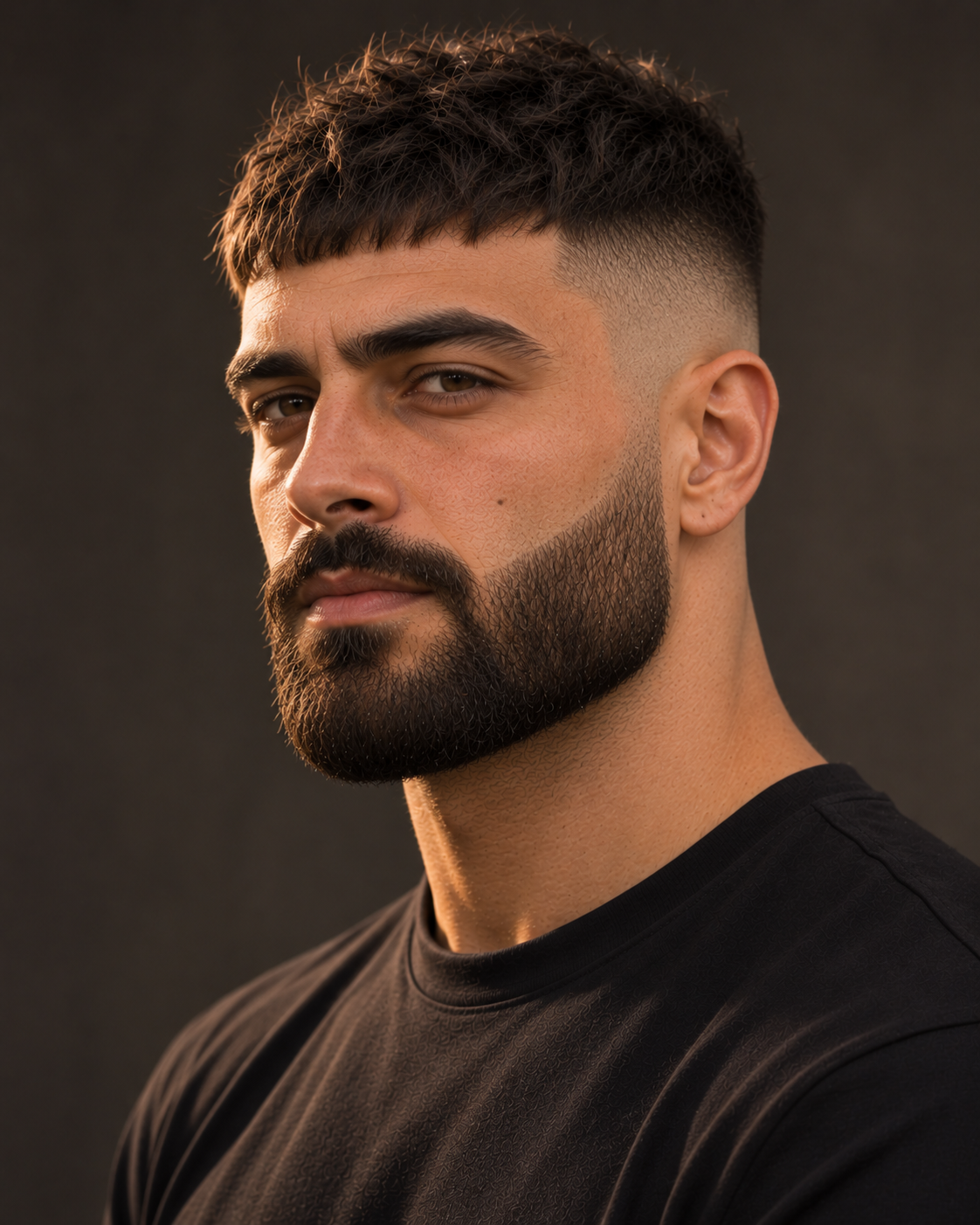
Short top, full beard, and nothing competing. The hair is cropped close with a blunt fringe just above the brows and plenty of rough texture through the top, while a high fade clears the sides so the beard carries the lower half of the face on its own. It works because neither half is fighting the other — but the beard needs a sharp cheek line, or the whole thing reads unfinished.
Dials: short fringe / blunt edge, rough inside / high fade
Ask for: “Short and rough on top, high fade, and give me a clean cheek line on the beard.”
Styling: A small amount of clay on the top, beard oil through the beard.
Back to the barber: Every 2 to 3 weeks.
21. The Everyday Messy Textured Crop
Best for: Your first crop

Start here. The top is short and loosely tousled with the fringe falling forward, the sides fade softly with no hard line anywhere, and the whole thing grows out gracefully instead of falling apart at week three. It is the version you can ask for on an ordinary Tuesday and the version that forgives a barber who has not cut your hair before.
Dials: medium fringe / soft point-cut edge / soft low fade
Ask for: “A longer top than you think I need, thinned out, with a soft fade — no hard lines.”
Styling: Rake your fingers through it. Optional product.
Back to the barber: Every 4 to 6 weeks.
What to Actually Say at the Barber
Photos help, but the right few sentences get you closer to a messy textured crop than a photo alone does, because they tell the barber what you want kept rather than what you want removed.
- “Cut the top forward, not back.” This is the sentence that makes it a crop. Say it first.
- “Point cut the fringe.” Asks for the broken, uneven front edge instead of a straight line. If you want the sharp version instead, say “blunt fringe, cut straight across.”
- “Taper the sides” versus “fade the sides.” A taper is a gradual shortening with no visible line. A fade is a blend down to a set height, and a skin fade goes to bare. These are three different requests — name the one you want.
- “Leave the weight on top.” Stops a barber thinning out the hair that is supposed to carry the texture. Say it before they pick up thinning shears, not after.
- “Keep the fringe corners longer.” The hairline sentence from entry 5. Worth saying even if your hairline is only starting to go.
If you are between two lengths, ask for the longer one. Every crop here can be taken shorter in the chair; none of them can be put back.
Product Cheat Sheet by Hair Type
| Hair type | Use | Avoid | Why |
|---|---|---|---|
| Fine, straight | Sea salt spray, light texture powder | Clay, wax, pomade | Weight flattens fine hair faster than anything else |
| Thick, straight | Matte clay, firm paste | Mousse | Thick hair needs hold, not lift |
| Wavy | Matte paste, texture spray | Heavy pomade | Enough hold to shape the wave, not enough to drown it |
| Curly | Curl cream, light mousse | Clay, drying gels | Curls need moisture; clay separates them into frizz |
| Coily (4A–4C) | Leave-in moisturiser, twist sponge | Alcohol-heavy gels | Definition comes from moisture and the sponge, not hold |
| Thinning or receding | Matte clay, dry texture spray | Anything with shine | Shine reveals scalp; matte product hides it |
| Grey or coarse | Matte cream | Hard clay | Grey hair is coarse and takes a softer product better |
One rule across all of them: warm the product between your palms until it goes thin and clear before it touches your hair. Product applied cold sits in one spot.
FAQ
What is the difference between a French crop and a messy textured crop?
A French crop is one specific setting of the dials — short blunt fringe, high fade. A messy textured crop is the broader family, and most versions of it are point cut rather than blunt, which is what makes them read softer. Every French crop is a crop; not every crop is French.
Will a messy textured crop work if my hair is thinning?
It is probably the best cut you can get. The fringe is cut forward, so it covers temple recession rather than exposing it, and the broken texture reads as more hair than a flat shape does. Male pattern hair loss is extremely common and treatable if you catch it early, so a dermatologist is worth a visit if the recession is bothering you — but on cut day, use matte product only, since shine is what gives thinning hair away.
How short is too short for a messy textured crop?
Once the top is short enough that you cannot push the front pieces forward with your fingers, it has stopped being a crop and started being a buzz cut with a fade. For most hair types that line sits somewhere around a centimetre at the front.
How often do I need to get it cut?
It depends entirely on the sides, not the top. A skin fade needs re-cutting every 2 weeks, a mid or low fade every 3 to 4, a taper every 4 to 5, and a softly shaped crop with no fade will hold for 6 to 8 weeks.
Can I get a messy textured crop with a cowlick?
Yes, but commit to short or long and skip the middle. Mid-length fringes are long enough for a cowlick to lift and too short for weight to hold them down, which is the exact combination that makes a fringe split. Entry 19 covers the short version.
The Bottom Line
The messy textured crop survives trend cycles because it is not really one haircut — it is three dials, and almost every man has a setting that suits him. Get the fringe cut forward, pick an edge, pick a side height, and you have a cut that takes thirty seconds in the morning and forgives the mornings you skip it.
If you want something with more length to work with, our guide to flow haircuts with beards covers the opposite end of the range. For something you can take into an office without thinking about it, start with our professional men’s hairstyles guide instead.


