
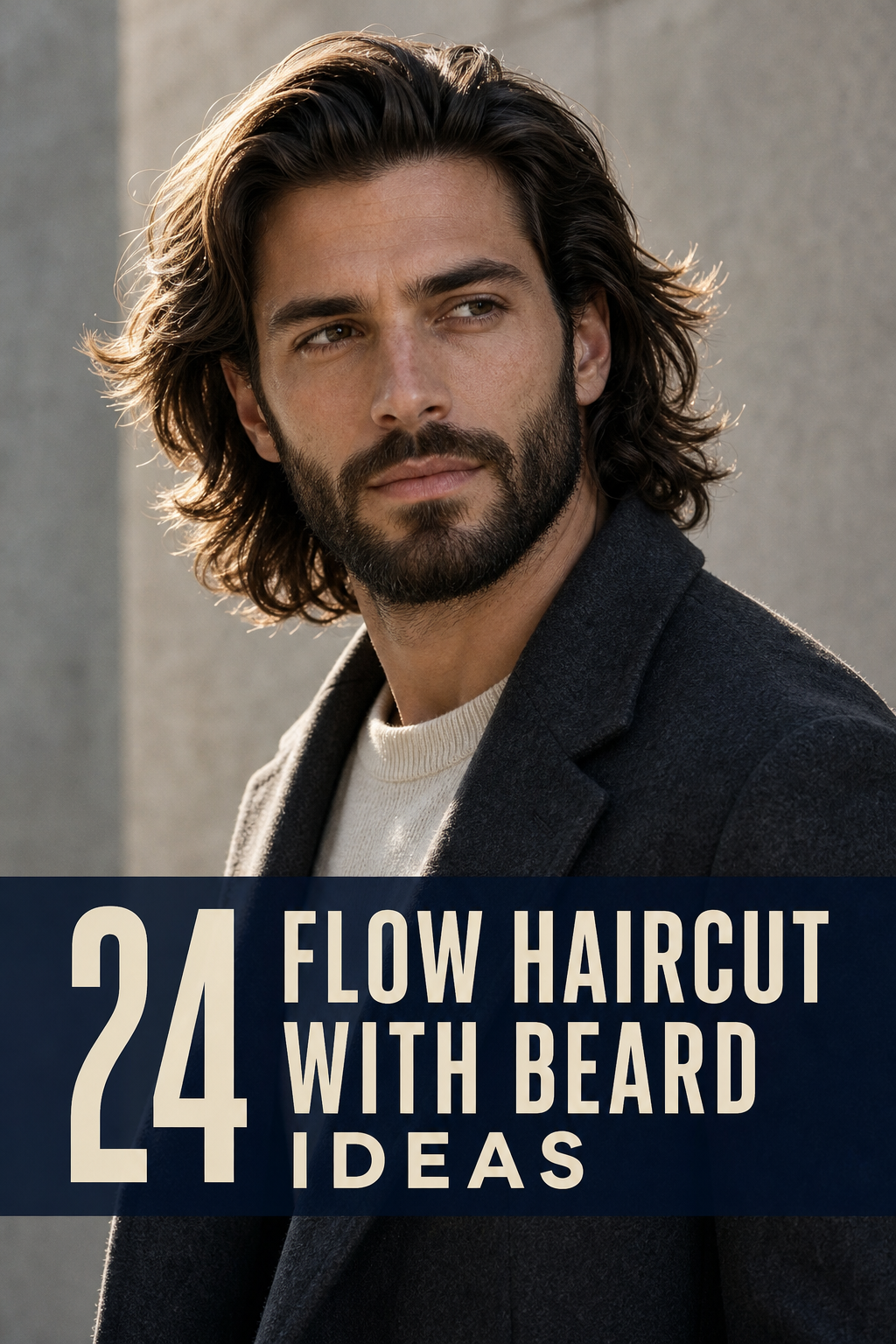
24 Flow Haircut with Beard Ideas Men Are Actually Getting Right Now
You cannot get a flow haircut with beard in one sitting, and that is the single most useful thing nobody tells you.
Flow is not a cut. It is a length — closer to what barbers sometimes call a shag-adjacent grow-out than a repeatable cut. No barber can hand it to you the way they can hand you a fade or a crop — they can only shape what you have already grown and point you toward the next stage. Which means the real work happens in month three, when the hair is sitting on your ears doing absolutely nothing, and you have to decide whether to keep going or give up and buzz it.
Most men give up there. The ones who stick with a flow haircut with beard end up with the looks below.
The beard is what carries you through that gap. A well-kept beard gives your face structure while the hair is still figuring itself out, and once the flow actually arrives, the two have to stay in proportion — which is its own skill, and the part most guides skip entirely.
The 24 flow haircut with beard ideas below are sorted by hair texture and length rather than by vibe, because what you can realistically achieve depends almost entirely on what grows out of your head. Each one lists what to ask for, how to style it, and how often to go back.
Before the list: three things that decide everything
The growing-out timeline is the whole game
- Months 0–2 — the dead zone. Nothing looks like anything. Keep the beard sharp, because it is doing all the work right now.
- Months 3–4 — the flare. Hair hits the ears and pushes outward instead of back. This is where most men quit. Ask your barber to take weight out of the sides without shortening the length and it passes faster.
- Months 5–7 — real flow. Length reaches the collar, gravity takes over, and it finally falls back on its own.
- Months 8+ — long flow. Shoulder length territory. Needs a trim every 10–12 weeks or the ends go scraggly.
Your hair texture decides which flow you get
- Straight — falls back cleanly but goes flat fast. You need layers for lift, and product is not optional.
- Wavy — the easiest texture for this, and the one in most of the reference photos. Minimal effort, maximum movement.
- Curly (2C–3C) — flow grows outward before it grows down. Expect an extra two months, and never let a barber use clippers on the top.
- Coily (4A–4C) — flow here means length and shape, not a falling wave. It works beautifully, but it is a different silhouette and needs daily moisture.
The beard proportion rule
This is the one nobody says out loud: as the hair gets longer, the beard needs to get tighter. Long hair and a long beard together read as one solid mass with a face somewhere in the middle. If you want both long, keep the beard narrow at the cheeks so the jaw still has an edge. If the hair is at collar length or beyond, a short boxed beard or heavy stubble will almost always look sharper than a full one.
And the quick face-shape version: round faces want height and a longer beard to lengthen the face. Long or oblong faces want width at the sides and a shorter beard. Square jaws can carry almost anything. Heart shapes want weight at the bottom, so a fuller beard and hair tucked behind the ears.
24 Flow Haircut with Beard Ideas
1. The Starter Flow with a Short Boxed Beard
Best for: Anyone at the three-month mark wondering whether to quit.
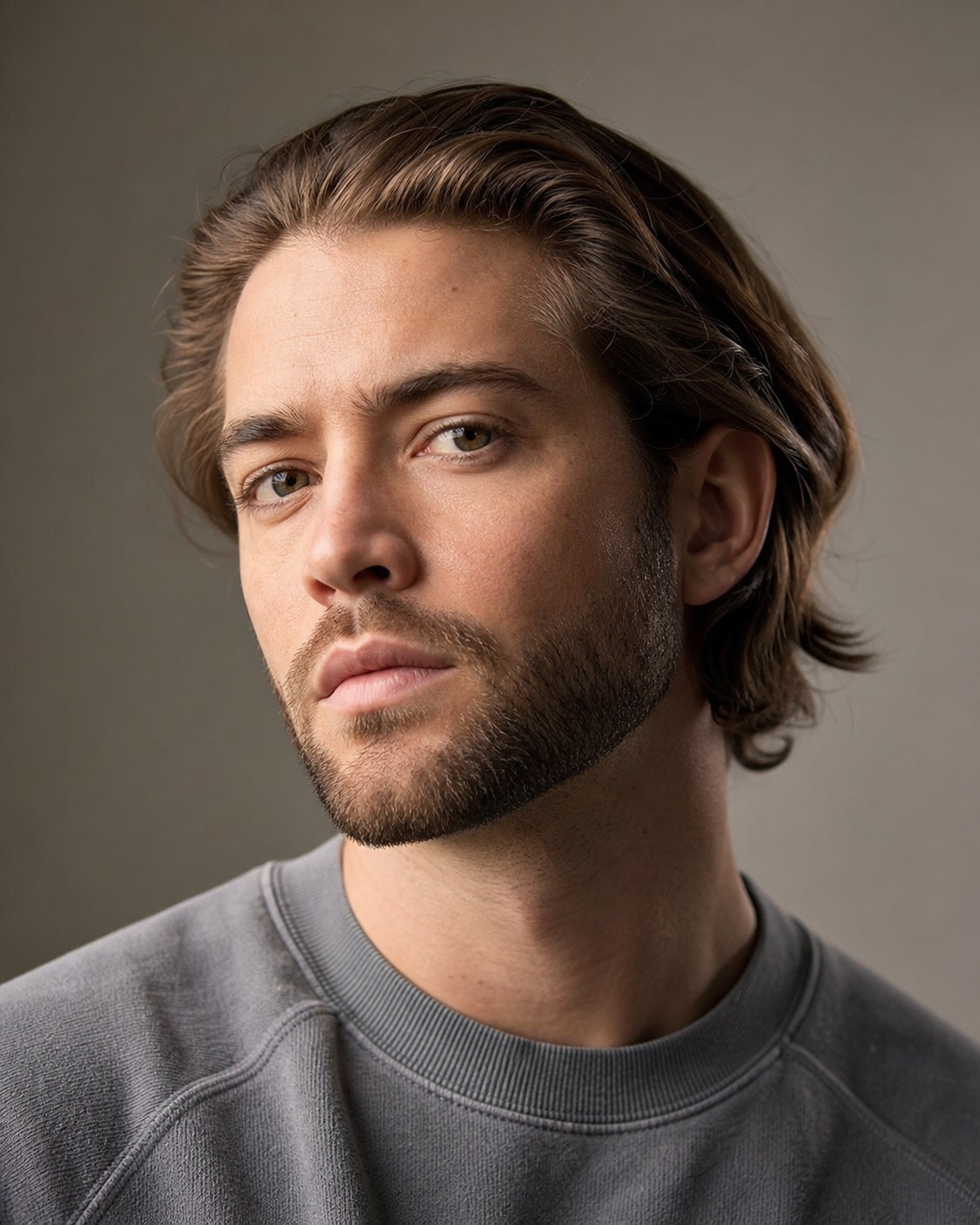
This is the stage that gets photographed least and needs the most help. Hair clears the ears but has not reached the collar yet, so it wants to sit outward rather than back. A short boxed beard — squared along the jaw, cleaned at the neck — gives the face a defined bottom edge while the top half is still in transition. That contrast is the entire trick. It makes an awkward length read as deliberate instead of neglected, and it buys you the two months you need.
Ask for: “I’m growing it out. Don’t shorten it — clean my neckline, take some weight out of the sides, leave the length.”
Styling: Damp hair, a pea-sized amount of light cream, push back with your hands and let it fall. No comb.
Back to the barber: Hair every 8–10 weeks. Beard neckline every 2 weeks.
2. Classic Mid-Length Flow with a Full Beard
Best for: Wavy hair, oval or square faces, guys who want the full version.

This is the reference picture most men already have in their head. Hair reaches the collar, sweeps back off the forehead, and curls out at the ends. A full beard follows the jaw and connects cleanly to the mustache. It works because the volume up top and the density below sit in balance — neither is competing for attention. The one thing that kills it is a beard left to grow wild at the neck, which collapses the whole silhouette into a single shape with no jawline in it.
Ask for: “Long layers through the back, keep my perimeter, soften the sides so it falls back instead of out.”
Styling: Sea salt spray on damp hair, rough dry with your fingers, matte cream at the roots for lift.
Back to the barber: Hair every 10–12 weeks. Beard shaped every 3 weeks.
3. Wavy Flow with Tapered Stubble
Best for: Patchy beard growth, and anyone who wants the look without the beard upkeep.

Not everyone grows a full beard, and pretending otherwise is why a lot of men end up with a thin, see-through beard they keep apologising for. Heavy stubble held at two to three millimetres solves it completely. It reads as a deliberate choice rather than a failed beard, it shadows the jaw and adds definition, and against mid-length waves it keeps the face from disappearing into hair. Taper it slightly shorter at the cheeks and leave it fuller at the chin.
Ask for: “Leave the length up top. For the beard, 3mm on the chin, 2mm at the cheeks, clean neckline two fingers above the Adam’s apple.”
Styling: Salt spray, air dry, run your hands back through it once it is 80% dry.
Back to the barber: Hair every 10 weeks. Stubble you maintain yourself weekly with a guard.
4. Middle Part Curtain Flow with a Faded Beard
Best for: Straight or slightly wavy hair, and anyone under about 35.

The centre part is back and it works far better with a beard than it did without one in its first life. Hair splits down the middle and falls in two soft curtains past the cheekbones, which can read a little soft on its own — the beard is what stops it. Fading the beard from short sideburns down to full density at the chin gives you a hard edge underneath all that movement. The transition is what makes it look current rather than dated.
Ask for: “Middle part, long soft layers around the face, and fade my beard from the sideburns down into the jaw.”
Styling: Blow dry with a round brush pulling away from the part, finish with a drop of hair oil on the ends.
Back to the barber: Hair every 8 weeks. Beard fade every 2–3 weeks — this one needs the barber.
5. Hockey Flow with a Squared Beard
Best for: Thick, dense hair and a strong jaw.
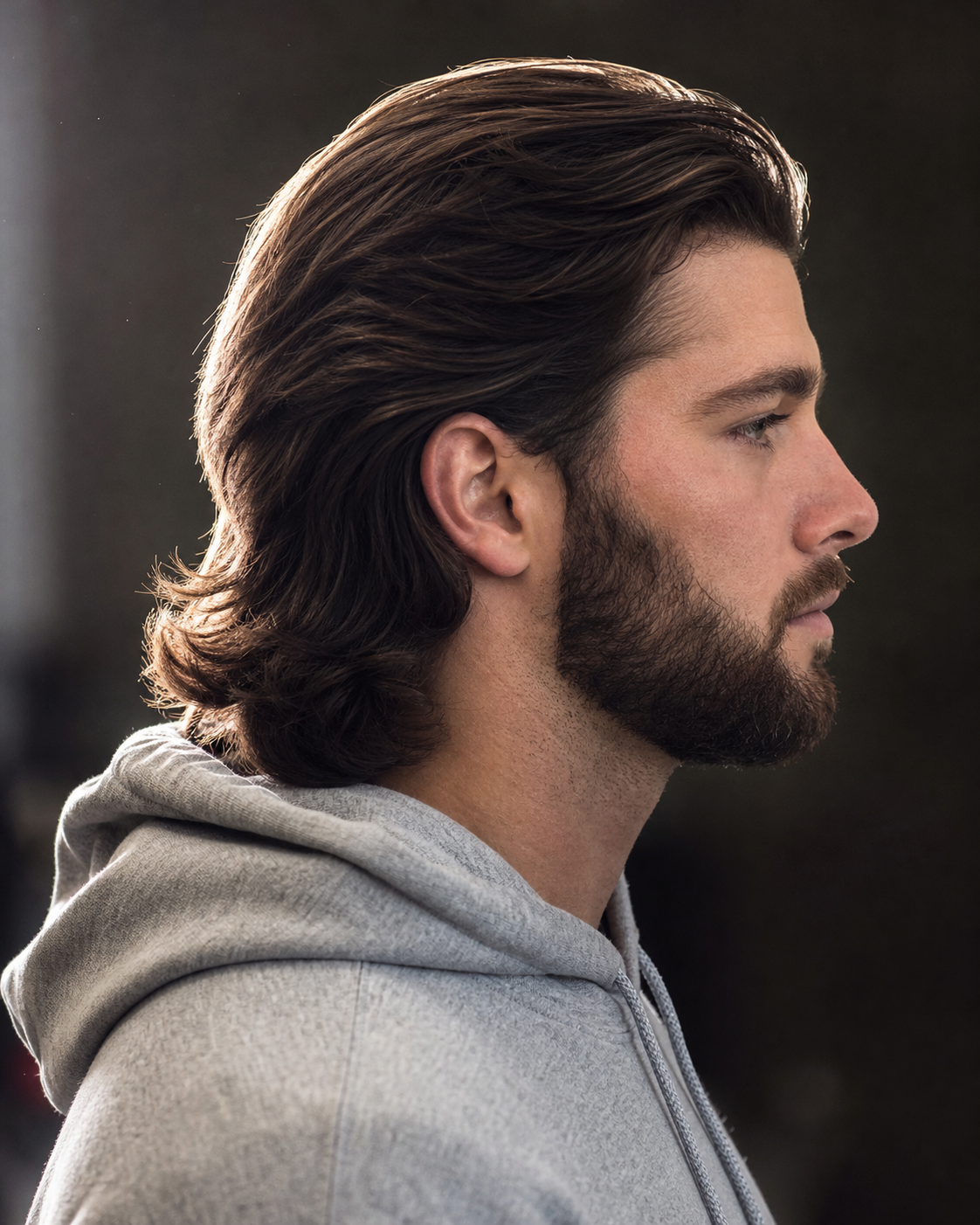
The hockey version is longer at the back than the sides, with enough weight that it actually moves when you do. It needs density to work — on fine hair it just hangs. Squaring the beard along the jaw rather than rounding it adds structure underneath all that volume and keeps the head from reading as a sphere. Keep the mustache slightly shorter than the chin so the whole thing has direction.
Ask for: “Medium to long layers, longer through the back, and square my beard along the jaw, shorter at the cheeks.”
Styling: Matte cream through damp hair for control without crunch. Let it dry naturally.
Back to the barber: Hair every 10–12 weeks. Beard squared every 3 weeks.
6. Surfer Flow with Sun-Lightened Ends
Best for: Wavy hair, lighter hair colours, and summer.

Lighter ends against a darker root make waves look twice as defined, which is the whole point of this one. Pair it with light stubble rather than a full beard — a heavy beard under sun-bleached hair makes the top look washed out and the bottom look heavy. Crisp up the cheek line so the stubble still reads as groomed. This is the most forgiving look on the list for guys who genuinely cannot be bothered with a morning routine.
Ask for: “Soft layers from the brow down to the collarbone, scissor-over-comb on the sides, nothing clipped.”
Styling: Sea salt spray, diffuser on low heat, or just let the air do it.
Back to the barber: Hair every 12 weeks. Stubble weekly at home.
7. Straight Hair Swept-Back Flow with a Sharp Beard Line
Best for: Straight hair that goes flat by lunchtime.
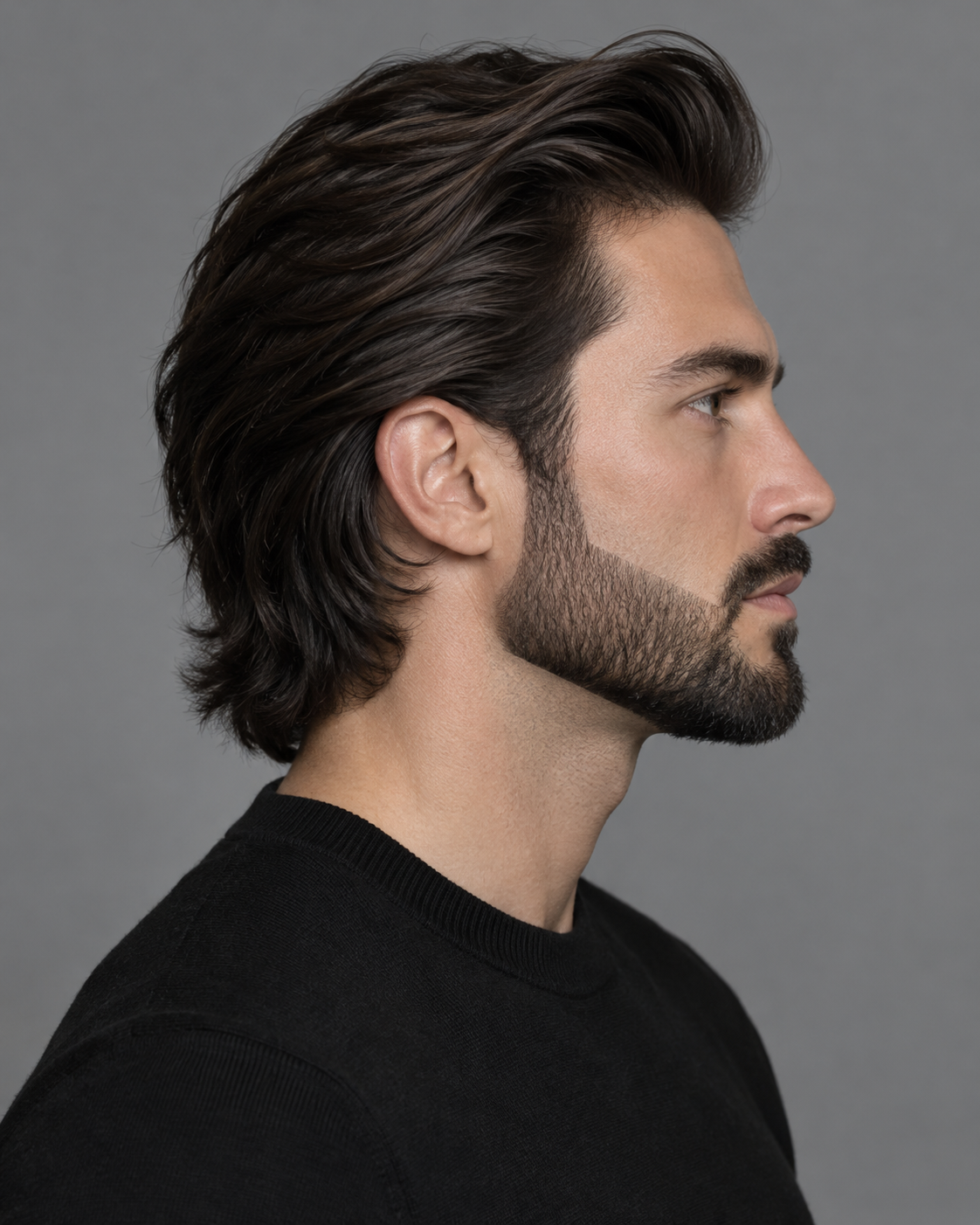
Straight hair is the hardest texture for flow because it has no natural reason to hold a shape. The fix is layers for lift and a hard line somewhere else on the face to carry the structure. A sharply lined beard — one clean curve along the jaw, defined cheek line, tight neck — does exactly that. The hair can be soft and swept back because the beard is doing the geometry.
Ask for: “Long layers for lift, keep the length. On the beard I want a defined cheek line and a crisp jaw.”
Styling: Blow dry back off the forehead with a round brush, then light pomade — not wax — to hold without flattening.
Back to the barber: Hair every 10 weeks. Beard line every 2 weeks.
8. Curly Flow with a Tapered Beard
Best for: 2C–3B curls, and guys who have been told curly hair “can’t do flow.”

It can — it just grows out rather than down for the first few months, so the volume arrives before the length does. The mistake is letting a barber thin it out with clippers or a razor, which destroys the curl pattern and leaves it frizzy. Long scissor layers remove weight while keeping the spring. Tapering the beard shorter at the cheeks stops the curls and the beard from merging into one mass at the sides of the face.
Ask for: “Cut it dry, long layers with scissors only, no thinning shears, no clippers on top. Taper the beard short at the cheeks.”
Styling: Curl cream on soaking wet hair, scrunch, diffuse or air dry. Never brush it dry.
Back to the barber: Hair every 12 weeks. Beard every 3 weeks.
9. Coily Flow with a Shaped Beard
Best for: 4A–4C hair, and a version of flow almost nobody writes about.
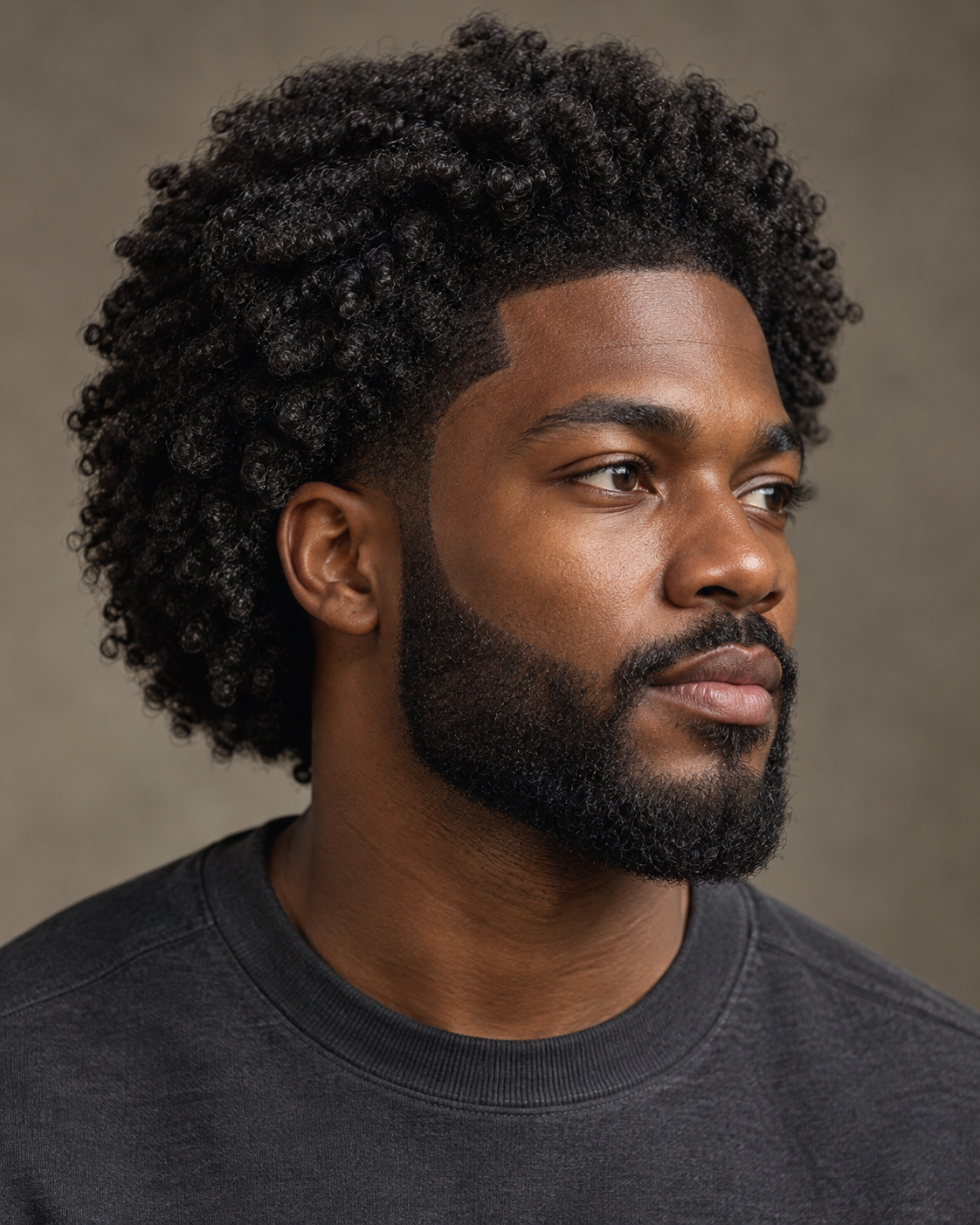
Flow on coily hair is not a falling wave — it is length with a deliberate shape, carried up and out, with the silhouette shaped by the cut rather than by gravity. Done properly it is one of the sharpest looks here. The beard should be shaped to echo the hairline, with a clean line-up at the temples connecting through to the beard so the whole frame reads as one intentional outline. Moisture is non-negotiable; dry coils lose shape immediately.
Ask for: “Shape it round and even, scissors only on top, line up my edges and connect them into the beard.”
Styling: Leave-in moisturiser daily, hair butter to seal, pick it out from the roots.
Back to the barber: Shape-up every 3–4 weeks — this one needs regular barber visits.
10. Shoulder-Length Flow with a Long Full Beard
Best for: Guys who have already committed, with thick hair and genuine beard density.
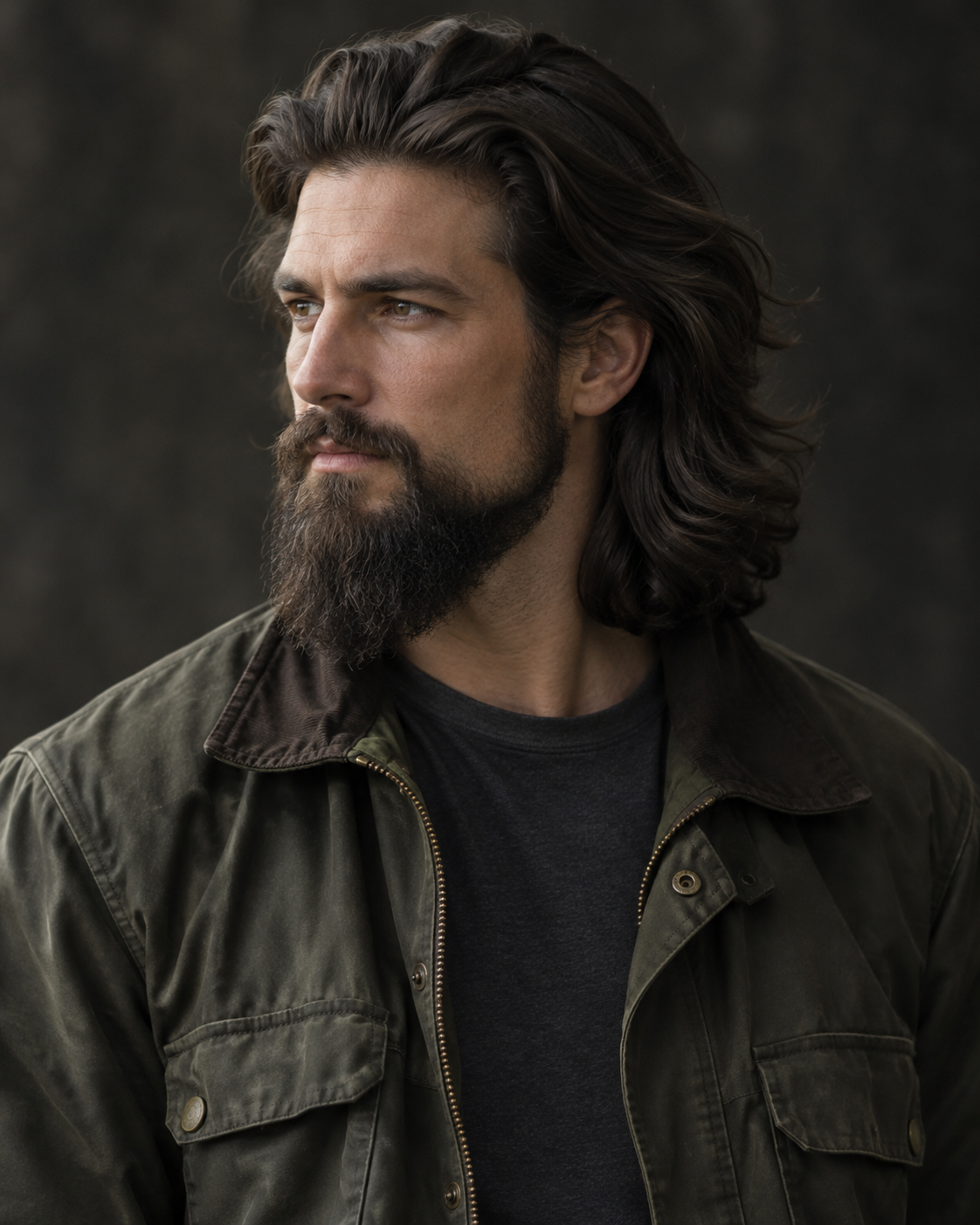
This is the maximum-length version and the one with the least margin for error. Both elements are long, so if you ignore the proportion rule you end up looking like a mass rather than a man. Keep the beard narrow at the cheeks, let it carry length at the chin, and keep the hair off the face rather than around it. Ends need trimming every three months or they split and the whole thing starts to look tired rather than deliberate.
Ask for: “Dust the ends only, keep all the length, and narrow my beard at the cheeks — I want the jaw to still read.”
Styling: Condition heavily, beard balm and a boar bristle brush for the beard, hair oil on the ends.
Back to the barber: Hair every 10–12 weeks. Beard every 3 weeks.
11. Low Taper Flow with a Connected Beard
Best for: Almost every face shape — the safest version on the list.
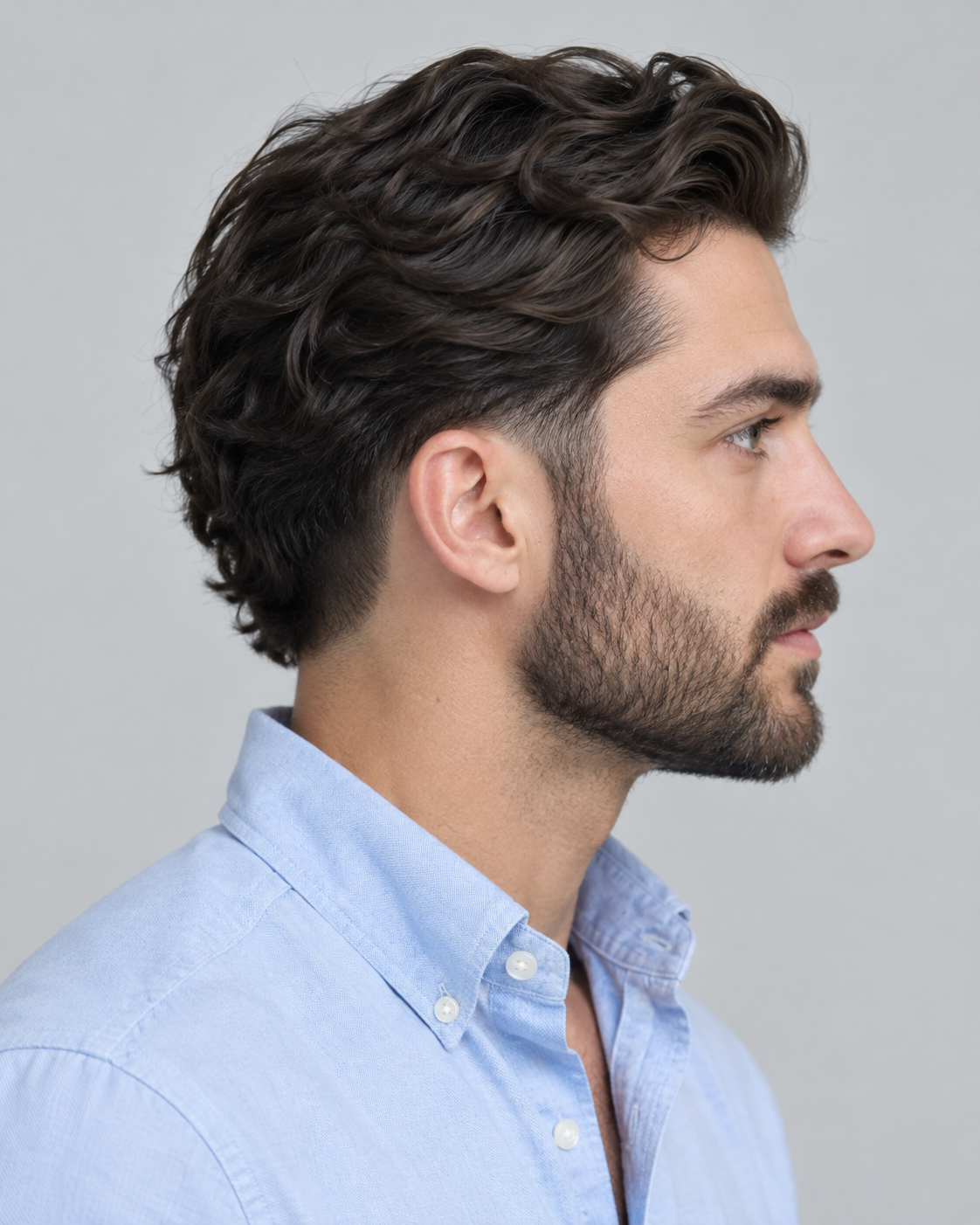
A low taper keeps the perimeter tidy without cutting into the length, which means you get flow up top and a clean edge above the ears. Connecting the sideburn into the beard closes the gap between hair and beard, so the whole side of the head reads as one continuous line rather than two separate things. This is the version that works in a conservative office without looking like you gave anything up.
Ask for: “Low taper just above the ear, don’t go into the length, and connect my sideburns into the beard.”
Styling: Light cream, hands only, pushed back and slightly to one side.
Back to the barber: Every 6–8 weeks — the taper is what needs refreshing, not the length.
12. Flow with a Beard Fade
Best for: Men whose beard is denser than their hair, and anyone wanting a more modern edge.
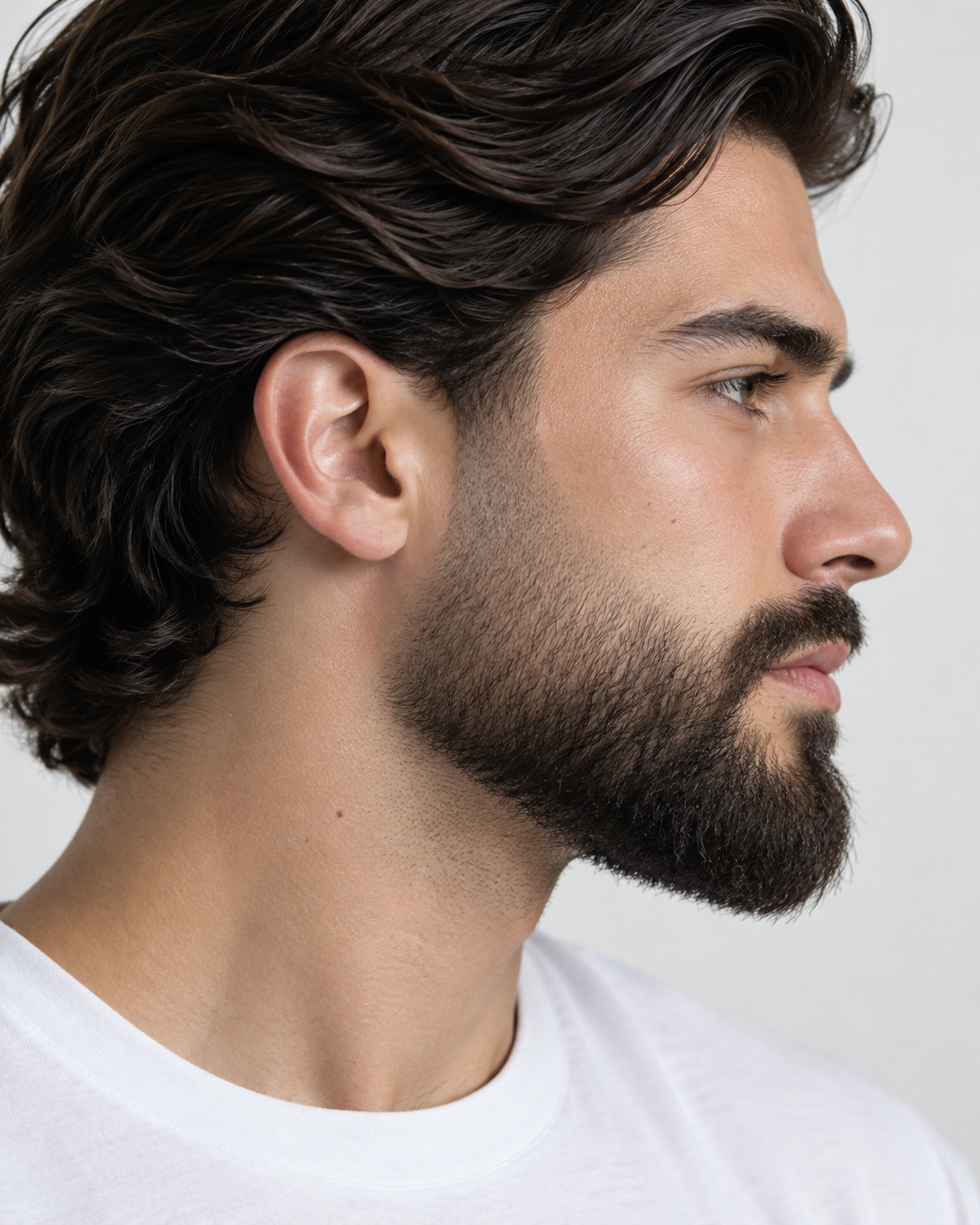
A beard fade runs short at the sideburns and gradually builds to full density at the jaw, which does something specific and useful: it stops a heavy beard from visually widening the face at the cheekbones. Under a flow cut it also creates a soft transition between hair and beard instead of a hard collision. It is the most barber-dependent look here — you cannot do a clean beard fade yourself — but it is also the one that most consistently gets noticed.
Ask for: “Fade the beard from the sideburns into full length at the jaw, and leave the hair on top alone.”
Styling: Beard oil daily to keep the faded section from looking patchy.
Back to the barber: Beard every 2 weeks, hair every 10.
13. Slicked-Back Flow with a Trimmed Beard
Best for: Evenings, events, and anyone who needs one sharp version of their everyday hair.

The same length, wet-styled flat against the head and swept straight back, becomes a completely different look. It exposes the hairline and the full face, so the beard needs to be shorter and neater than you would wear it day to day — a trimmed, close beard that follows the jaw without bulk. Think of this as the formal setting on a cut you already have, not a separate haircut.
Ask for: Nothing extra. This is a styling variation on any mid-length flow.
Styling: Light-hold pomade on damp hair, comb straight back, let it set. Avoid gel, which cracks.
Back to the barber: Whatever your base cut needs.
14. Tucked-Behind-the-Ears Flow with Heavy Stubble
Best for: Collar-length hair and anyone who needs a work version and a weekend version.

Once the hair clears the ears you get a second look for free. Tucked back it is clean and professional; down it is relaxed. Heavy stubble is the beard length that works for both — a full beard tucked-behind-the-ears can tip into severe, while clean-shaven loses the balance entirely. This is the most practical entry on the list if you need one haircut to cover a Monday meeting and a Saturday night.
Ask for: “Keep enough length behind the ear that it stays tucked, and keep the layers long.”
Styling: Cream on damp hair, tuck while wet so it holds the position as it dries.
Back to the barber: Hair every 10 weeks. Stubble weekly at home.
15. Flow with a Receding Hairline and a Full Beard
Best for: Anyone whose hairline has moved and assumes flow is off the table. It is not.

A receding hairline is actually easier to carry with length than with short hair, because length gives you something to sweep across and the eye follows the movement rather than the hairline. The rule is to sweep back and slightly to one side rather than straight back, which would expose the temples. Pair it with a full, substantial beard — weight at the bottom of the face pulls attention downward, which is exactly what you want. What does not work is a comb-forward fringe; it draws attention to the thing you are hiding.
Ask for: “Keep the length, layer it so it sweeps to one side, and give me a full beard with a defined jaw.”
Styling: Matte product only — shine separates the hair and shows scalp. Texture powder at the roots if you need lift.
Back to the barber: Hair every 10 weeks. Beard every 3 weeks.
16. Salt-and-Pepper Flow with a Matching Beard
Best for: Men over 45 with grey coming in, and one of the best-looking combinations here.
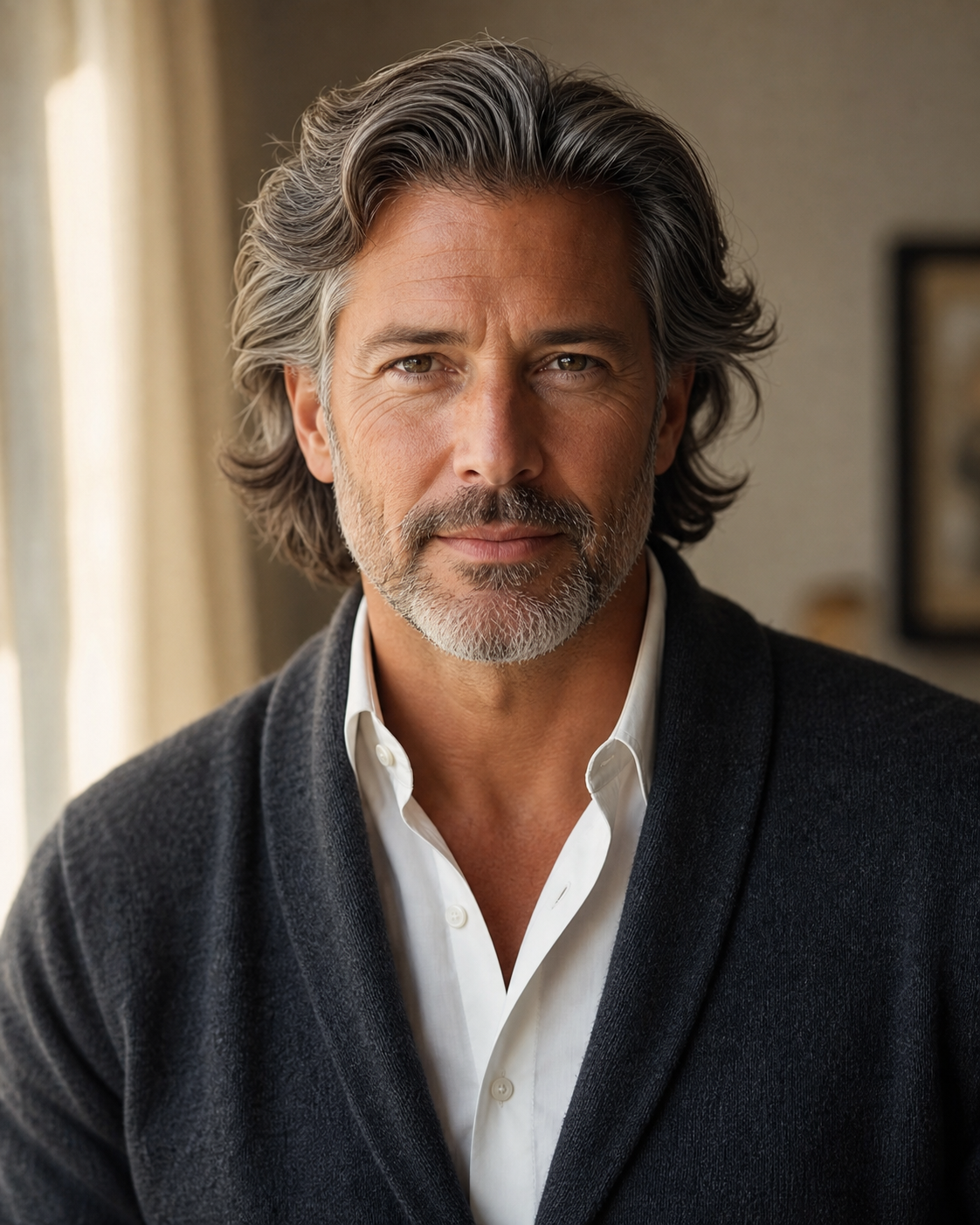
Grey hair at flow length reads as distinguished in a way that short grey hair rarely does, and a matching grey beard doubles the effect. The thing that undoes it is dryness — grey hair is coarser and loses moisture faster, so it goes from silver to straw quickly. Conditioning products, not matte ones, are the whole maintenance strategy. Keep the beard shorter than the hair and shaped close to the jaw.
Ask for: “Keep the length, long layers to take the coarseness out, and a close shaped beard along the jaw.”
Styling: Conditioning cream, never clay. Beard oil daily without exception.
Back to the barber: Hair every 10 weeks. Beard every 3 weeks.
17. Fine Hair Flow with a Heavier Beard
Best for: Fine or thinning hair, where the usual advice is “go short.”

Fine hair at flow length will not give you volume, so stop chasing it and rebalance instead. A heavier, fuller beard shifts the visual weight to the bottom of the face, which makes the lighter hair on top read as intentional rather than sparse. Keep the hair length moderate — just past the ears, not to the collar — because fine hair past a certain length only looks thinner. Matte products only, and never anything with shine.
Ask for: “Just past the ears, layers for movement not volume, and leave my beard full.”
Styling: Texture powder at the roots, sea salt spray, no oils and no shine products at all.
Back to the barber: Hair every 8 weeks. Beard every 3 weeks.
18. Thick Coarse Flow with the Weight Taken Out
Best for: Hair so thick it sits like a helmet instead of falling.
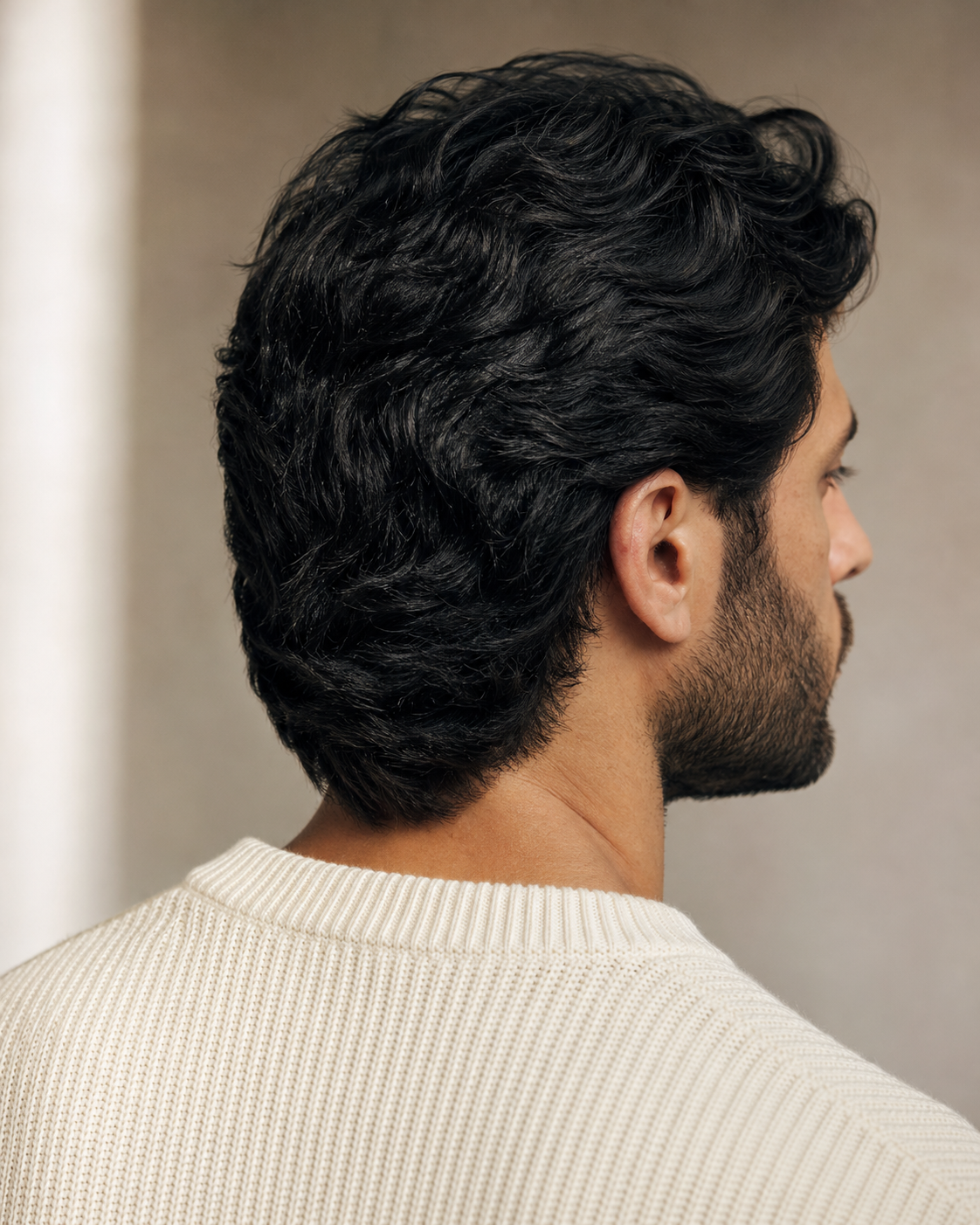
Very thick hair does not flow on its own — it holds its shape, flares at the sides, and makes the head look wider every month. The fix is not length, it is weight removal: long interior layers cut with scissors that thin the bulk without touching the outline. Most barbers will not do this unless you ask directly. The beard should be kept close here, because a full beard under very thick hair widens the face even further.
Ask for: “Take the weight out of the interior with long layers, keep my perimeter and length exactly where it is.”
Styling: Light cream only — thick hair does not need hold, it needs softening.
Back to the barber: Every 8–10 weeks, because the weight builds back faster than the length.
19. The Office-Safe Short Flow with Tidy Stubble
Best for: Conservative workplaces where shoulder-length is not going to fly.

Flow does not have to be long. Hair that just covers the ear, swept back with a low taper underneath and clean stubble on the face, reads as a deliberate, well-kept style rather than a grown-out one — which is the only thing a conservative office actually objects to. Keep the neckline tapered rather than blocked so it grows out cleanly between visits. This is the entry point for anyone who likes the look but has a dress code to respect.
Ask for: “Just over the ear, low taper at the neck, tapered neckline not blocked, and stubble kept at 2mm.”
Styling: A small amount of cream, pushed back, nothing dramatic.
Back to the barber: Every 6 weeks. Stubble twice weekly at home.
20. Mustache-Forward Flow with a Light Beard
Best for: Guys whose mustache grows in stronger than their cheeks.

If your mustache is your best facial hair, build around it instead of waiting for the rest to catch up. A fuller mustache over short, light beard growth gives the face a defined centre and avoids the patchy-cheek problem entirely. Under mid-length flow it reads as a styled choice rather than an incomplete beard — and it photographs noticeably better than a thin full beard does.
Ask for: “Keep the mustache full and shaped, take the cheeks and jaw down short, and leave the hair length alone.”
Styling: Mustache wax for shape, beard oil on the short growth so it does not look dry.
Back to the barber: Hair every 10 weeks. Mustache shaped every 2 weeks.
21. Half-Up Flow with a Full Beard
Best for: Shoulder-length hair, and the most practical thing on this list.
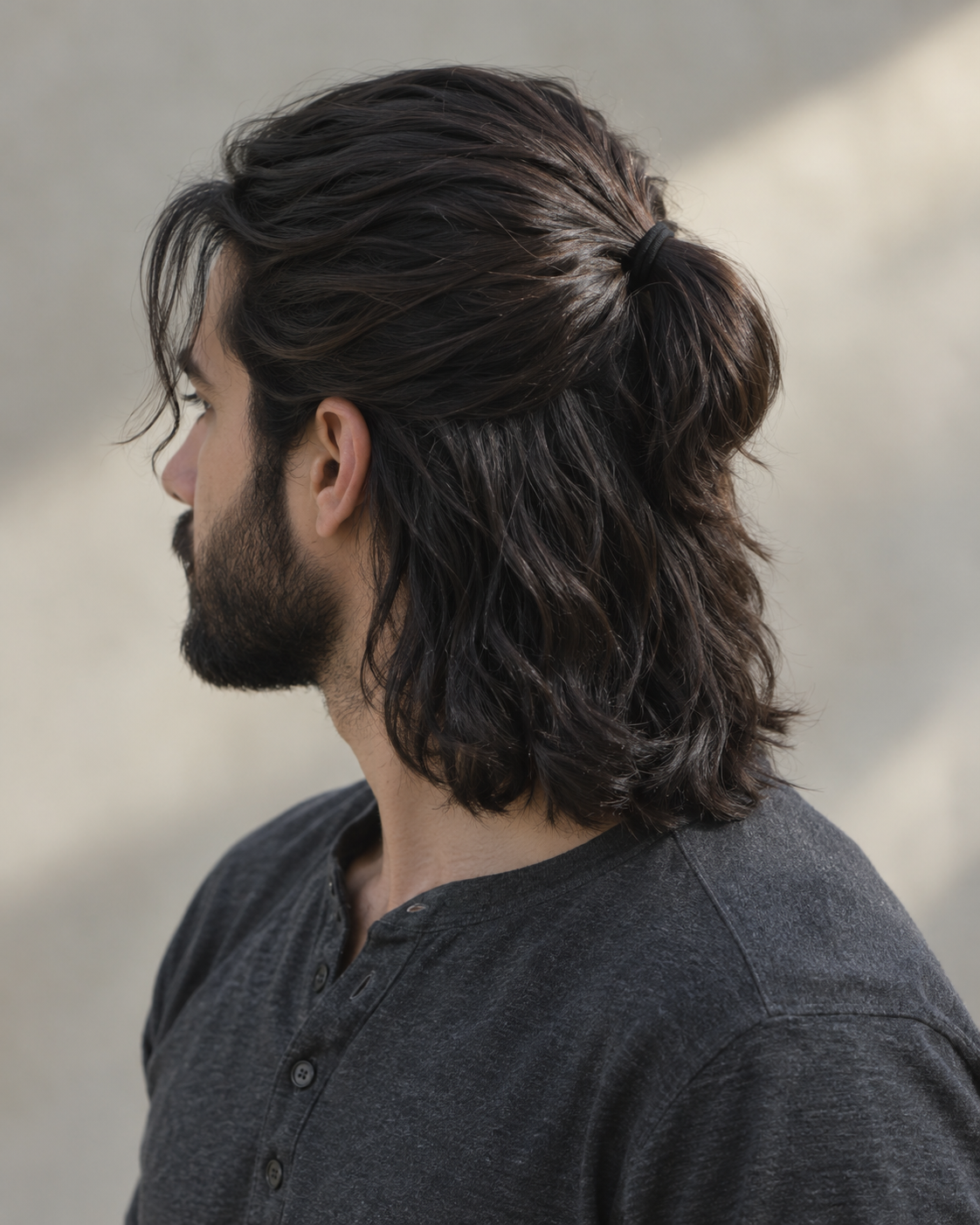
Pulling the top section back and securing it while the rest falls solves the single biggest complaint about long hair: it stays out of your face without you cutting anything. With a full beard underneath it also stops being a hairstyle and starts being a silhouette — strong at the top, strong at the jaw, clear in between. Use a plain band, not an elastic with metal, which snags and breaks the hair at exactly the length you worked hardest for.
Ask for: Nothing extra — this works on any flow past the collar.
Styling: Gather the top third, secure loosely at the crown, pull a few front pieces out so the hairline stays soft.
Back to the barber: Whatever your base length needs — usually every 10–12 weeks.
22. Choppy Textured Flow with a Short Beard
Best for: Straight or fine hair that needs the ends to do something.
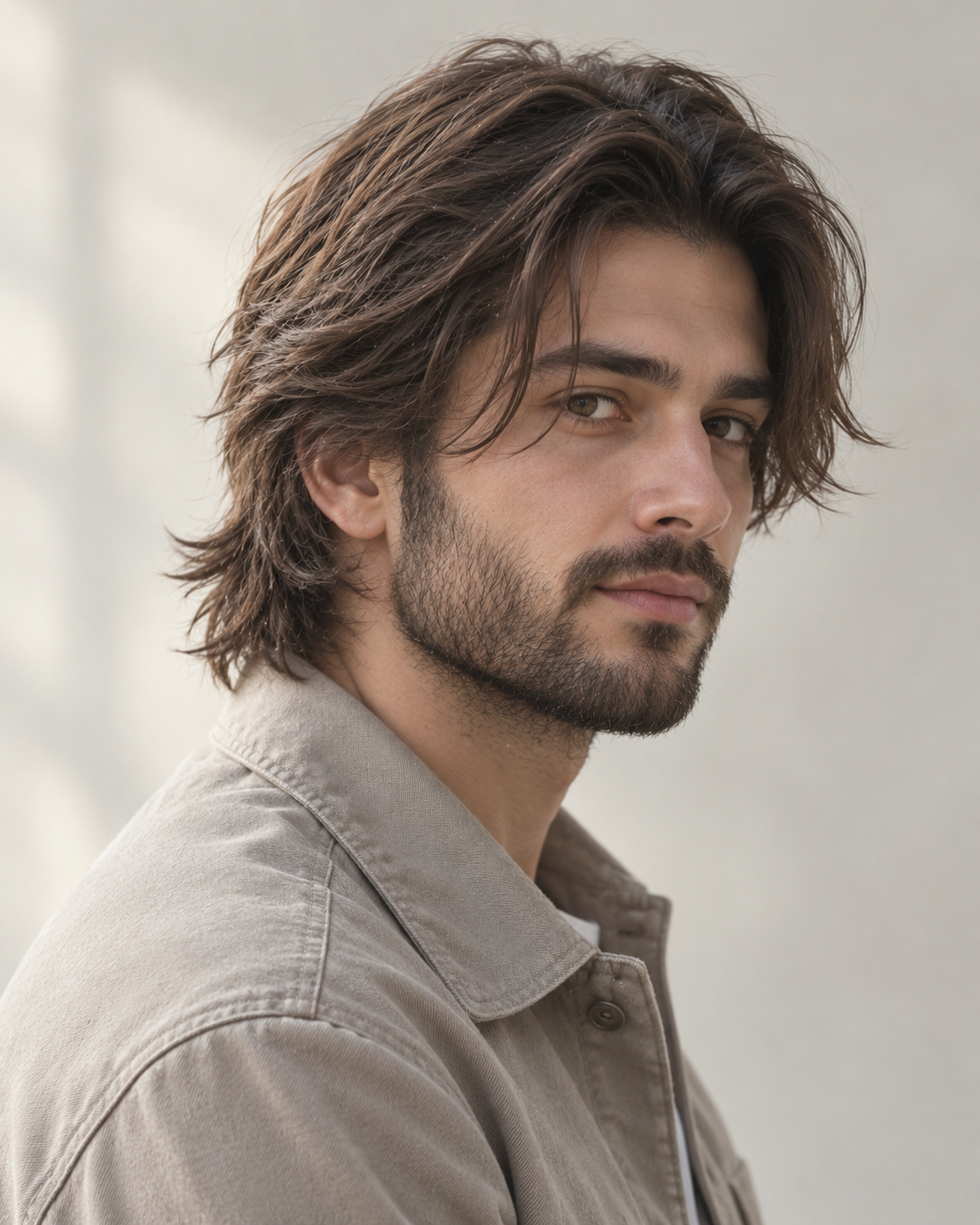
Blunt ends on flow hang like a curtain. Point-cut, choppy ends break that up and create the impression of movement even when the hair itself is not doing much. Keep the beard short and neat underneath — the top already has visual noise, and a full beard competes with it. This is the version that works best on hair that would otherwise look flat no matter how many products you apply.
Ask for: “Point cut the ends, I want texture not bluntness, and keep my beard short and clean.”
Styling: Salt spray and matte paste worked through the ends with your fingertips.
Back to the barber: Every 8–10 weeks — point-cut ends soften as they grow.
23. Flow with a Goatee
Best for: Men whose cheeks grow in sparse, and strong or long face shapes.
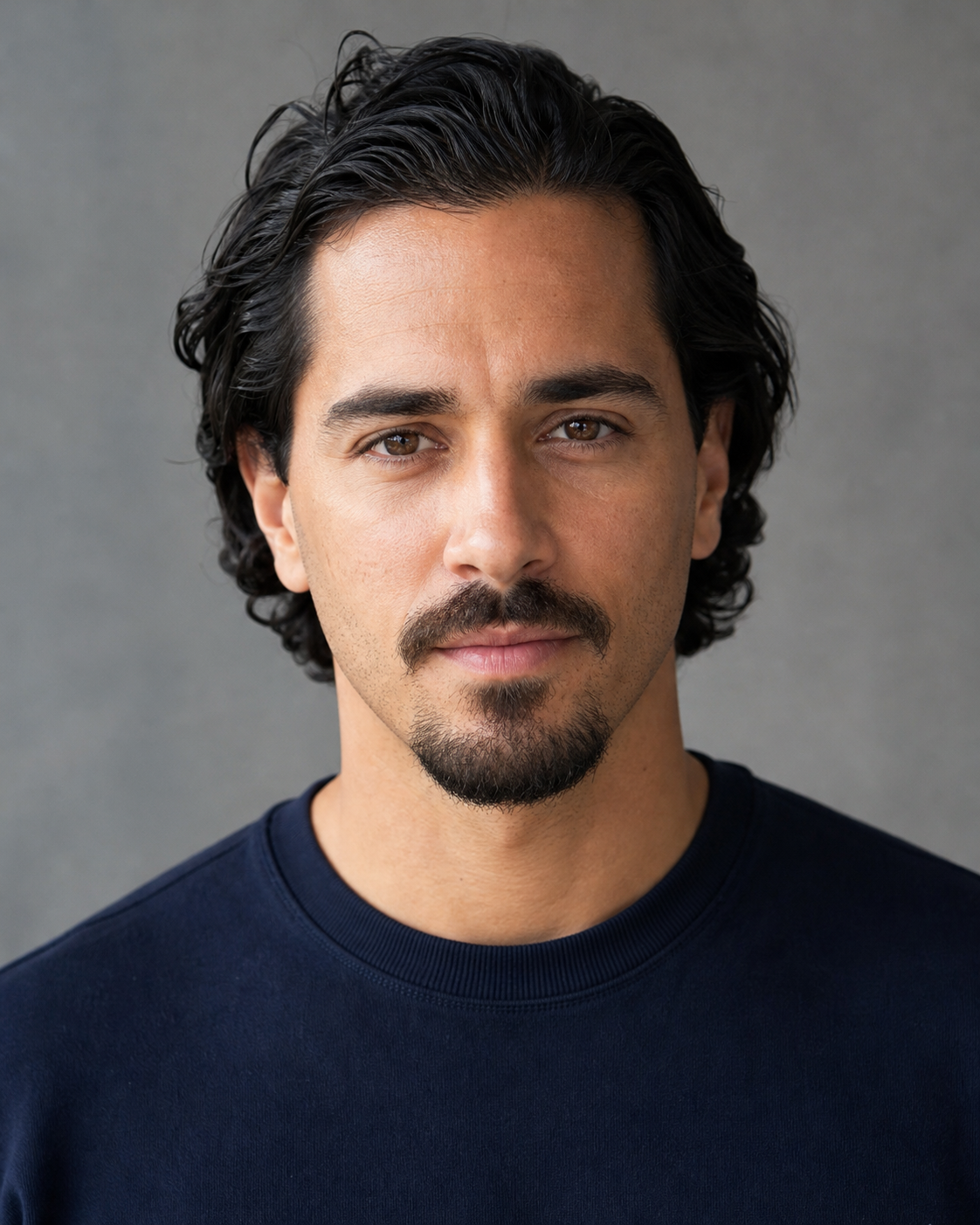
A goatee under flow is a sharper, more deliberate combination than it gets credit for, as long as the proportions are right. Keep it connected through the mustache and kept tight — a wide, bushy goatee under long hair dates badly. Because it concentrates the facial hair at the chin, it lengthens the face, which makes it a strong choice if your face is round and a poor one if it is already long.
Ask for: “Connected goatee, kept narrow, clean cheeks, and leave the hair length alone.”
Styling: Trim the goatee yourself weekly with a 4mm guard, and keep the cheek edges razor-clean.
Back to the barber: Hair every 10 weeks. Goatee you can maintain at home.
24. The Low-Effort Flow with a Tight Beard
Best for: Anyone who wants the look and will not do a routine. Be honest about whether this is you.

This is flow stripped of everything optional: mid-length wavy hair with long layers, no fade, no part, no blow-drying, and a short beard kept at one guard length all over. Three minutes in the morning, and the only maintenance that actually matters is the beard neckline, which you do yourself once a fortnight. It will never be the sharpest version here. It will also still be running in two years, which is more than most grooming routines manage.
Ask for: “Long layers, no fade, nothing that needs styling — I want it to look fine when I do nothing.”
Styling: Wash, towel dry, hands through it once. That is the whole routine.
Back to the barber: Hair every 12 weeks. Beard neckline every 2 weeks at home.
What to Actually Say at the Barber
Flow is the one length where the barber’s default instincts work against you. They are trained to cut; you are trying to keep. These are the sentences that close that gap.
The one that saves everything: “I’m growing it out. Shape it, don’t shorten it.” Say this before they pick anything up. It reframes the entire appointment from a cut into a shaping, and most barbers will immediately adjust what they reach for.
“Keep my perimeter.” Perimeter means the outline — the actual ends and length. A barber can take out a lot of weight without touching your perimeter, which is exactly what you want during months three to five.
Long layers, not short layers. Both are “layers” and they do opposite things. Long layers remove weight and keep length. Short layers create volume and remove length. Say which one.
“Scissor-over-comb on the sides, no clippers.” Clippers create a hard line that takes months to grow back into the rest. On curly or coily hair, clippers on top also flatten the pattern.
Tapered neckline, not blocked. A blocked neckline looks sharp for nine days and messy for the next thirty. A tapered one grows out invisibly, which matters a lot when your visits are ten weeks apart.
For the beard, say millimetres and say where the lines sit. “Three millimetres, cheek line following my natural growth, neckline two fingers above the Adam’s apple” leaves nothing to interpretation. “Just tidy it up” leaves everything to interpretation.
And the rule that governs both: as the hair gets longer, the beard gets tighter. If you say nothing else, say that.
Product Cheat Sheet by Hair and Beard Type
| Hair type | For the hair | For the beard | Avoid |
|---|---|---|---|
| Fine / thinning | Texture powder, sea salt spray | Beard oil, light | Oils, pomade, anything with shine |
| Thick, straight | Light cream, light pomade | Beard balm | More hold — it needs softening, not control |
| Wavy | Sea salt spray, curl-friendly cream | Beard oil plus balm | Clay, which stiffens and breaks the wave |
| Curly (2C–3B) | Curl cream, leave-in conditioner | Beard oil, wide-tooth comb | Brushing it dry, sulfate shampoo |
| Coily (4A–4C) | Leave-in moisturiser, hair butter | Beard butter, daily oil | Letting either dry out, clipper work on top |
| Grey / coarse | Conditioning cream | Beard oil, daily | Matte clay — it turns grey into straw |
Final Thoughts
The flow haircut with beard is less a style than a commitment with a style at the end of it — and it rewards the men who treat it that way. The cut itself is the easy part. Getting through months three and four without reaching for the clippers is the hard part, and a sharp beard is what makes those months survivable.
If you are starting your own flow haircut with beard from short hair today, pick number 1 and number 19 as your first two stops — the starter flow and the office-safe short flow — and reassess at month five, when you will actually have options. If you already have the length and it has never quite looked right, the problem is almost certainly proportion rather than the cut, so start with the beard.
And once the hair and beard are working, the clothes have to keep up with them. Our guide to professional men’s hairstyles covers the shorter end of the spectrum if you decide flow is not for you, and flannel shirt outfits for men handles the casual fit rules that make a rugged haircut look intentional instead of accidental.


